







Question: QUESTION 2. DELAYS, THROUGHPUT, HTTP/DNS CACHES Consider the networks shown in the figure. There are two user machines m1.a.com and m2.a.com in the network a.com.
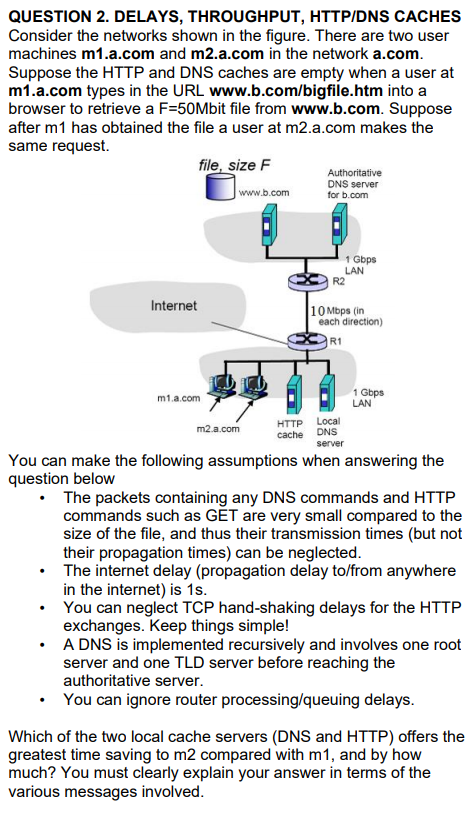
QUESTION 2. DELAYS, THROUGHPUT, HTTP/DNS CACHES Consider the networks shown in the figure. There are two user machines m1.a.com and m2.a.com in the network a.com. Suppose the HTTP and DNS caches are empty when a user at m1.a.com types in the URL www.b.com/bigfile.htm into a browser to retrieve a F=50Mbit file from www.b.com. Suppose after m1 has obtained the file a user at m2.a.com makes the same request. file, size F Authoritative DNS server www.b.com for b.com 1 Gbps LAN R2 Internet 10 Mbps (in each direction) R1 m1.a.com 1 Gbps LAN HTTP Local m2.a.com cache DNS server You can make the following assumptions when answering the question below The packets containing any DNS commands and HTTP commands such as GET are very small compared to the size of the file, and thus their transmission times (but not their propagation times) can be neglected. The internet delay (propagation delay to/from anywhere in the internet) is 1s. You can neglect TCP hand-shaking delays for the HTTP exchanges. Keep things simple! A DNS is implemented recursively and involves one root server and one TLD server before reaching the authoritative server. You can ignore router processing/queuing delays. Which of the two local cache servers (DNS and HTTP) offers the greatest time saving to m2 compared with m1, and by how much? You must clearly explain your answer in terms of the various messages involved. QUESTION 2. DELAYS, THROUGHPUT, HTTP/DNS CACHES Consider the networks shown in the figure. There are two user machines m1.a.com and m2.a.com in the network a.com. Suppose the HTTP and DNS caches are empty when a user at m1.a.com types in the URL www.b.com/bigfile.htm into a browser to retrieve a F=50Mbit file from www.b.com. Suppose after m1 has obtained the file a user at m2.a.com makes the same request. file, size F Authoritative DNS server www.b.com for b.com 1 Gbps LAN R2 Internet 10 Mbps (in each direction) R1 m1.a.com 1 Gbps LAN HTTP Local m2.a.com cache DNS server You can make the following assumptions when answering the question below The packets containing any DNS commands and HTTP commands such as GET are very small compared to the size of the file, and thus their transmission times (but not their propagation times) can be neglected. The internet delay (propagation delay to/from anywhere in the internet) is 1s. You can neglect TCP hand-shaking delays for the HTTP exchanges. Keep things simple! A DNS is implemented recursively and involves one root server and one TLD server before reaching the authoritative server. You can ignore router processing/queuing delays. Which of the two local cache servers (DNS and HTTP) offers the greatest time saving to m2 compared with m1, and by how much? You must clearly explain your answer in terms of the various messages involved
Step by Step Solution
There are 3 Steps involved in it

Get step-by-step solutions from verified subject matter experts
 Study Help