







Question: Consider two diffusing species A and B, which undergo a reaction A+BC, where the back-reaction can be disregarded. If we assume that the two species
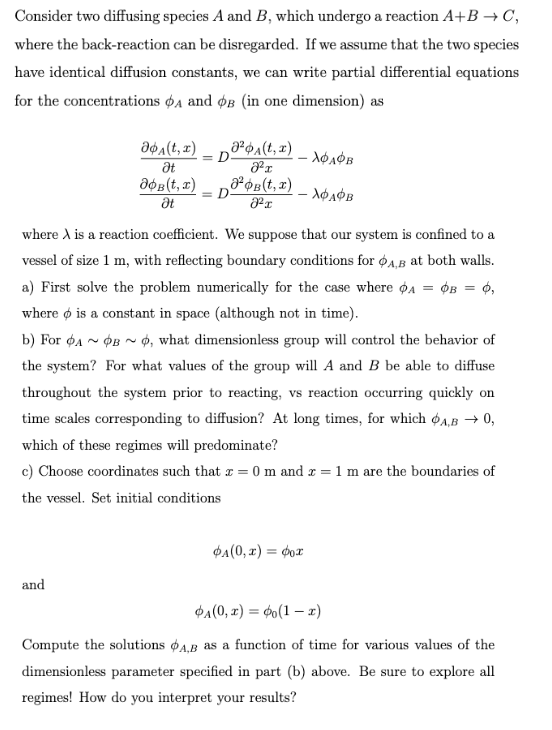
Consider two diffusing species A and B, which undergo a reaction A+BC, where the back-reaction can be disregarded. If we assume that the two species have identical diffusion constants, we can write partial differential equations for the concentrations A and B (in one dimension) as tA(t,x)=D2x2A(t,x)ABtB(t,x)=D2x2B(t,x)AB where is a reaction coefficient. We suppose that our system is confined to a vessel of size 1m, with reflecting boundary conditions for A,B at both walls. a) First solve the problem numerically for the case where A=B=, where is a constant in space (although not in time). b) For AB, what dimensionless group will control the behavior of the system? For what values of the group will A and B be able to diffuse throughout the system prior to reacting, vs reaction occurring quickly on time scales corresponding to diffusion? At long times, for which A,B0, which of these regimes will predominate? c) Choose coordinates such that x=0m and x=1m are the boundaries of the vessel. Set initial conditions A(0,x)=0x and A(0,x)=0(1x) Compute the solutions A,B as a function of time for various values of the dimensionless parameter specified in part (b) above. Be sure to explore all regimes! How do you interpret your results
Step by Step Solution
There are 3 Steps involved in it

Get step-by-step solutions from verified subject matter experts
 Study Help