



Question: Consider two separate queueing systems operating side-by-side. System A is an M/M/2/4 system with a queue capacity of two people (i.e., it can hold a
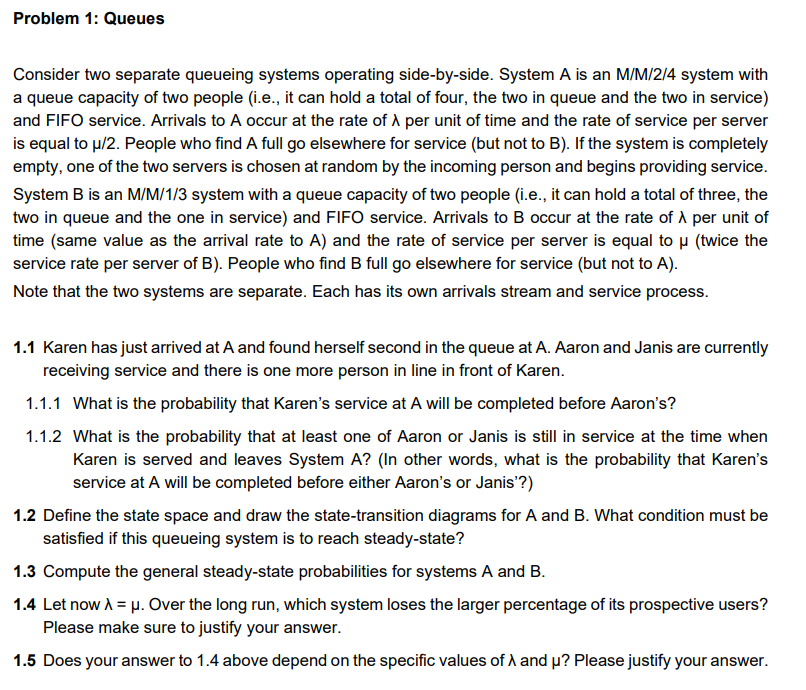
Consider two separate queueing systems operating side-by-side. System A is an M/M/2/4 system with a queue capacity of two people (i.e., it can hold a total of four, the two in queue and the two in service) and FIFO service. Arrivals to A occur at the rate of per unit of time and the rate of service per server is equal to /2. People who find A full go elsewhere for service (but not to B ). If the system is completely empty, one of the two servers is chosen at random by the incoming person and begins providing service. System B is an M/M/1/3 system with a queue capacity of two people (i.e., it can hold a total of three, the two in queue and the one in service) and FIFO service. Arrivals to B occur at the rate of per unit of time (same value as the arrival rate to A ) and the rate of service per server is equal to (twice the service rate per server of B ). People who find B full go elsewhere for service (but not to A ). Note that the two systems are separate. Each has its own arrivals stream and service process. 1.1 Karen has just arrived at A and found herself second in the queue at A. Aaron and Janis are currently receiving service and there is one more person in line in front of Karen. 1.1.1 What is the probability that Karen's service at A will be completed before Aaron's? 1.1.2 What is the probability that at least one of Aaron or Janis is still in service at the time when Karen is served and leaves System A? (In other words, what is the probability that Karen's service at A will be completed before either Aaron's or Janis'?) 1.2 Define the state space and draw the state-transition diagrams for A and B. What condition must be satisfied if this queueing system is to reach steady-state? 1.3 Compute the general steady-state probabilities for systems A and B. 1.4 Let now =. Over the long run, which system loses the larger percentage of its prospective users? Please make sure to justify your answer. 1.5 Does your answer to 1.4 above depend on the specific values of and ? Please justify your
Step by Step Solution
There are 3 Steps involved in it

Get step-by-step solutions from verified subject matter experts