







Question: Constants and information that you may need: Drag force = Cd0.5pu Af Universal gas constant, R = 8.3143 x 10³ J/kmol-K. Solid propellant burning
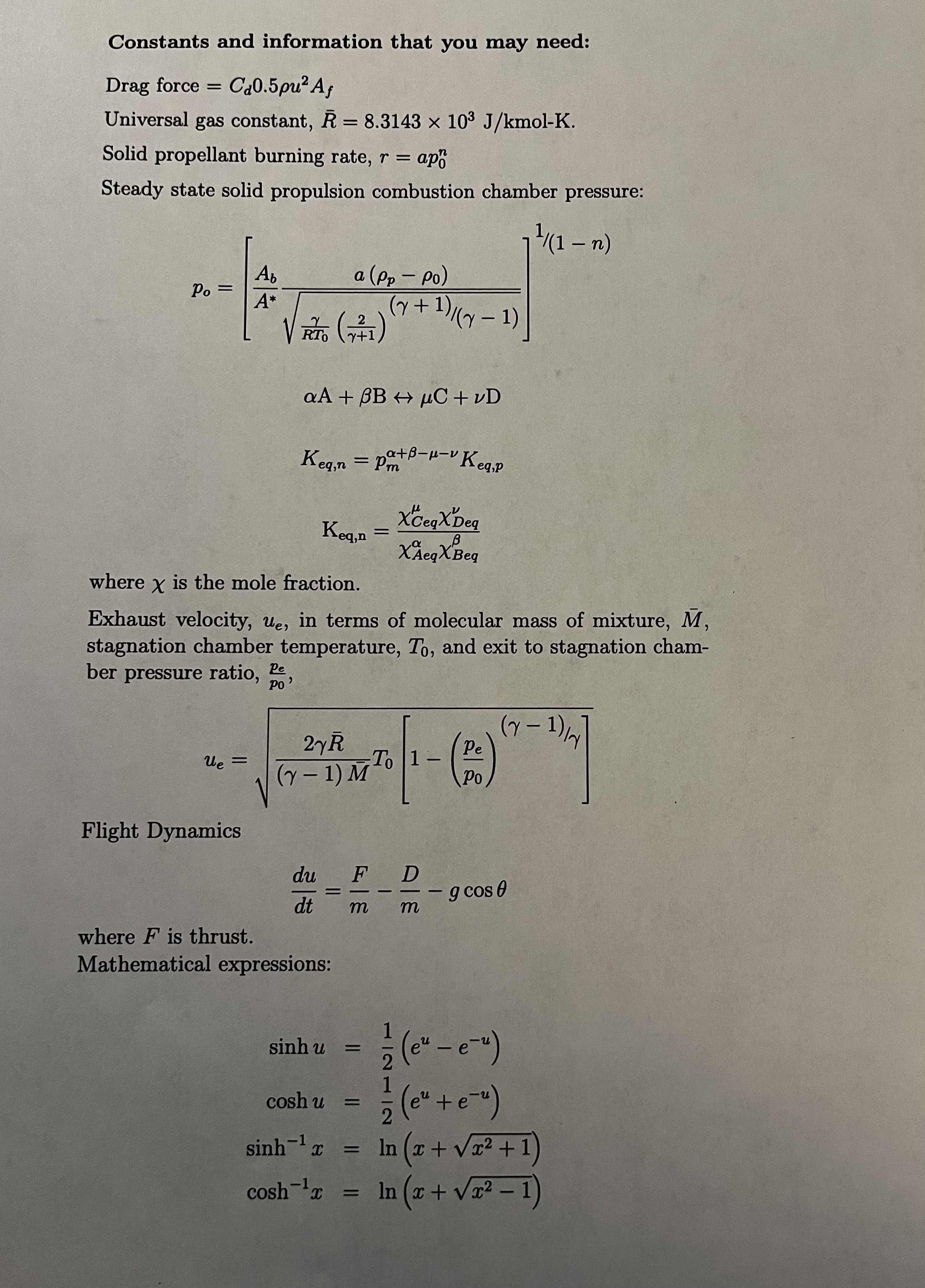
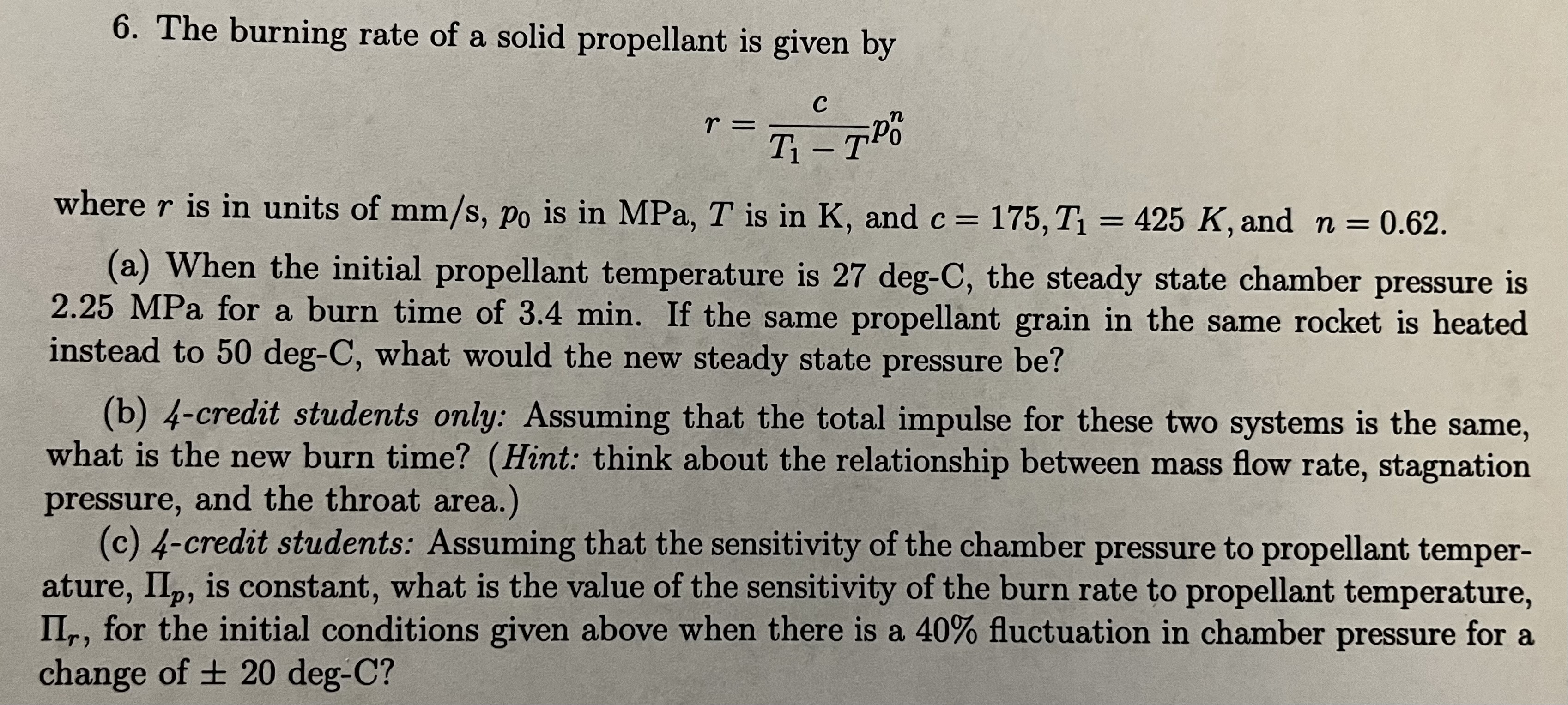
Constants and information that you may need: Drag force = Cd0.5pu Af Universal gas constant, R = 8.3143 x 10³ J/kmol-K. Solid propellant burning rate, r = = ap Steady state solid propulsion combustion chamber pressure: Ab a (pp - Po) Po= A* (+ RTO (741) 2 + 1) ( y 1) - + aA+BBC+vD Keq,n = pa+B--v Keq,p XCeqXDeq Keq,n = B XAeqX Beq (1 n) where is the mole fraction. Exhaust velocity, ue, in terms of molecular mass of mixture, M, stagnation chamber temperature, To, and exit to stagnation cham- ber pressure ratio, Pe PO' ue = Flight Dynamics V (Y - 1) / Pe To 1 - 2R (Y - 1) M To du F dt m where F is thrust. Mathematical expressions: Po D m - g cos 0 sinh u = cosh u 1- (eu - e-u) 1 = 2 (e + e ) sinh-12 = ln (x+x+1) cosh 1x = In (x + x - 1) 6. The burning rate of a solid propellant is given by C r = T-T where r is in units of mm/s, po is in MPa, T is in K, and c = 175, T = 425 K, and n = 0.62. (a) When the initial propellant temperature is 27 deg-C, the steady state chamber pressure is 2.25 MPa for a burn time of 3.4 min. If the same propellant grain in the same rocket is heated instead to 50 deg-C, what would the new steady state pressure be? (b) 4-credit students only: Assuming that the total impulse for these two systems is the same, what is the new burn time? (Hint: think about the relationship between mass flow rate, stagnation pressure, and the throat area.) (c) 4-credit students: Assuming that the sensitivity of the chamber pressure to propellant temper- ature, II,, is constant, what is the value of the sensitivity of the burn rate to propellant temperature, II,, for the initial conditions given above when there is a 40% fluctuation in chamber pressure for a change of 20 deg-C?
Step by Step Solution
There are 3 Steps involved in it

Get step-by-step solutions from verified subject matter experts
 Study Help