



Question: constraint is given by G = T + AB + AM. G is government expenditures, T is total tax revenue, AB is the net issuance
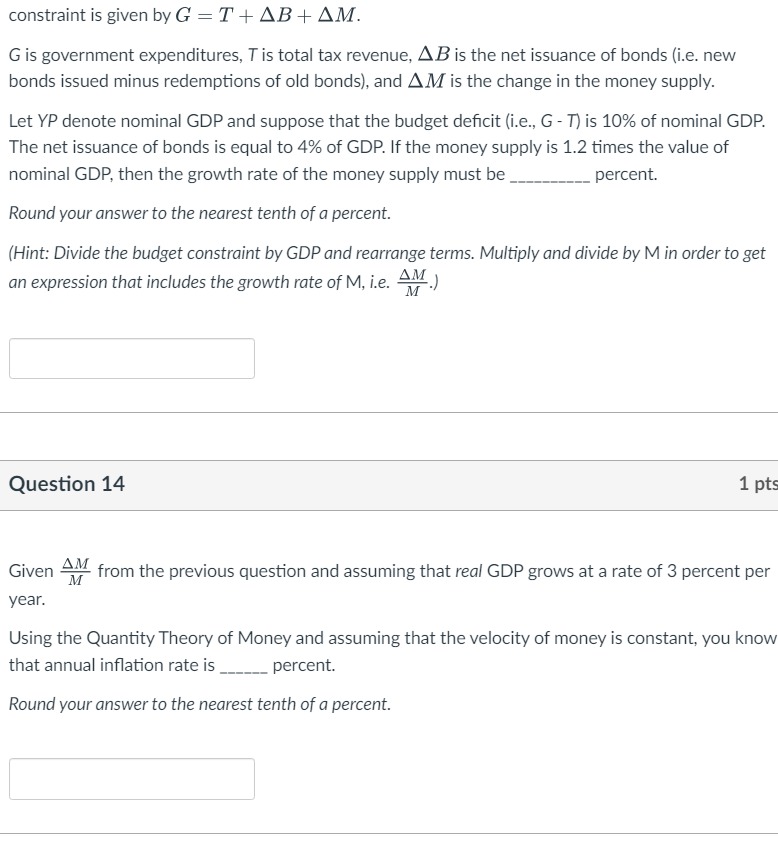
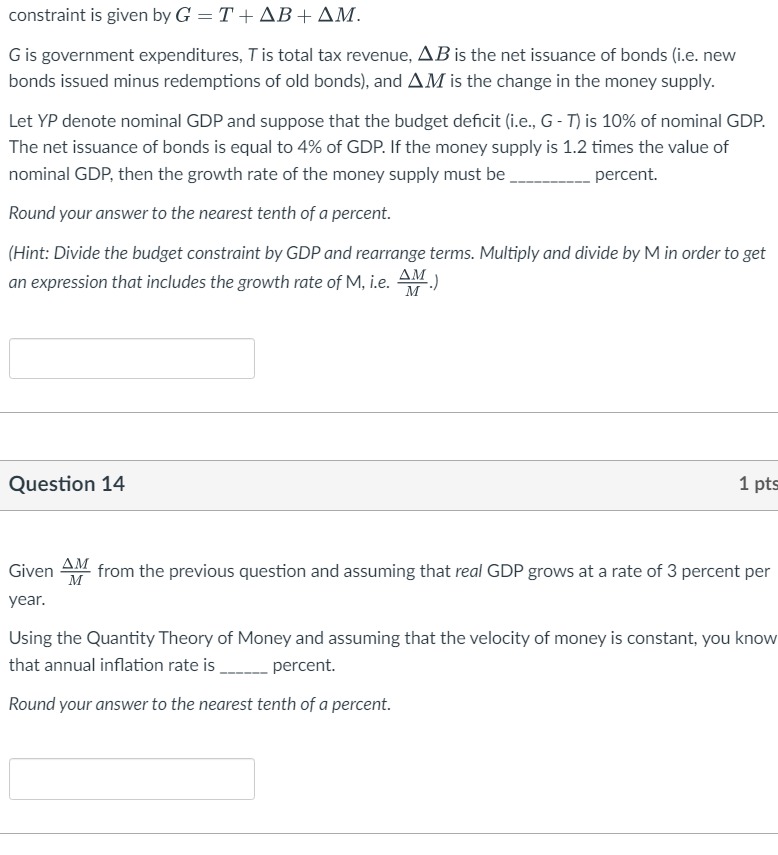
constraint is given by G = T + AB + AM. G is government expenditures, T is total tax revenue, AB is the net issuance of bonds (i.e. new bonds issued minus redemptions of old bonds), and AM is the change in the money supply. Let YP denote nominal GDP and suppose that the budget deficit (i.e., G - T) is 10% of nominal GDP. The net issuance of bonds is equal to 4% of GDP. If the money supply is 1.2 times the value of nominal GDP, then the growth rate of the money supply must be percent. Round your answer to the nearest tenth of a percent. (Hint: Divide the budget constraint by GDP and rearrange terms. Multiply and divide by M in order to get an expression that includes the growth rate of M, i.e. AM) Question 14 1 pts Given from the previous question and assuming that real GDP grows at a rate of 3 percent per year. Using the Quantity Theory of Money and assuming that the velocity of money is constant, you know that annual inflation rate is percent. Round your answer to the nearest tenth of a percent.constraint is given by G = T + AB + AM. G is government expenditures, T is total tax revenue, AB is the net issuance of bonds (i.e. new bonds issued minus redemptions of old bonds), and AM is the change in the money supply. Let YP denote nominal GDP and suppose that the budget deficit (i.e., G - T) is 10% of nominal GDP. The net issuance of bonds is equal to 4% of GDP. If the money supply is 1.2 times the value of nominal GDP, then the growth rate of the money supply must be percent. Round your answer to the nearest tenth of a percent. (Hint: Divide the budget constraint by GDP and rearrange terms. Multiply and divide by M in order to get an expression that includes the growth rate of M, i.e. AM) Question 14 1 pts Given from the previous question and assuming that real GDP grows at a rate of 3 percent per year. Using the Quantity Theory of Money and assuming that the velocity of money is constant, you know that annual inflation rate is percent. Round your answer to the nearest tenth of a percent
Step by Step Solution
There are 3 Steps involved in it

Get step-by-step solutions from verified subject matter experts