



Question: Consumer Choice Microeconomics Homework Assignment # 5 Due: October 6, 2020, before 12:30 Part I. Short questions. For each question, provide both answer and explanation.
Consumer Choice
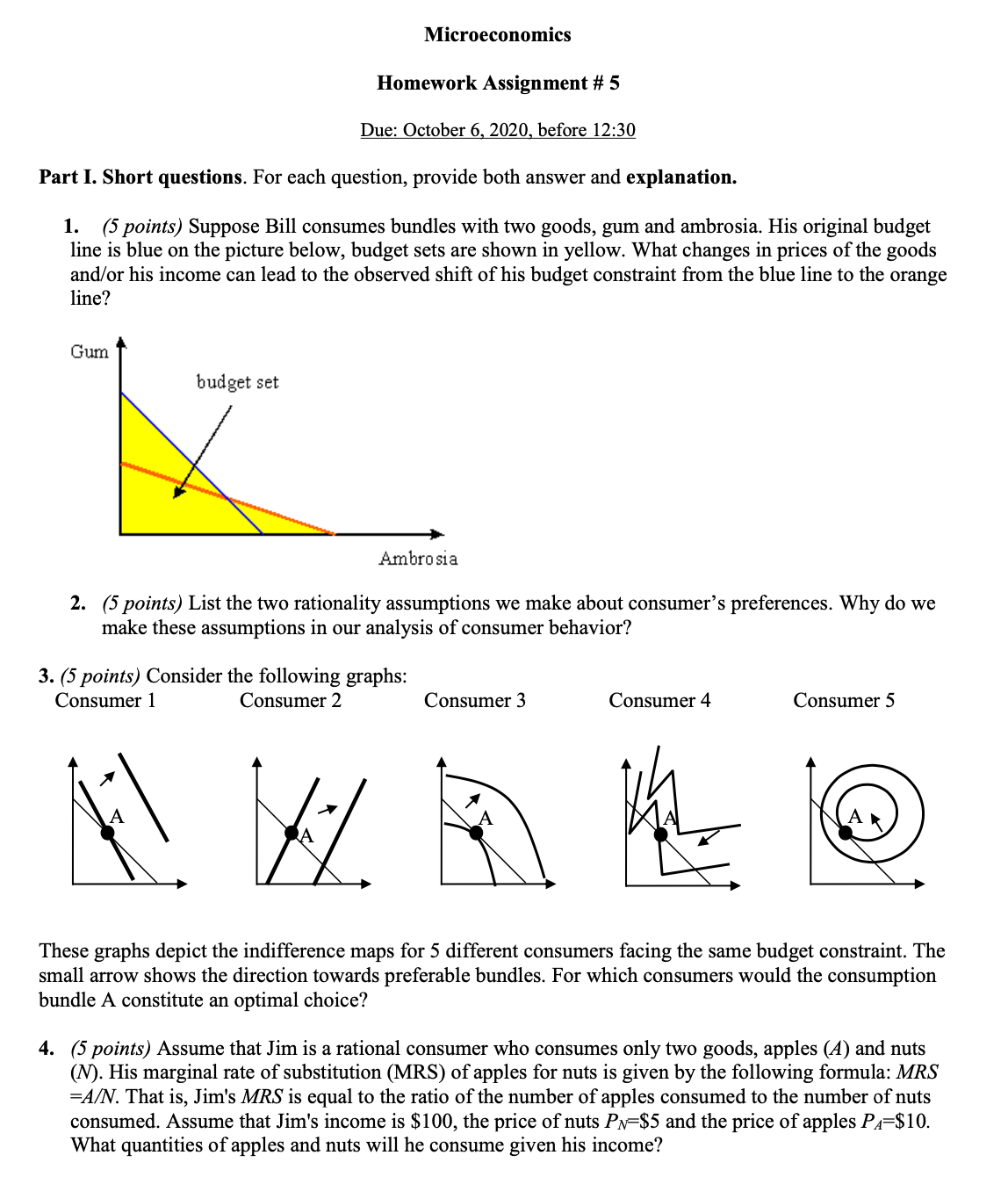
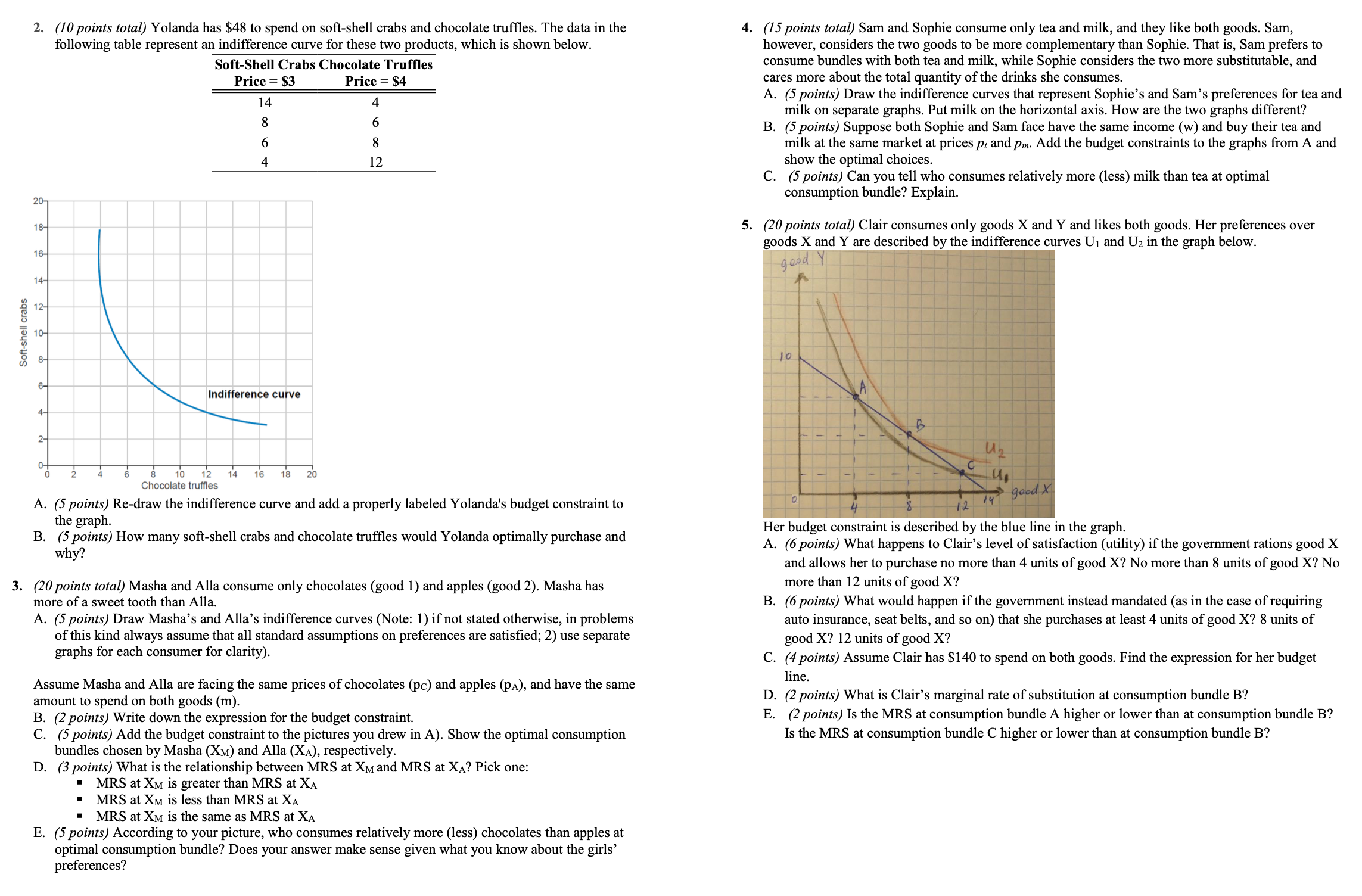
Microeconomics Homework Assignment # 5 Due: October 6, 2020, before 12:30 Part I. Short questions. For each question, provide both answer and explanation. 1. (5 points) Suppose Bill consumes bundles with two goods, gum and ambrosia. His original budget line is blue on the picture below, budget sets are shown in yellow. What changes in prices of the goods and/or his income can lead to the observed shift of his budget constraint from the blue line to the orange line? Gum bud get set Ambro sia 2. (5 points) List the two rationality assumptions we make about consumer's preferences. Why do we make these asSumptions in our analysis of conSumer behavior? 3. (5 points) Consider the following graphs: Consumer 1 Consumer 2 Consumer 3 Consumer 4 Consumer 5 Mrs . These graphs depict the indifference maps for 5 different consumers facing the same budget constraint. The small arrow shows the direction towards preferable bundles. For which consumers would the consumption bundle A constitute an optimal choice? 4. (5 points) Assume that Jim is a rational consumer who consumes only two goods, apples (A) and nuts (N). His marginal rate of substitution (MRS) of apples for nuts is given by the following formula: MRS =A/N. That is, Jim's MRS is equal to the ratio of the number of apples consumed to the number of nuts consumed. Assume that Jim's income is $100, the price of nuts PN=$S and the price of apples PA=$10 What quantities of apples and nuts will he consume given his income? Soilshell Crabs 2. (10 point: total) Yolanda has $48 to spend on so-shell crabs and chocolate truffles. The data in the following table represent an indifference curve for these two products, which is shown below. Soft-Shell Crabs Chocolate Trufes Price = $3 Price = $4 14 4 8 6 6 8 4 12 12 Indlerenoe curve a 2 4 a 91012 14 Is 1520 Chocolale trumes A. (5 points) Re-draw the indifference curve and add a properly labeled Yolanda's budget constraint to the graph. B. (5 points) How many soft-shell crabs and chocolate truffles would Yolanda optimally purchase and why? (20 point: total) Masha and Alla consume only chocolates (good 1) and apples (good 2). Masha has more of a sweet tooth than Alla. A. (5 pointr) Draw Masha's and Alla's indifference curves (Note: 1) if not stated otherwise, in problems of this kind always assume that all standard assumptions on preferences are satised; 2) use separate graphs for each consumer for clarity). Assume Masha and Alla are facing the same prices ofehooolates (pc) and apples (DA), and have the same amount to spend on both goods (m). B. (2 pointr) Write down the expression for the budget constraint C. (51mins) Add the budget constraint to the pictures you drew in A). Show the optimal consumption bundles chosen by Masha (XM) and Alla (XA), respectively. D. (31mins) What is the relationship between MRS at XM and MRS at XA? Pick one: I MRS atXM is greatertbanMRS atXA I MRS at XM is less than MRS at X; I MRS atXM isthesarnemMRS atXA E. (5 points) According to your picture, who consumes relatively more (less) chocolates than apples at optimal consumption bundle? Does your answer make sense given what you know about the girls' preferences? 4. (15 point: total) Sam and Sophie consume only tea and milk, and they like both goods. Sam, however, considers the two goods to be more complementary than Sophie. That is, Sam prefers to consume bundles with both tea and milk, while Sophie considers the two more substitutable, and cares more about the total quantity of the drinks she consumes. A. (Spoints) Draw the indifference curves that represent Sophie's and Sam's preferences for tea and milk on separate graphs. Put milk on the horizontal axis. How are the two graphs different? B. (Spoints) Suppose both Sophie and Sam face have the same income (w) and buy their tea and milk at the same market at prices p: and pm. Add the budget constraints to the graphs from A and show the optimal choices. C. (5 points) Can you tell who consumes relatively more (less) milk than tea at optimal consumption bundle? Explain. 5. (20 point: total) Clair consumes only goods X and Y and likes both goods. Her preferences over goods X and Y are described by the indifference curves U1 and U2 in the graph below. Her budget constraint is described by the blue line in the graph. A. {6points) What happens to Clair's level of satisfaction (utility) if the government rations good X and allows her to purchase no more than 4 units of good X? No more than 8 units of good X'? No more than 12 units of good X? B. {6points) What would happen if the government instead mandated (as in the case of requiring auto insurance, seat belts, and so on) that she purchases at least 4 units of good X? 8 units of good X? 12 units of good X? C. (4 points) Assume Clair has $140 to spend on both goods. Find the expression for her budget line. {2points) What is Clair's marginal rate of substitution at consumption bundle B? (2 points) Is the MRS at consumption bundle A higher or lower than at consumption bundle B? Is the MRS at consumption bundle C higher or lower than at consumption bundle B? .119
Step by Step Solution
There are 3 Steps involved in it

Get step-by-step solutions from verified subject matter experts