







Question: Corporate decision makers and analysts often use a particular technique, DuPont analysis, to better understand the factors that drive company performance, as reflected in its
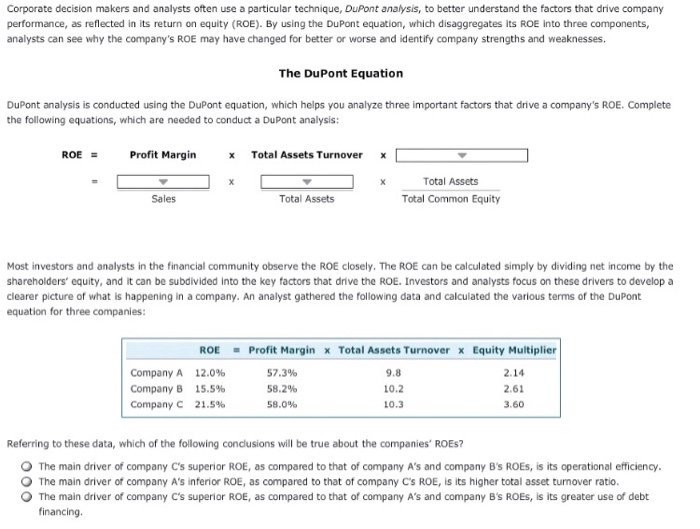
Corporate decision makers and analysts often use a particular technique, DuPont analysis, to better understand the factors that drive company performance, as reflected in its return on equity (ROE). By using the DuPont equation, which disaggregates its ROE into three components, analysts can see why the company's ROE may have changed for better or worse and identify company strengths and weaknesses. The DuPont Equation DuPont analysis is conducted using the DuPont equation, which helps you analyze three important factors that drive a company's ROE. Complete the following equations, which are needed to conduct a DuPont analysis: ROE x Total Assets Turnoverx Total Assets Sales Total Assets Total Common Equity Most investors and analysts in the financial community observe the ROE closely. The ROE can be calculated simply by dividing net income by the shareholders' equity, and it can be subdivided into the key factors that drive the ROE. Investors and analysts focus on these drivers to develop a clearer picture of what is happening in a company. An analyst gathered the following data and calculated the various terms of the DuPont equation for three companies Company A Company B Company C ROE Profit Margin x Total Assets Turnover x Equity Multiplier 12.0% 15.5% 21.5% 57.3% 58.2% 58.0% 9.8 10.2 10.3 2.14 2.61 3.60 Referring to these data, which of the following conclusions will be true about the companies' ROEs O The main driver of company C's superior ROE, as compared to that of company A's and company B's ROEs, is its operational efficiency O The main driver of company A's inferior ROE, as compared to that of company C's ROE, is its higher total asset turnover ratio O The main driver of company C's superior ROE, as compared to that of company A's and company B's ROEs, is its greater use of debt financing
Step by Step Solution
There are 3 Steps involved in it

Get step-by-step solutions from verified subject matter experts
 Study Help