







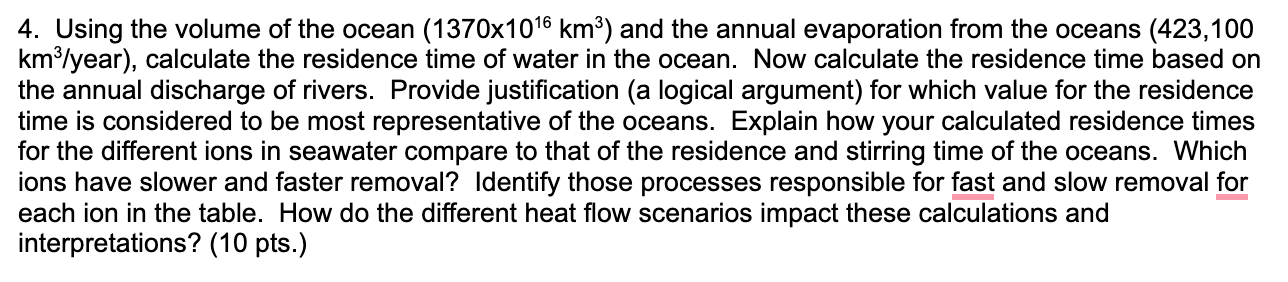
Question: CORRECT VERSION BELOW ARE THE ANSWERS TO THE PREVIOUS TWO QUESTIONS FOR REFERENCE: 4. Using the volume of the ocean (1370x1016 km) and the annual
CORRECT VERSION
 BELOW ARE THE ANSWERS TO THE PREVIOUS TWO QUESTIONS FOR REFERENCE:
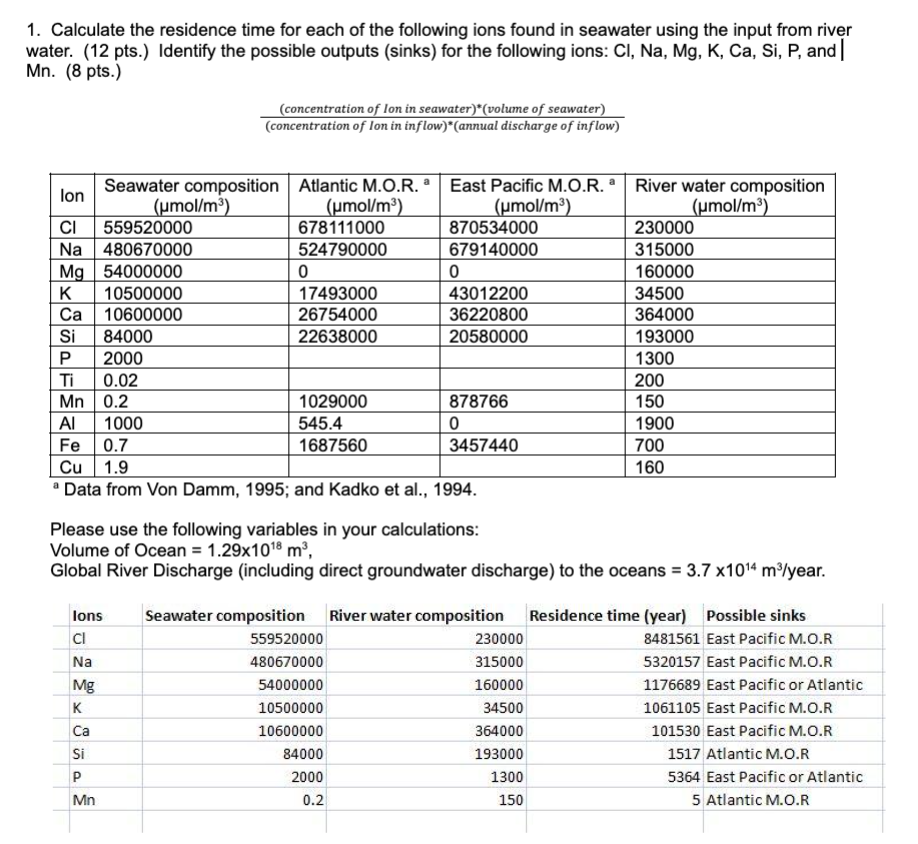
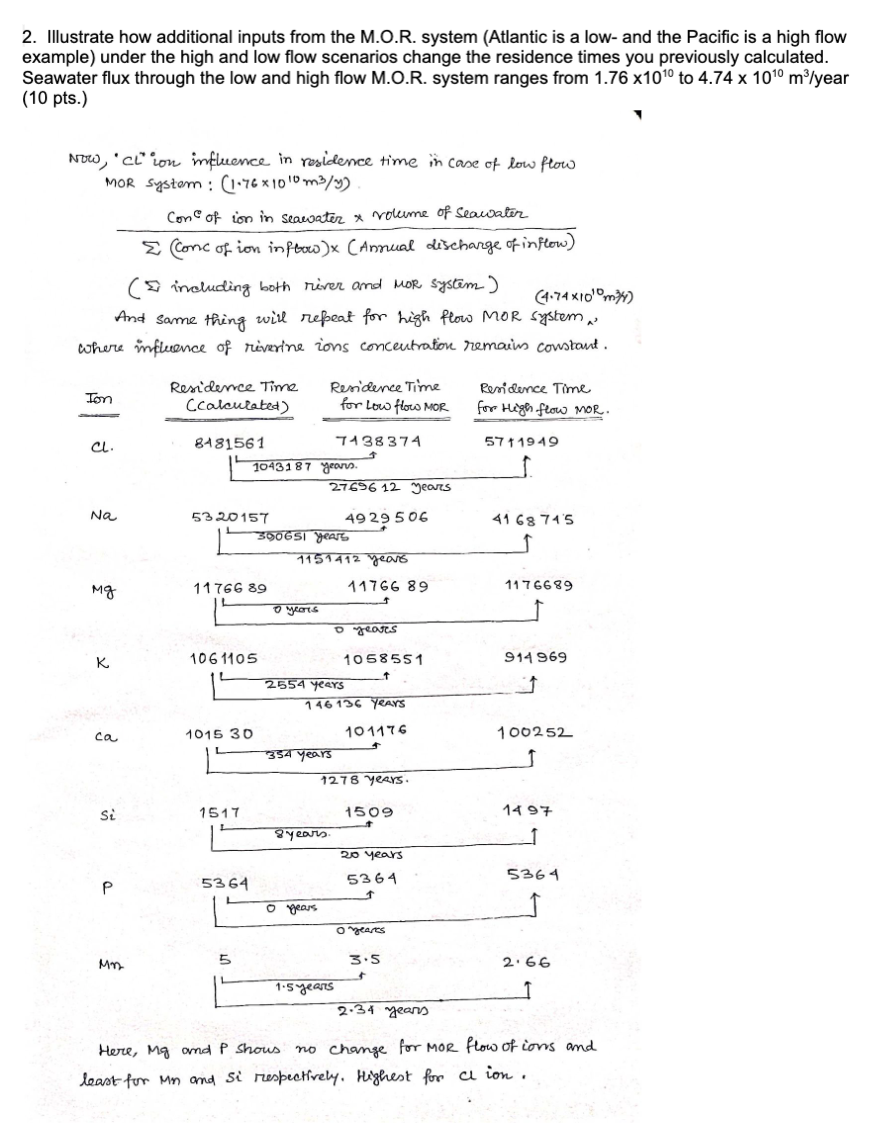
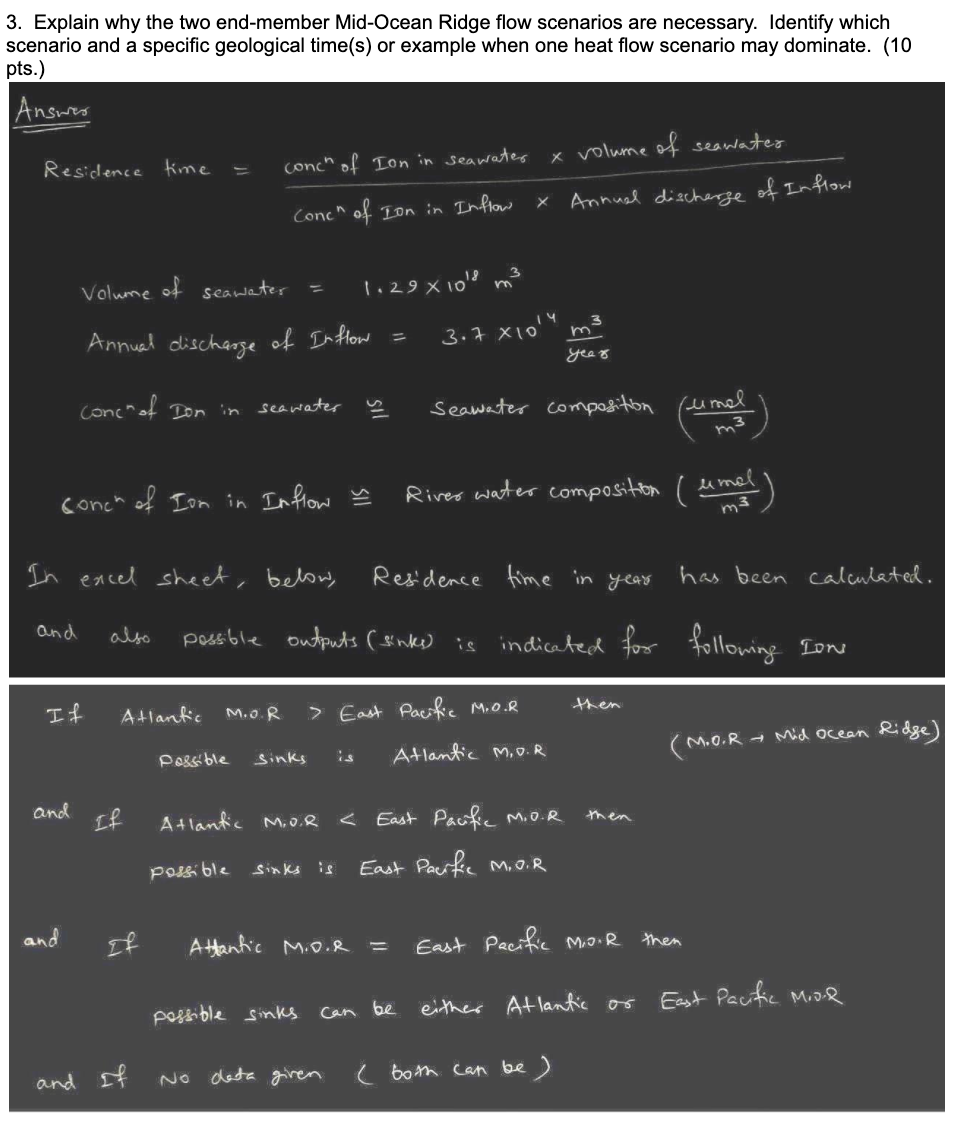
4. Using the volume of the ocean (1370x1016 km) and the annual evaporation from the oceans (423,100 km/year), calculate the residence time of water in the ocean. Now calculate the residence time based on the annual discharge of rivers. Provide justification (a logical argument) for which value for the residence time is considered to be most representative of the oceans. Explain how your calculated residence times for the different ions in seawater compare to that of the residence and stirring time of the oceans. Which ions have slower and faster removal? Identify those processes responsible for fast and slow removal for each ion in the table. How do the different heat flow scenarios impact these calculations and interpretations? (10 pts.) 1. Calculate the residence time for each of the following ions found in seawater using the input from river water. (12 pts.) Identify the possible outputs (sinks) for the following ions: CI, Na, Mg, K, Ca, Si, P, and Mn. (8 pts.) concentration of lon in seawater)*(volume of seawater) (concentration of lon in inflow)'annual discharge of inflow) lon Seawater composition Atlantic M.O.R. * East Pacific M.O.R. a River water composition (umol/m3) (umol/m) (umol/m) (umol/m3) CI 559520000 678111000 870534000 230000 Na 480670000 524790000 679140000 315000 Mg 54000000 0 0 160000 K 10500000 17493000 43012200 34500 Ca 10600000 26754000 36220800 364000 Si 84000 22638000 20580000 193000 P 2000 1300 Ti 0.02 200 Mn 0.2 1029000 878766 150 AI 1000 545.4 0 1900 Fe 0.7 1687560 3457440 700 Cu 1.9 160 a Data from Von Damm, 1995; and Kadko et al., 1994. Please use the following variables in your calculations: Volume of Ocean = 1.29x10¹⁸ m, Global River Discharge (including direct groundwater discharge) to the oceans = 3.7 x10¹⁴ myear. lons CI Na Mg K Seawater composition River water composition Residence time (year) Possible sinks 559520000 230000 8481561 East Pacific M.O.R 480670000 315000 5320157 East Pacific M.O.R 54000000 160000 1176689 East Pacific or Atlantic 10500000 34500 1061105 East Pacific M.O.R 10600000 364000 101530 East Pacific M.O.R 84000 193000 1517 Atlantic M.O.R 2000 1300 5364 East Pacific or Atlantic 0.2 150 5 Atlantic M.O.R Si Mn 2. Illustrate how additional inputs from the M.O.R. system (Atlantic is a low- and the Pacific is a high flow example) under the high and low flow scenarios change the residence times you previously calculated. Seawater flux through the low and high flow M.O.R. system ranges from 1.76 x10¹⁰ to 4.74 x 10¹⁰ m/year (10 pts.) Now, 'cl ion influence in residence time in case of low flow MOR System : (1-76*10'0m3/) Cone of ion in seawater & rolume of seawater E Comic of ion in flow)x (Annual discharge of inflow) (including both river and mor system) (4.74x100m 2 And same thing will repeat for high flow MoR system a where influence of riverine ions concentration remains cowstant. Ton Residence Time Ccalculated) Renidence Time for low flow MOR Residence Time for High flow MOR. CL 5711949 8481561 7438374 1043187 years. 27696 12 years Na 41 68 74'5 53 20 157 4929506 300651 years 1151 412 years 11766 89 11766 89 o years O geoses 1176689 . 914 969 106 1105 1058551 2554 Yeers 146 136 Years ca 1015 30 101176 3 354 years 1278 years 1 00252 1 SL 1517 1509 1497 gyears 200 years 5364 5364 5364 P o years Ongearts 5 3.5 MY) 2.66 1.5 years 2.34 Jeans 1 Here, Mg and P shows no change for MOR flow of ions and least for Mn and si respectively. Highest for a ion. 3. Explain why the two end-member Mid-Ocean Ridge flow scenarios are necessary. Identify which scenario and a specific geological time(s) or example when one heat flow scenario may dominate. (10 pts.) Answer Residence time conch of Ion in seawater x volume of seawater Annual discharge of In flow Conch of Lon in Inflow Volume of seawater 1.29 X 100 m Annual discharge of In flow 3.7 810l4 m year conca of Don in seawater Seawater composition rumal umel conch of Ion in In flow River water composition ( m3 In encel sheet, below, Residence time in year has been calculated. and also possible outputs (sinks is indicated for following lon then If Atlantic MOR > East Pacific M.O.R Possible (M.O.R - Mid ocean Ridge) sinks Atlantic Moor and If Atlantic Moore then East Pacific M.O.R Possible (M.O.R - Mid ocean Ridge) sinks Atlantic Moor and If Atlantic Moore then
Step by Step Solution
There are 3 Steps involved in it

Get step-by-step solutions from verified subject matter experts
 Study Help