Question: Cost Accounting/Managerial Accounting Homework Sequential Method Sequential Method Belami Company manufactures both shampoo and conditioner, with each product manufactured in separate departments. Three support departments
Cost Accounting/Managerial Accounting Homework
Sequential Method
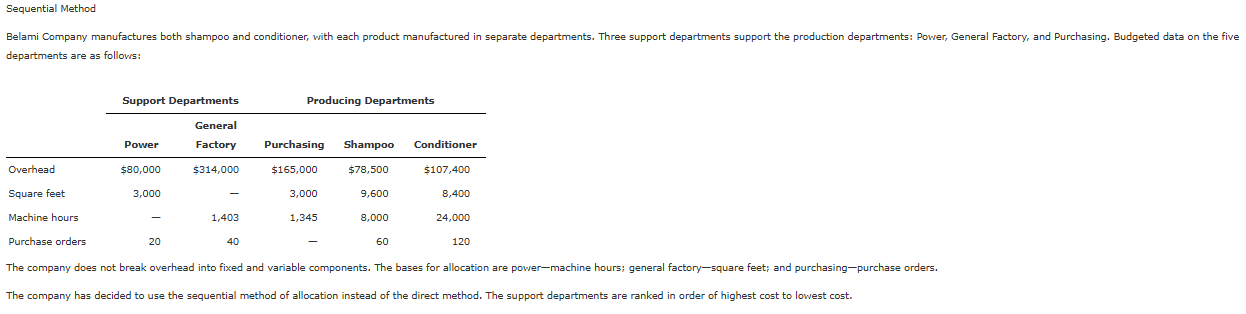
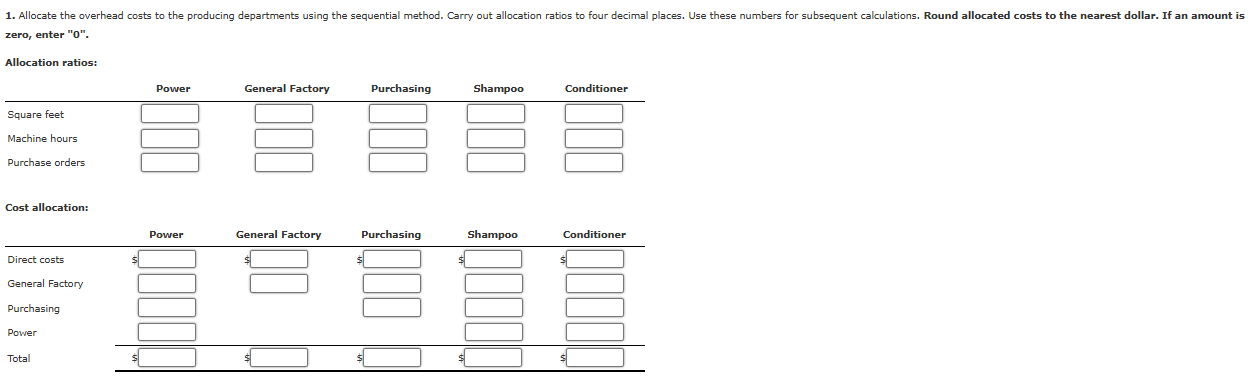
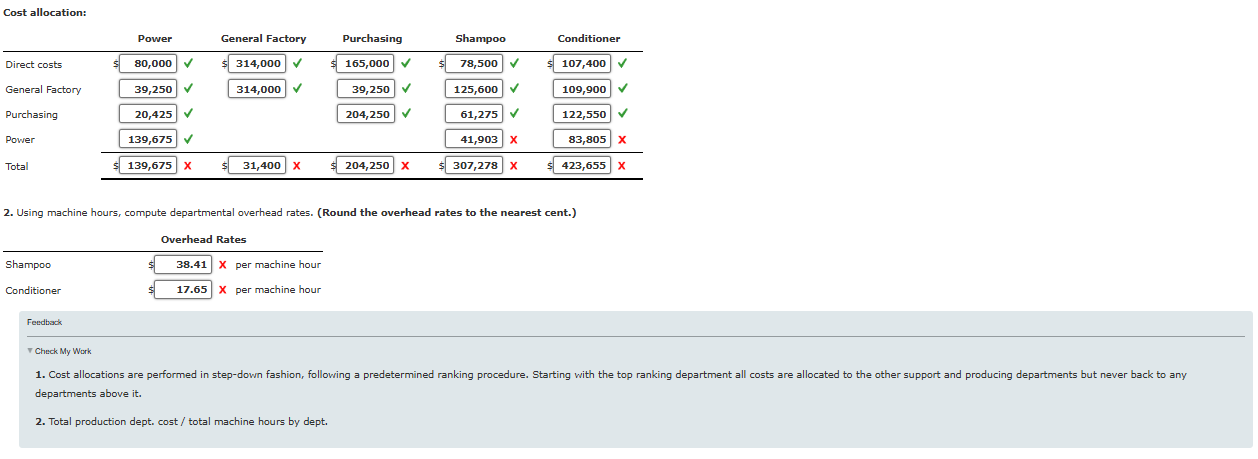
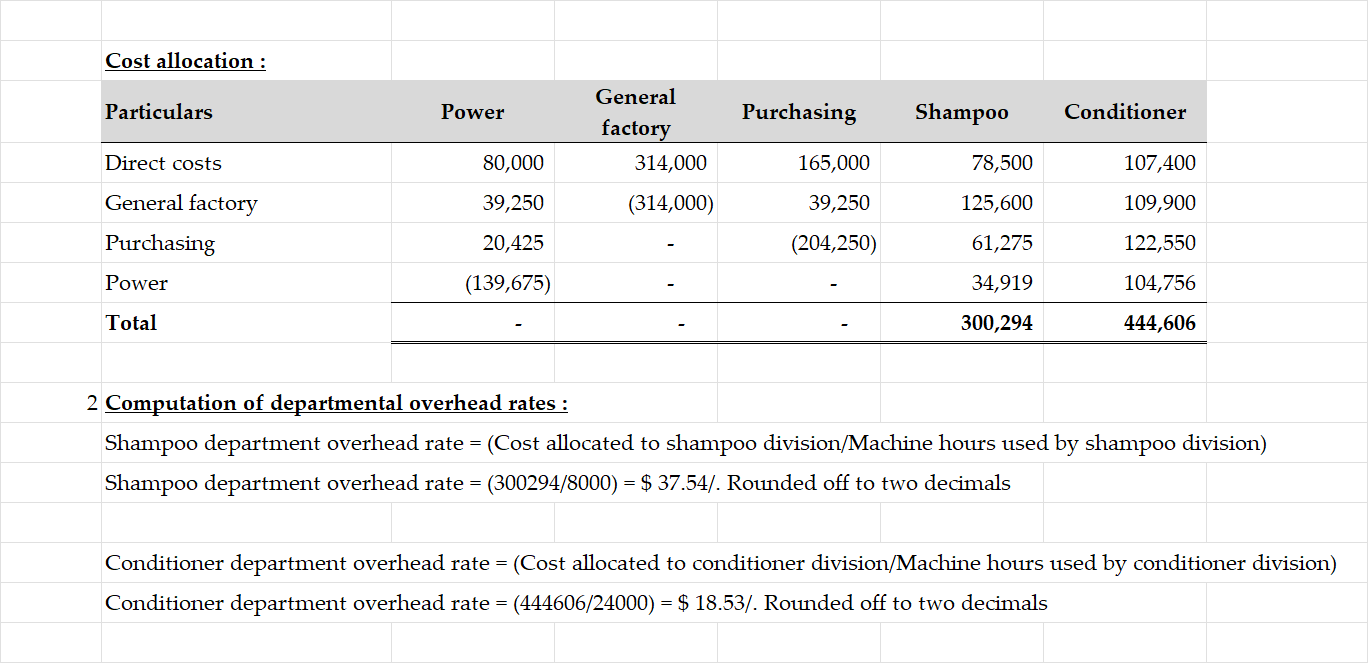
Sequential Method Belami Company manufactures both shampoo and conditioner, with each product manufactured in separate departments. Three support departments support the production departments: Power, General Factory, and Purchasing. Budgeted data on the five departments are as follows: Support Departments Producing Departments General Power Factory Purchasing Shampoo Conditioner Overhead $80,000 $314,000 $165,000 $78,500 $107,400 Square feet 3,000 3,000 9,600 8,400 Machine hours 1,403 1,345 8,000 24,000 Purchase orders 20 40 60 120 The company does not break overhead into fixed and variable components. The bases for allocation are power-machine hours; general factory-square feet; and purchasing-purchase orders. The company has decided to use the sequential method of allocation instead of the direct method. The support departments are ranked in order of highest cost to lowest cost.1. Allocate the overhead costs to the producing departments using the sequential method. Carry out allocation ratios to four decimal places. Use these numbers for subsequent calculations. Round allocated costs to the nearest dollar. If an amount is zero, enter "0". Allocation ratios: Power General Factory Purchasing Shampoo Conditioner Square feet Machine hours Purchase orders Cost allocation: Power General Factory Purchasing Shampoo Conditioner Direct costs $ General Factory Purchasing Power Total $2. Using machine hours, compute departmental overhead rates. (Round the overhead rates to the nearest cent.) Overhead Rates Shampoo E per machine hour Conditioner s:l per machine hour Cost allocation: Power General Factory Purchasing Shampoo Conditioner Direct costs 80,000 $ 314,000 165,000 78,500 107,400 General Factory 39,250 314,000 39,250 125,600 109,900 V Purchasing 20,425 204,250 61,275 122,550 V Power 139,675 41,903 X 83,805 X Total $ 139,675 X $ 31,400 X $ 204,250 X $ 307,278 X 423,655 X 2. Using machine hours, compute departmental overhead rates. (Round the overhead rates to the nearest cent.) Overhead Rates Shampoo 38.41 X per machine hour Conditioner 17.65 X per machine hour Feedback Check My Work 1. Cost allocations are performed in step-down fashion, following a predetermined ranking procedure. Starting with the top ranking department all costs are allocated to the other support and producing departments but never back to any departments above it. 2. Total production dept. cost / total machine hours by dept.Cost allocation : Particulars Power General Purchasing Shampoo Conditioner factory Direct costs 80,000 314,000 165,000 78,500 107,400 General factory 39,250 (314,000) 39,250 125,600 109,900 Purchasing 20,425 - (204,250) 61,275 122,550 Power (139,675) - - 34,919 104,756 Total - - - 300,294 444,606 2 Computation of departmental overhead rates : Shampoo department overhead rate = (Cost allocated to shampoo division/Machine hours used by shampoo division) Shampoo department overhead rate = (300294/8000) = $ 37.54/. Rounded off to two decimals Conditioner department overhead rate = (Cost allocated to conditioner division/Machine hours used by conditioner division) Conditioner department overhead rate = (444606/24000) = $ 18.53/. Rounded off to two decimals
Step by Step Solution
There are 3 Steps involved in it
1 Expert Approved Answer
Step: 1 Unlock
Question Has Been Solved by an Expert!
Get step-by-step solutions from verified subject matter experts
Step: 2 Unlock
Step: 3 Unlock
Students Have Also Explored These Related Accounting Questions!










 Study Help