







Question: COST-BENEFIT ANALYSIS ECON CLASS Reference - Boardman et al., Cost-benefit Analysis: Concepts and Practice. 4th Ed. Exercise 1: Sensitivity Analysis Explain the three methods of
COST-BENEFIT ANALYSIS ECON CLASS
Reference - Boardman et al., Cost-benefit Analysis: Concepts and Practice. 4th Ed.
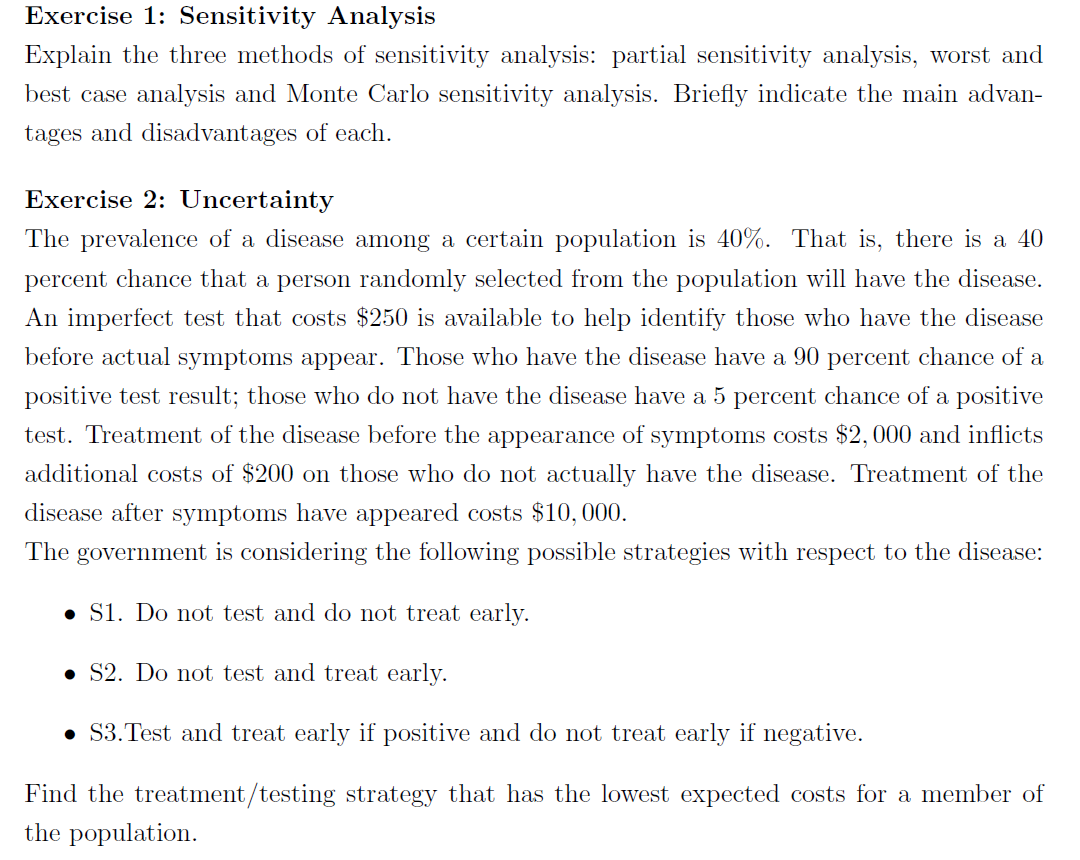
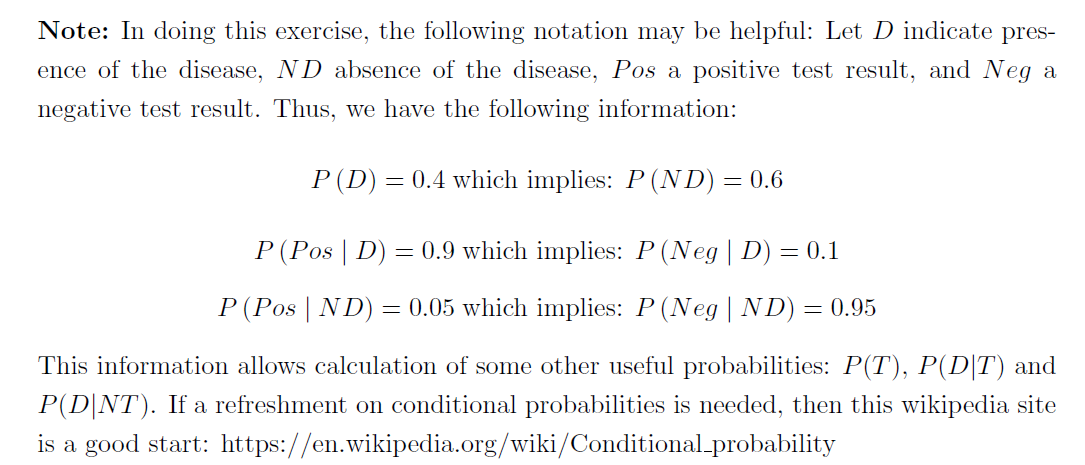
Exercise 1: Sensitivity Analysis Explain the three methods of sensitivity analysis: partial sensitivity analysis, worst and best case analysis and Monte Carlo sensitivity analysis. Briey indicate the main advan- tages and disadvantages of each. Exercise 2: Uncertainty The prevalence of a disease among a certain population is 40%. That is, there is a 40 percent chance that a person randomly selected from the population will have the disease. An imperfect test that costs $250 is available to help identify those who have the disease before actual symptoms appear. Those who have the disease have a 90 percent chance of a positive test result; those who do not have the disease have a 5 percent chance of a positive test. Treatment of the disease before the appearance of symptoms costs $2, 000 and inflicts additional costs of $200 on those who do not actually have the disease. Treatment of the disease after symptoms have appeared costs $10, 000. The government is considering the following possible strategies with respect to the disease: 0 81. Do not test and do not treat early. 0 S2. Do not test and treat early. 0 83.Test and treat early if positive and do not treat early if negative. Find the treatment/testing strategy that has the lowest expected costs for a member of the population. Note: In doing this exercise, the following notation may be helpful: Let D indicate pres- ence of the disease, ND absence of the disease, Pos a positive test result, and Neg a negative test result. Thus, we have the following information: P(D) = 0.4 which implies: P (ND) = 0.6 P (Pos | D) = 0.9 which implies: P (Neg | D) = 0.1 P (Pos | ND) = 0.05 which implies: P (Neg | ND) = 0.95 This information allows calculation of some other useful probabilities: P(T), P(DIT) and P(D NT). If a refreshment on conditional probabilities is needed, then this wikipedia site is a good start: https://en. wikipedia.org/wiki/Conditional_probability
Step by Step Solution
There are 3 Steps involved in it

Get step-by-step solutions from verified subject matter experts
 Study Help