







Question: Could anyone explain about this paragraph for me with notes about jobwithdrawl Thank you in advance Lauupuon of corporate culture 58 su imployee engagement, reten-
Could anyone explain about this paragraph for me with notes about jobwithdrawl 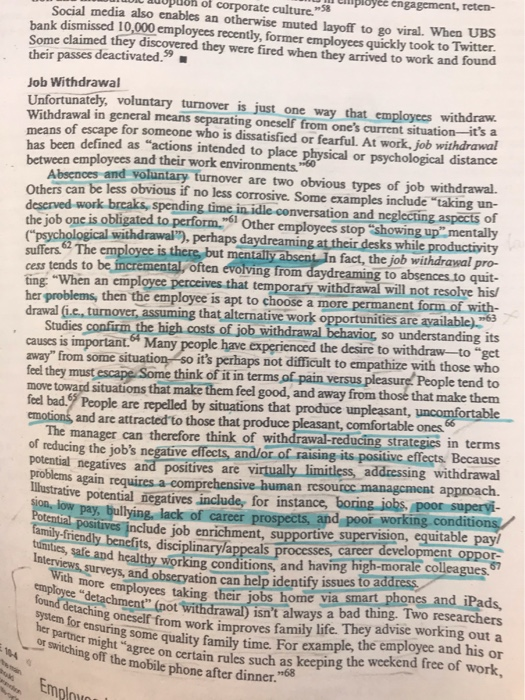
Lauupuon of corporate culture 58 su imployee engagement, reten- Social media also enables an otherwise muted layoff to go viral. When UBS bank dismissed 10,000 employees recently, former employees quickly took to Twitter. Some claimed they discovered they were fired when they arrived to work and found their passes deactivated. Job Withdrawal Unfortunately, voluntary turnover is just one way that employees withdraw. Withdrawal in general means separating oneself from one's current situation-it's a means of escape for someone who is dissatisfied or fearful. At work, job withdrawal has been defined as "actions intended to place physical or psychological distance between employees and their work environments 60 Absences and voluntary turnover are two obvious types of job withdrawal. Others can be less obvious if no less corrosive. Some examples include "taking un- deserved work breaks, spending time in idle conversation and neglecting aspects of the job one is obligated to perform." Other employees stop "showing up" mentally (psychological withdrawal), perhaps daydreaming at their desks while productivity suffers 2 The employee is there, but mentally absent. In fact, the job withdrawal pro- cess tends to be incremental, often evolving from daydreaming to absences to quit- ting "When an employee perceives that temporary withdrawal will not resolve his! her problems, then the employee is apt to choose a more permanent form of with- drawal (ie, turnover, assuming that alternative work opportunities are available) Studies confirm the high costs of job withdrawal behavior, so understanding its causes is important. Many people have experienced the desire to withdraw-to "get away" from some situation-so it's perhaps not difficult to empathize with those who feel they must escape Some think of it in terms of pain versus pleasure. People tend to move toward situations that make them feel good, and away from those that make them feel bad. People are repelled by situations that produce unpleasant, uncomfortable emotions and are attracted to those that produce pleasant, comfortable ones The manager can therefore think of withdrawal-reducing strategies in terms of reducing the job's negative effects, and/or of raising its positive effects. Because potential negatives and positives are virtually limitless, addressing withdrawal problems aca olems again requires a comprehensive human resource management approach. ustrative potential negatives include, for instance, boring jobs, poor supervi- pay, bullying. lack of career prospects, and poor working conditions positives include job enrichment, supportive supervision, equitable payl Hy benefits, disciplinary/appeals processes, career development oppor- and healthy working conditions, and having high-morale colleagues. surveys, and obseryation can help identify issues to address Ernployees taking their jobs home via smart phones and iPads, nent" (not withdrawal isn't always a bad thing. Two researchers ag oneself from work improves family life. They advise working out a uring some quality family time. For example, the employee and his or agree on certain rules such as keeping the weekend free of work. family-friendly benefits, disciplina tunities, safe and healthy wor Interviews, surveys, and With more employees ta found detaching oneselt 10 her partner might "agree on certa switching off the mobile phone after dinner. Emplona ter dinner, 68 Thank you in advance
Step by Step Solution
There are 3 Steps involved in it
1 Expert Approved Answer
Step: 1 Unlock

Question Has Been Solved by an Expert!
Get step-by-step solutions from verified subject matter experts
Step: 2 Unlock
Step: 3 Unlock
 Study Help