







Question: Could Do Better School is an 11-18 state school (non-fee paying), situated on the outskirts of a major city in a socially deprived community where
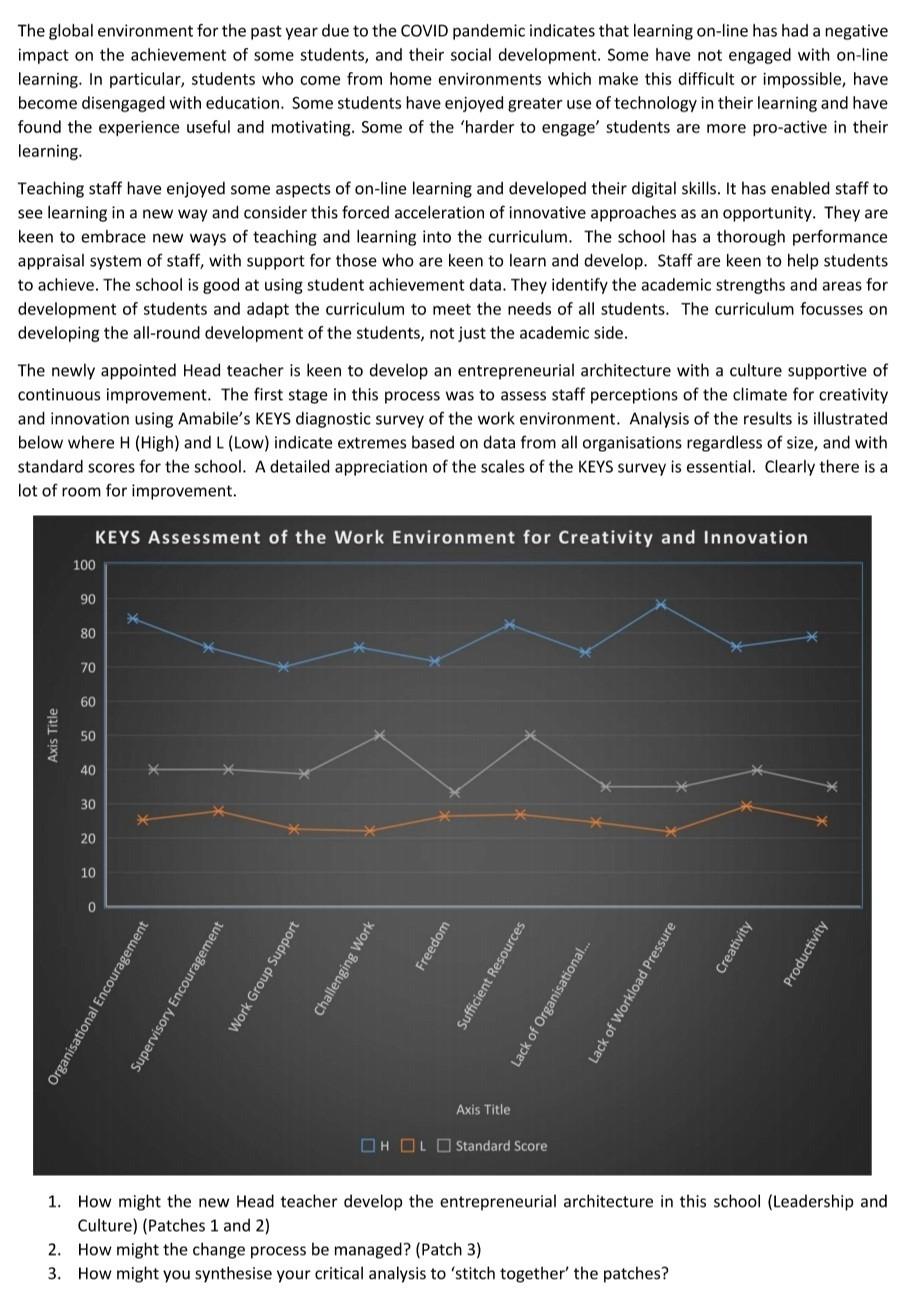
Could Do Better School is an 11-18 state school (non-fee paying), situated on the outskirts of a major city in a socially deprived community where incomes tend to be low and where family members have not been to university. All state schools are subject to external inspection every 2 years to assess academic performance and well-being of students. The school is currently identified as 'requiring improvement' which means increased external monitoring, scrutiny and paperwork. Students enter with results well below the national average and, although they make good progress, achievements are below the national average for 16-18 year olds. There are 1200 students aged 11-18 years organised in year groups and taught in ability groupings for their lessons. They also have a tutor group with students from their own year group that meets each day for registration. The curriculum is a standard national curriculum. Each lesson is one hour long, taken by a specialist teacher. Sometimes the students get taken on days out or have suspended curriculum activities such as those focussed on a particular subject e.g. art or drama, or they could be could be involved in charity fund-raising events. Many staff run activities outside of class for students. There is low level poor behaviour in lessons, less so in fun lessons, or in lessons of experienced staff. The Senior Leadership Team consists of a Head teacher and Deputy Head teachers supported by Heads of Subject (Curriculum focussed) and Heads of Year (student focussed). There are 100 staff, 68 are teachers and 10 are part- time. There are talented staff, but they are tired, and their confidence is low because of the inspection grading. Rates of pay are dictated by Government and finances are tight. As the school is outside the city centre the rate of pay for teachers in the school is less that those few miles away city centre. Attracting staff, both those new to the profession, and experienced staff is challenging as the schools in the city centre offer a higher wage. Currently employed staff are also attracted to the higher wages of the city. As there has been inconsistency in the delivery of lessons, in the past, the previous Head teacher has introduced a standard lesson framework for staff to follow: . . . . Meet and greet Starter Review of past learning/ link to new learning Outline Learning Objectives New learning Activity to embed learning Review of learning objectives . Every lesson requires a lesson plan and senior staff patrol the school during the day, to monitor behaviour. Teachers feel restricted by the standard lesson framework and do not feel trusted by senior staff. They want to be free to experiment and take risks in lessons. A staff survey indicates that many staff do not feel trusted or valued. They feel that there is little support from the leaders in the school. They feel that there is too much paperwork to complete, and too much marking. The Senior Leadership Team, who teach as well, also feel not trusted due to external scrutiny. They too are tired. They have lots of reports to complete, they have to plan their lessons, mark books and monitor other staff. Teachers have two afterschool meetings per week; a whole school one where the agenda is set by the Senior Leadership Team, and a department/ subject meeting where the agenda is set by the Head of Subject. Leaders have an extra meeting each week. Teachers resent having to go to these meetings as they would prefer to spend time on planning lessons and marking work. Some weeks have additional training meetings. Five days a year the School is closed to students, so that teachers can spend the full day in training. The content of these training sessions is set by the Senior Leadership Team. Teachers can go on external training courses. This can be on subject areas, on developing students or career development. Traditionally the school has been very insular. However, all staff are committed to giving their time and expertise to improve the school, and the life chances of students. The Governing body are supportive in the appointment of a new Head teacher who is keen to work with other local schools and the local authority. The other local schools consist of 'feeder primary schools (schools which the students went to before going to Could Do Better School) and other state schools. They are also keen to work with the local University to inspire students in the school. The school are reviewing communication mechanisms to get parents on- board. The global environment for the past year due to the COVID pandemic indicates that learning on-line has had a negative impact on the achievement of some students, and their social development. Some have not engaged with on-line learning, In particular, students who come from home environments which make this difficult or impossible, have become disengaged with education. Some students have enjoyed greater use of technology in their learning and have found the experience useful and motivating. Some of the 'harder to engage' students are more pro-active in their learning, Teaching staff have enjoyed some aspects of on-line learning and developed their digital skills. It has enabled staff to see learning in a new way and consider this forced acceleration of innovative approaches as an opportunity. They are keen to embrace new ways of teaching and learning into the curriculum. The school has a thorough performance appraisal system of staff, with support for those who are keen to learn and develop. Staff are keen to help students to achieve. The school is good at using student achievement data. They identify the academic strengths and areas for development of students and adapt the curriculum to meet the needs of all students. The curriculum focusses on developing the all-round development of the students, not just the academic side. The newly appointed Head teacher is keen to develop an entrepreneurial architecture with a culture supportive of continuous improvement. The first stage in this process was to assess staff perceptions of the climate for creativity and innovation using Amabile's KEYS diagnostic survey of the work environment. Analysis of the results is illustrated below where H (High) and L (Low) indicate extremes based on data from all organisations regardless of size, and with standard scores for the school. A detailed appreciation of the scales of the KEYS survey is essential. Clearly there is a lot of room for improvement. KEYS Assessment of the Work Environment for Creativity and Innovation 100 90 80 70 60 Axis Title 50 40 30 20 10 0 Freedom Creativity Organisational Encouragement Challenging Work Supervisory Encouragement Work Group Support Productivity Sufficient Resources Lack of Organisational... Lack of Workload Pressure Axis Title OHOL Standard Score 1. How might the new Head teacher develop the entrepreneurial architecture in this school (Leadership and Culture) (Patches 1 and 2) 2. How might the change process be managed? (Patch 3) 3. How might you synthesise your critical analysis to 'stitch together' the patches
Step by Step Solution
There are 3 Steps involved in it
1 Expert Approved Answer
Step: 1 Unlock

Question Has Been Solved by an Expert!
Get step-by-step solutions from verified subject matter experts
Step: 2 Unlock
Step: 3 Unlock
 Study Help