







Question: Could you explain with example graphs? Thank you A depth-first forest classifies the edges of a graph into tree, back, forward, and cross edges. A
 Could you explain with example graphs? Thank you
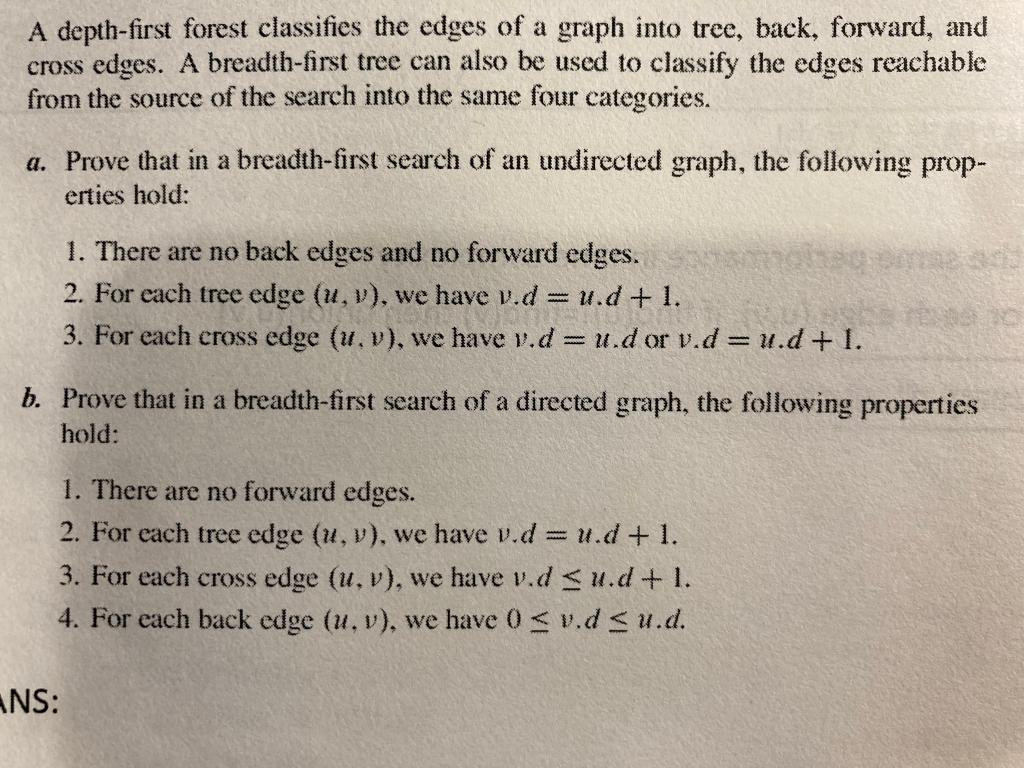
A depth-first forest classifies the edges of a graph into tree, back, forward, and cross edges. A breadth-first tree can also be used to classify the edges reachable from the source of the search into the same four categories. a. Prove that in a breadth-first search of an undirected graph, the following prop- erties hold: 1. There are no back edges and no forward edges. 2. For each tree edge (u, v), we have v.d = u.d + 1. 3. For each cross edge (u, v), we have v.d=u.d or v.d=u.d +1. b. Prove that in a breadth-first search of a directed graph, the following properties hold: 1. There are no forward edges. 2. For each tree edge (11, v), we have v.d=u.d + 1. 3. For each cross edge (u, v), we have v.d
Step by Step Solution
There are 3 Steps involved in it

Get step-by-step solutions from verified subject matter experts
 Study Help