







Question: Could you guys summarize this case study and analyze stakeholders in this case, please? (There are 4 pictures below) STARBUCKS COFFEE COMPANY AND STAKEHOLDER ENGAGEMENT
Could you guys summarize this case study and analyze stakeholders in this case, please? (There are 4 pictures below)
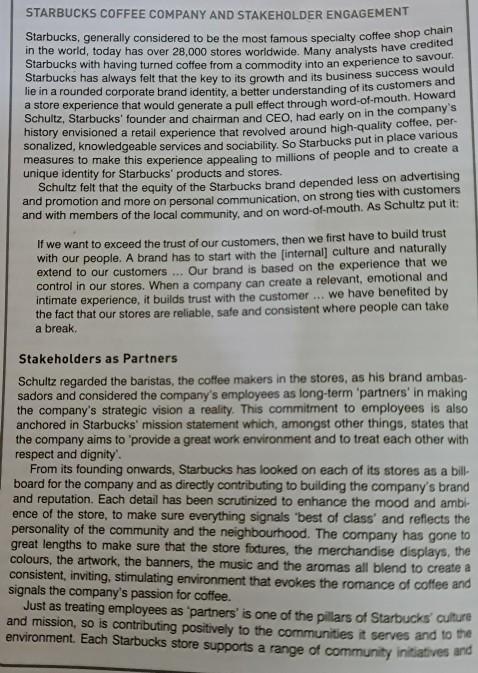
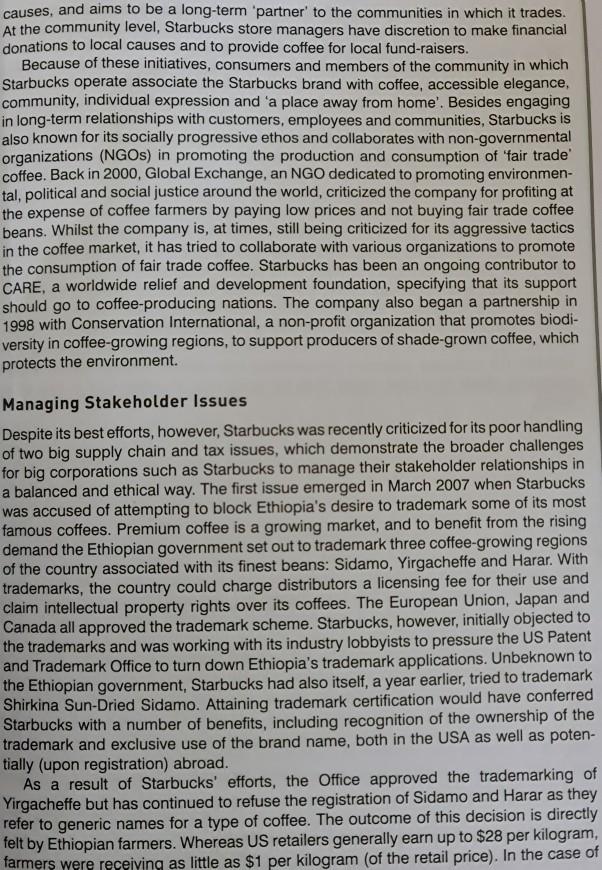
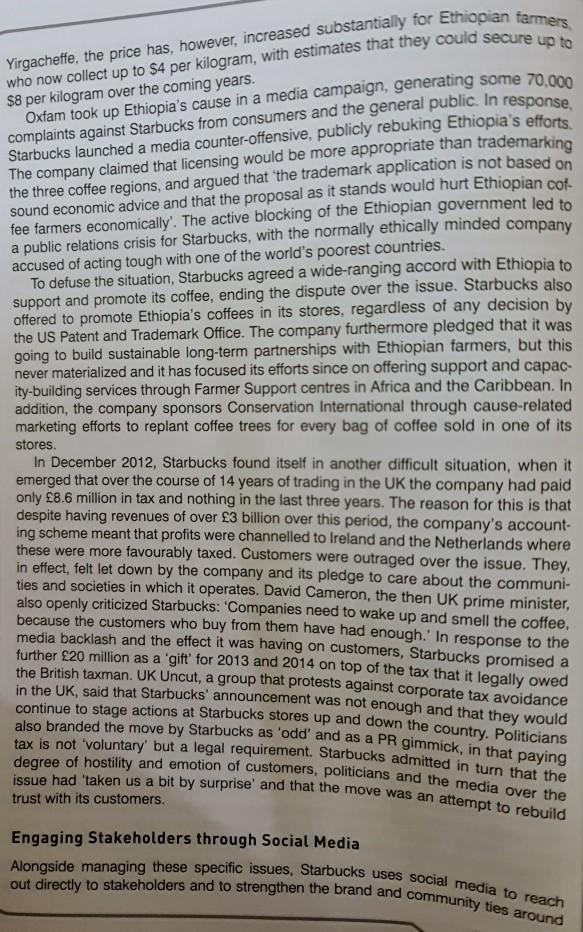
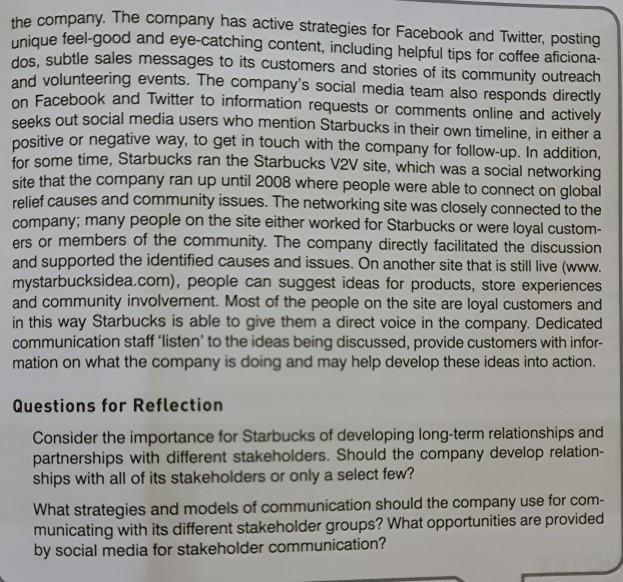
STARBUCKS COFFEE COMPANY AND STAKEHOLDER ENGAGEMENT Starbucks, generally considered to be the most famous specialty coffee shop chain in the world, today has over 28,000 stores worldwide. Many analysts have credited Starbucks with having turned coffee from a commodity into an experience to savour Starbucks has always felt that the key to its growth and its business success would lie in a rounded corporate brand identity, a better understanding of its customers and a store experience that would generate a pull effect through word-of-mouth. Howard Schultz, Starbucks' founder and chairman and CEO, had early on in the company's history envisioned a retail experience that revolved around high-quality coffee, pero sonalized, knowledgeable services and sociability. So Starbucks put in place various measures to make this experience appealing to millions of people and to create a unique identity for Starbucks' products and stores. Schultz felt that the equity of the Starbucks brand depended less on advertising and promotion and more on personal communication, on strong ties with customers and with members of the local community, and on word-of-mouth. As Schultz put it If we want to exceed the trust of our customers, then we first have to build trust with our people. A brand has to start with the [internal culture and naturally extend to our customers ... Our brand is based on the experience that we control in our stores. When a company can create a relevant, emotional and intimate experience, it builds trust with the customer ... we have benefited by the fact that our stores are reliable, safe and consistent where people can take a break. Stakeholders as Partners Schultz regarded the baristas, the coffee makers in the stores, as his brand ambas- sadors and considered the company's employees as long-term partners' in making the company's strategic vision a reality. This commitment to employees is also anchored in Starbucks' mission statement which, amongst other things, states that the company aims to provide a great work environment and to treat each other with respect and dignity From its founding onwards, Starbucks has looked on each of its stores as a bill- board for the company and as directly contributing to building the company's brand and reputation. Each detail has been scrutinized to enhance the mood and ambi- ence of the store, to make sure everything signals 'best of class' and reflects the personality of the community and the neighbourhood. The company has gone to great lengths to make sure that the store foctures, the merchandise displays, the colours, the artwork, the banners, the music and the aromas all blend to create a consistent, inviting, stimulating environment that evokes the romance of coffee and signals the company's passion for coffee. Just as treating employees as partners' is one of the pillars of Starbucks culture and mission, so is contributing positively to the communities it serves and to the environment. Each Starbucks store supports a range of community initiatives and causes, and aims to be a long-term 'partner' to the communities in which it trades. At the community level, Starbucks store managers have discretion to make financial donations to local causes and to provide coffee for local fund-raisers. Because of these initiatives, consumers and members of the community in which Starbucks operate associate the Starbucks brand with coffee, accessible elegance, community, individual expression and a place away from home'. Besides engaging in long-term relationships with customers, employees and communities, Starbucks is also known for its socially progressive ethos and collaborates with non-governmental organizations (NGOs) in promoting the production and consumption of "fair trade coffee. Back in 2000, Global Exchange, an NGO dedicated to promoting environmen- tal, political and social justice around the world, criticized the company for profiting at the expense of coffee farmers by paying low prices and not buying fair trade coffee beans. Whilst the company is, at times, still being criticized for its aggressive tactics in the coffee market, it has tried to collaborate with various organizations to promote the consumption of fair trade coffee. Starbucks has been an ongoing contributor to CARE, a worldwide relief and development foundation, specifying that its support should go to coffee-producing nations. The company also began a partnership in 1998 with Conservation International, a non-profit organization that promotes biodi- versity in coffee-growing regions, to support producers of shade-grown coffee, which protects the environment. Managing Stakeholder Issues Despite its best efforts, however, Starbucks was recently criticized for its poor handling of two big supply chain and tax issues, which demonstrate the broader challenges for big corporations such as Starbucks to manage their stakeholder relationships in a balanced and ethical way. The first issue emerged in March 2007 when Starbucks was accused of attempting to block Ethiopia's desire to trademark some of its most famous coffees. Premium coffee is a growing market, and to benefit from the rising demand the Ethiopian government set out to trademark three coffee-growing regions of the country associated with its finest beans: Sidamo, Yirgacheffe and Harar. With trademarks, the country could charge distributors a licensing fee for their use and claim intellectual property rights over its coffees. The European Union, Japan and Canada all approved the trademark scheme. Starbucks, however, initially objected to the trademarks and was working with its industry lobbyists to pressure the US Patent and Trademark Office to turn down Ethiopia's trademark applications. Unbeknown to the Ethiopian government, Starbucks had also itself, a year earlier, tried to trademark Shirkina Sun-Dried Sidamo. Attaining trademark certification would have conferred Starbucks with a number of benefits, including recognition of the ownership of the trademark and exclusive use of the brand name, both in the USA as well as poten- tially (upon registration) abroad. As a result of Starbucks' efforts, the Office approved the trademarking of Yirgacheffe but has continued to refuse the registration of Sidamo and Harar as they refer to generic names for a type of coffee. The outcome of this decision is directly felt by Ethiopian farmers. Whereas US retailers generally earn up to $28 per kilogram, farmers were receiving as little as $1 per kilogram (of the retail price). In the case of issue had taken us a bit by surprise and that the move was an attempt to rebuild out directly to stakeholders and to strengthen the brand and community ties around $8 per kilogram over the coming years. Yirgacheffe, the price has, however, increased substantially for Ethiopian farmers, who now collect up to $4 per kilogram, with estimates that they could secure up to Oxfam took up Ethiopia's cause in a media campaign, generating some 70.000 Alongside managing these specific issues, Starbucks uses social media to reach complaints against Starbucks from consumers and the general public. In response, Starbucks launched a media counter-offensive, publicly rebuking Ethiopia's efforts The company claimed that licensing would be more appropriate than trademarking the three coffee regions, and argued that the trademark application is not based on sound economic advice and that the proposal as it stands would hurt Ethiopian cof fee farmers economically'. The active blocking of the Ethiopian government led to a public relations crisis for Starbucks, with the normally ethically minded company accused of acting tough with one of the world's poorest countries. To defuse the situation, Starbucks agreed a wide-ranging accord with Ethiopia to support and promote its coffee, ending the dispute over the issue. Starbucks also offered to promote Ethiopia's coffees in its stores, regardless of any decision by the US Patent and Trademark Office. The company furthermore pledged that it was going to build sustainable long-term partnerships with Ethiopian farmers, but this never materialized and it has focused its efforts since on offering support and capac- ity-building services through Farmer Support centres in Africa and the Caribbean. In addition, the company sponsors Conservation International through cause-related marketing efforts to replant coffee trees for every bag of coffee sold in one of its stores. In December 2012, Starbucks found itself in another difficult situation, when it emerged that over the course of 14 years of trading in the UK the company had paid only 8.6 million in tax and nothing in the last three years. The reason for this is that despite having revenues of over 3 billion over this period, the company's account- ing scheme meant that profits were channelled to Ireland and the Netherlands where these were more favourably taxed. Customers were outraged over the issue. They in effect, felt let down by the company and its pledge to care about the communi- ties and societies in which it operates. David Cameron, the then UK prime minister, also openly criticized Starbucks: 'Companies need to wake up and smell the coffee, because the customers who buy from them have had enough.' In response to the media backlash and the effect it was having on customers, Starbucks promised a further 20 million as a 'gift' for 2013 and 2014 on top of the tax that it legally owed the British taxman. UK Uncut, a group that protests against corporate tax avoidance in the UK, said that Starbucks' announcement was not enough and that they would continue to stage actions at Starbucks stores up and down the country. Politicians also branded the move by Starbucks as odd' and as a PR gimmick, in that paying tax is not 'voluntary' but a legal requirement. Starbucks admitted in turn that the degree of hostility and emotion of customers, politicians and the media over the trust with its customers. Engaging Stakeholders through Social Media the company. The company has active strategies for Facebook and Twitter , posting unique feel-good and eye-catching content, including helpful tips for coffee aficiona- dos, subtle sales messages to its customers and stories of its community Outreach and volunteering events. The company's social media team also responds directly on Facebook and Twitter to information requests or comments online and actively seeks out social media users who mention Starbucks in their own timeline, in either a positive or negative way, to get in touch with the company for follow-up. In addition, for some time, Starbucks ran the Starbucks V2V site, which was a social networking site that the company ran up until 2008 where people were able to connect on global relief causes and community issues. The networking site was closely connected to the company, many people on the site either worked for Starbucks or were loyal custom- ers or members of the community. The company directly facilitated the discussion and supported the identified causes and issues. On another site that is still live (www. mystarbucksidea.com), people can suggest ideas for products, store experiences and community involvement. Most of the people on the site are loyal customers and in this way Starbucks is able to give them a direct voice in the company. Dedicated communication staff listen to the ideas being discussed, provide customers with infor- mation on what the company is doing and may help develop these ideas into action. Questions for Reflection Consider the importance for Starbucks of developing long-term relationships and partnerships with different stakeholders. Should the company develop relation- ships with all of its stakeholders or only a select few? What strategies and models of communication should the company use for com- municating with its different stakeholder groups? What opportunities are provided by social media for stakeholder communication
Step by Step Solution
There are 3 Steps involved in it
1 Expert Approved Answer
Step: 1 Unlock

Question Has Been Solved by an Expert!
Get step-by-step solutions from verified subject matter experts
Step: 2 Unlock
Step: 3 Unlock
 Study Help