







Question: could you help me answer these questions with based on the interview below Supply Chain Overview: 1. Can you provide an overview of your supply
could you help me answer these questions with based on the interview below
Supply Chain Overview: 1. Can you provide an overview of your supply chain, from sourcing to delivery? * Yes, our supply chain includes sourcing, quality control, warehousing, order processing, packing, shipping, logistics, customer service, returns, and continuous improvement to ensure efficient and reliable delivery of products to our customers.
2. What key components make up your supply chain network? * Our supply chain network comprises key components such as sourcing, manufacturing (if applicable), logistics, warehousing, order fulfillment, transportation, and customer service. These components work together to ensure the smooth flow of products from production to delivery to the customer.
Supplier Relations:
3. What strategies do you use to ensure a consistent and high-quality supply of products? * Supplier Selection: We carefully vet and select reputable suppliers based on their track record, quality standards, and ethical practices.
* Quality Control: Rigorous quality control processes are in place to inspect incoming materials and products to ensure they meet our standards.
* Supplier Audits: We conduct regular supplier audits to assess their production processes and adherence to quality and ethical standards.
* Inventory Management: We maintain optimal inventory levels through efficient inventory management systems to prevent stockouts or overstocking.
* Supplier Relationships: Building strong relationships with suppliers promotes open communication and a mutual commitment to quality.
* Continuous Improvement: We continually assess and improve our processes, incorporating feedback and lessons learned to enhance product quality.
* Technology Integration: We leverage technology for real-time tracking and data analysis to identify and address quality issues promptly.
* Feedback Loops: We encourage feedback from customers, suppliers, and employees to identify and rectify any quality-related concerns.
By implementing these strategies, we ensure a consistent and high-quality supply of products to meet customer expectations.
Inventory Management:
4. How do you manage inventory levels to meet customer demand while minimizing excess stock? * We employ advanced inventory management techniques, including demand forecasting, just-in-time inventory practices, and data analytics. These methods help us accurately predict customer demand and maintain optimal inventory levels, minimizing excess stock and ensuring products are available when needed.
Order Fulfillment:
5. What is your process for order fulfilment, and how do you handle peak demand periods? * Our order fulfillment process involves receiving orders, checking inventory, picking and packing, and shipping. During peak demand, we scale up by hiring extra staff, increasing inventory, prioritizing orders, and ensuring clear communication with customers to manage the higher order volumes effectively.
6. Are there any unique challenges in fulfilling orders for your specific industry or product types? * Yes, in our industry, product availability and demand can vary significantly. Keeping a diverse range of products in stock and predicting changing customer preferences can be challenging. Additionally, ensuring the safe and timely delivery of fragile or high-value items requires extra care and attention in our order fulfillment process.
Logistics and Transportation:
7. How do you handle the transportation and logistics of getting products from suppliers to your warehouse and from your warehouse to customers? * Supplier to Warehouse: Suppliers use their preferred carriers or our designated transport partners to deliver products to our warehouse. We track shipments to ensure on-time arrivals.
* Warehouse Operations: Upon receipt, we inspect and log incoming products, updating inventory in real-time. Products are then stored efficiently in our warehouse.
* Order Fulfillment: When orders are placed, our team picks and packs items. We work with reliable shipping partners to ensure timely and secure delivery to customers.
* Shipping Tracking: We provide customers with shipment tracking details, allowing them to monitor the status of their orders in real-time. * Logistics Optimization: We continually optimize logistics operations to minimize costs and reduce delivery times.
This process ensures the efficient movement of products from suppliers to our warehouse and from our warehouse to customers, delivering products in a timely and cost-effective manner.
Technology and Automation:
8. What role does technology play in your supply chain management? * Technology plays a pivotal role in our supply chain management by improving efficiency, enhancing visibility, and enabling data-driven decision-making.
Customer Experience:
9. How do you handle returns and customer complaints related to order fulfillment? * Returns: Customers can initiate returns through our website. Once received, we inspect the returned items and process refunds or replacements per our return policy. * Customer Complaints: We have a dedicated customer service team that addresses complaints promptly. We investigate issues, resolve them in line with our policies, and use feedback to improve our processes.
Our goal is to ensure a seamless and positive customer experience, even when issues arise.
Cost Optimization:
10. How do you work to optimize supply chain costs without sacrificing quality or customer
satisfaction? * Efficiency Gains: Identifying and eliminating inefficiencies in processes and operations to reduce costs.
* Demand Forecasting: Using accurate demand forecasts to prevent overstocking and stockouts, minimizing carrying costs.
* Supplier Negotiation: Negotiating favorable terms with suppliers while maintaining quality standards.
* Logistics Optimization: Streamlining transportation and distribution to reduce shipping costs and delivery times.
* Inventory Management: Implementing just-in-time inventory practices to reduce storage costs.
* Technology Integration: Utilizing advanced supply chain management software for real-time monitoring and data-driven decisions.
* Quality Assurance: Maintaining strict quality control measures to prevent costly errors.
* Continuous Improvement: Regularly reviewing and optimizing supply chain processes to identify cost-saving opportunities.
This approach allows us to achieve cost efficiencies while upholding product quality and ensuring customer satisfaction.
Data and Analytics:
11. How do you use data and analytics to make informed supply chain decisions? * We use data and analytics to make informed supply chain decisions by analyzing historical data, demand forecasts, and real-time information. This enables us to optimize inventory levels, improve logistics routing, reduce lead times, enhance supplier performance, and ultimately deliver better customer service by ensuring products are available when and where they are needed most.
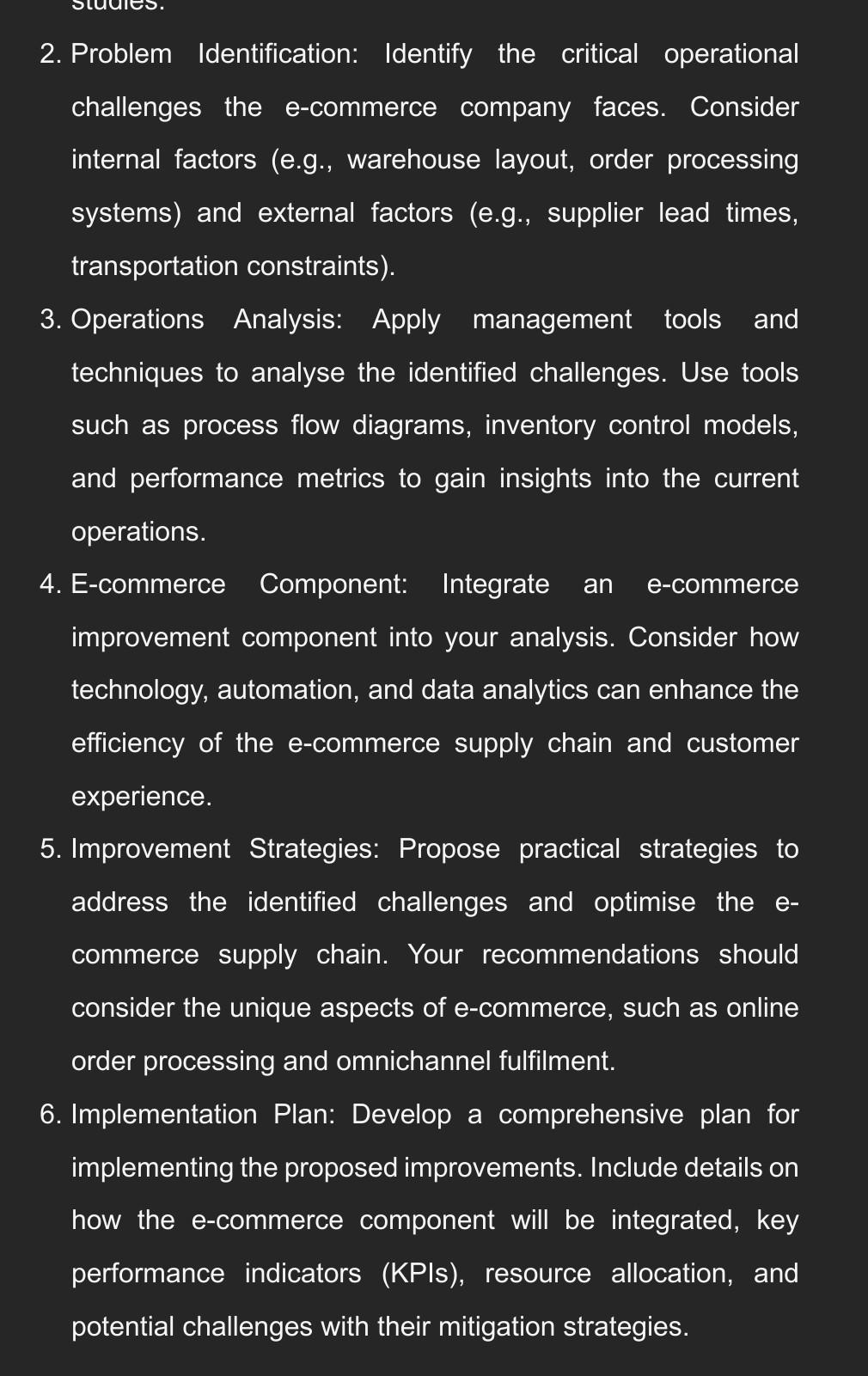
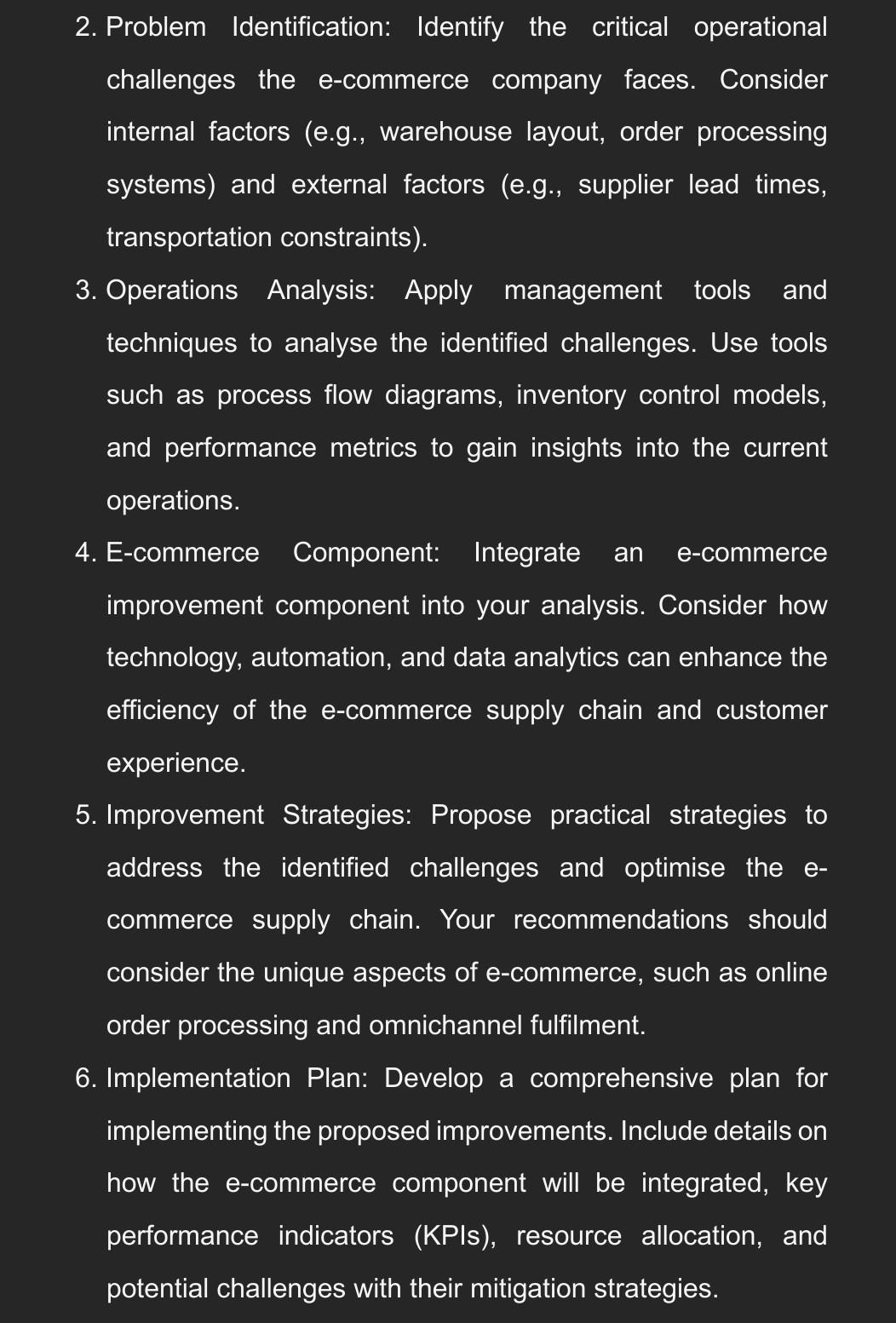
2. Problem Identification: Identify the critical operational challenges the e-commerce company faces. Consider internal factors (e.g., warehouse layout, order processing systems) and external factors (e.g., supplier lead times, transportation constraints). 3. Operations Analysis: Apply management tools and techniques to analyse the identified challenges. Use tools such as process flow diagrams, inventory control models, and performance metrics to gain insights into the current operations. 4. E-commerce Component: Integrate an e-commerce improvement component into your analysis. Consider how technology, automation, and data analytics can enhance the efficiency of the e-commerce supply chain and customer experience. 5. Improvement Strategies: Propose practical strategies to address the identified challenges and optimise the ecommerce supply chain. Your recommendations should consider the unique aspects of e-commerce, such as online order processing and omnichannel fulfilment. 6. Implementation Plan: Develop a comprehensive plan for implementing the proposed improvements. Include details on how the e-commerce component will be integrated, key performance indicators (KPIs), resource allocation, and potential challenges with their mitigation strategies. 2. Problem Identification: Identify the critical operational challenges the e-commerce company faces. Consider internal factors (e.g., warehouse layout, order processing systems) and external factors (e.g., supplier lead times, transportation constraints). 3. Operations Analysis: Apply management tools and techniques to analyse the identified challenges. Use tools such as process flow diagrams, inventory control models, and performance metrics to gain insights into the current operations. 4. E-commerce Component: Integrate an e-commerce improvement component into your analysis. Consider how technology, automation, and data analytics can enhance the efficiency of the e-commerce supply chain and customer experience. 5. Improvement Strategies: Propose practical strategies to address the identified challenges and optimise the ecommerce supply chain. Your recommendations should consider the unique aspects of e-commerce, such as online order processing and omnichannel fulfilment. 6. Implementation Plan: Develop a comprehensive plan for implementing the proposed improvements. Include details on how the e-commerce component will be integrated, key performance indicators (KPIs), resource allocation, and potential challenges with their mitigation strategies
Step by Step Solution
There are 3 Steps involved in it

Get step-by-step solutions from verified subject matter experts
 Study Help