could you help me with the case study questions. Thank you!!!
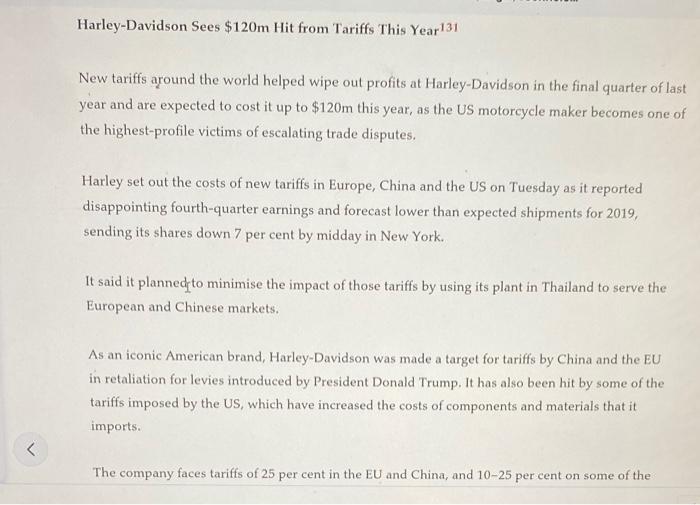
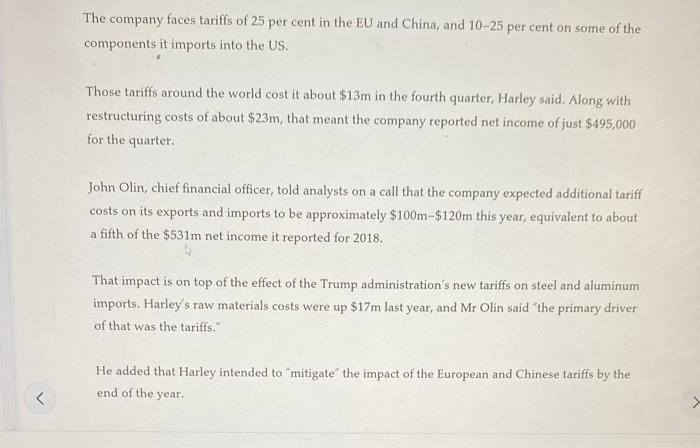
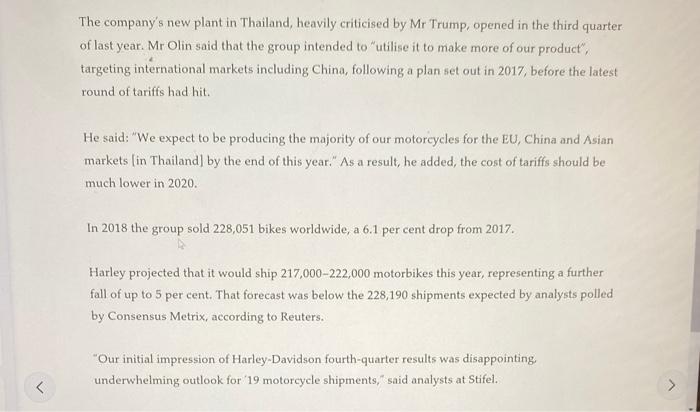
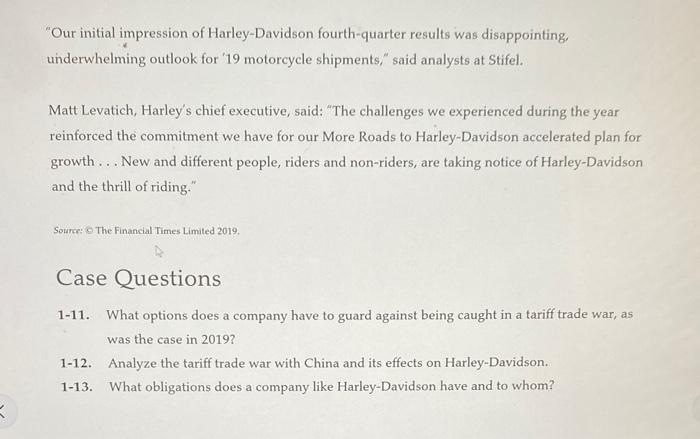
Harley-Davidson Sees $120m Hit from Tariffs This Year131 New tariffs around the world helped wipe out profits at Harley-Davidson in the final quarter of last year and are expected to cost it up to $120m this year, as the US motorcycle maker becomes one of the highest-profile victims of escalating trade disputes. Harley set out the costs of new tariffs in Europe, China and the US on Tuesday as it reported disappointing fourth-quarter earnings and forecast lower than expected shipments for 2019, sending its shares down 7 per cent by midday in New York. It said it planned to minimise the impact of those tariffs by using its plant in Thailand to serve the European and Chinese markets. As an iconic American brand, Harley-Davidson was made a target for tariffs by China and the EU in retaliation for levies introduced by President Donald Trump. It has also been hit by some of the tariffs imposed by the US, which have increased the costs of components and materials that it imports. The company faces tariffs of 25 per cent in the EU and China, and 10-25 per cent on some of the The company faces tariffs of 25 per cent in the EU and China, and 10-25 per cent on some of the components it imports into the US. Those tariffs around the world cost it about $13m in the fourth quarter, Harley said. Along with restructuring costs of about $23m, that meant the company reported net income of just $495,000 for the quarter. John Olin, chief financial officer, told analysts on a call that the company expected additional tariff costs on its exports and imports to be approximately $100m-$120m this year, equivalent to about a fifth of the $531m net income it reported for 2018. That impact is on top of the effect of the Trump administration's new tariffs on steel and aluminum imports. Harley's raw materials costs were up $17m last year, and Mr Olin said the primary driver of that was the tariffs. He added that Harley intended to "mitigate the impact of the European and Chinese tariffs by the end of the year. The company's new plant in Thailand, heavily criticised by Mr Trump, opened in the third quarter of last year. Mr Olin said that the group intended to "utilise it to make more of our product", targeting international markets including China, following a plan set out in 2017, before the latest round of tariffs had hit. He said: "We expect to be producing the majority of our motorcycles for the EU, China and Asian markets (in Thailand) by the end of this year." As a result, he added, the cost of tariffs should be much lower in 2020. In 2018 the group sold 228,051 bikes worldwide, a 6.1 per cent drop from 2017. Harley projected that it would ship 217,000-222,000 motorbikes this year, representing a further fall of up to 5 per cent. That forecast was below the 228,190 shipments expected by analysts polled by Consensus Metrix, according to Reuters. "Our initial impression of Harley-Davidson fourth-quarter results was disappointing, underwhelming outlook for 19 motorcycle shipments," said analysts at Stifel. "Our initial impression of Harley-Davidson fourth-quarter results was disappointing, underwhelming outlook for '19 motorcycle shipments," said analysts at Stifel. Matt Levatich, Harley's chief executive, said: "The challenges we experienced during the year reinforced the commitment we have for our More Roads to Harley-Davidson accelerated plan for growth ... New and different people, riders and non-riders, are taking notice of Harley-Davidson and the thrill of riding." Source: The Financial Times Limited 2019. Case Questions 1-11. What options does a company have to guard against being caught in a tariff trade war, as was the case in 20192 1-12. Analyze the tariff trade war with China and its effects on Harley-Davidson. 1-13. What obligations does a company like Harley-Davidson have and to whom