







Question: Could you please help me with these question so I can prepare for my final 3 problems x 4 points each = 12 points 1)
Could you please help me with these question so I can prepare for my final
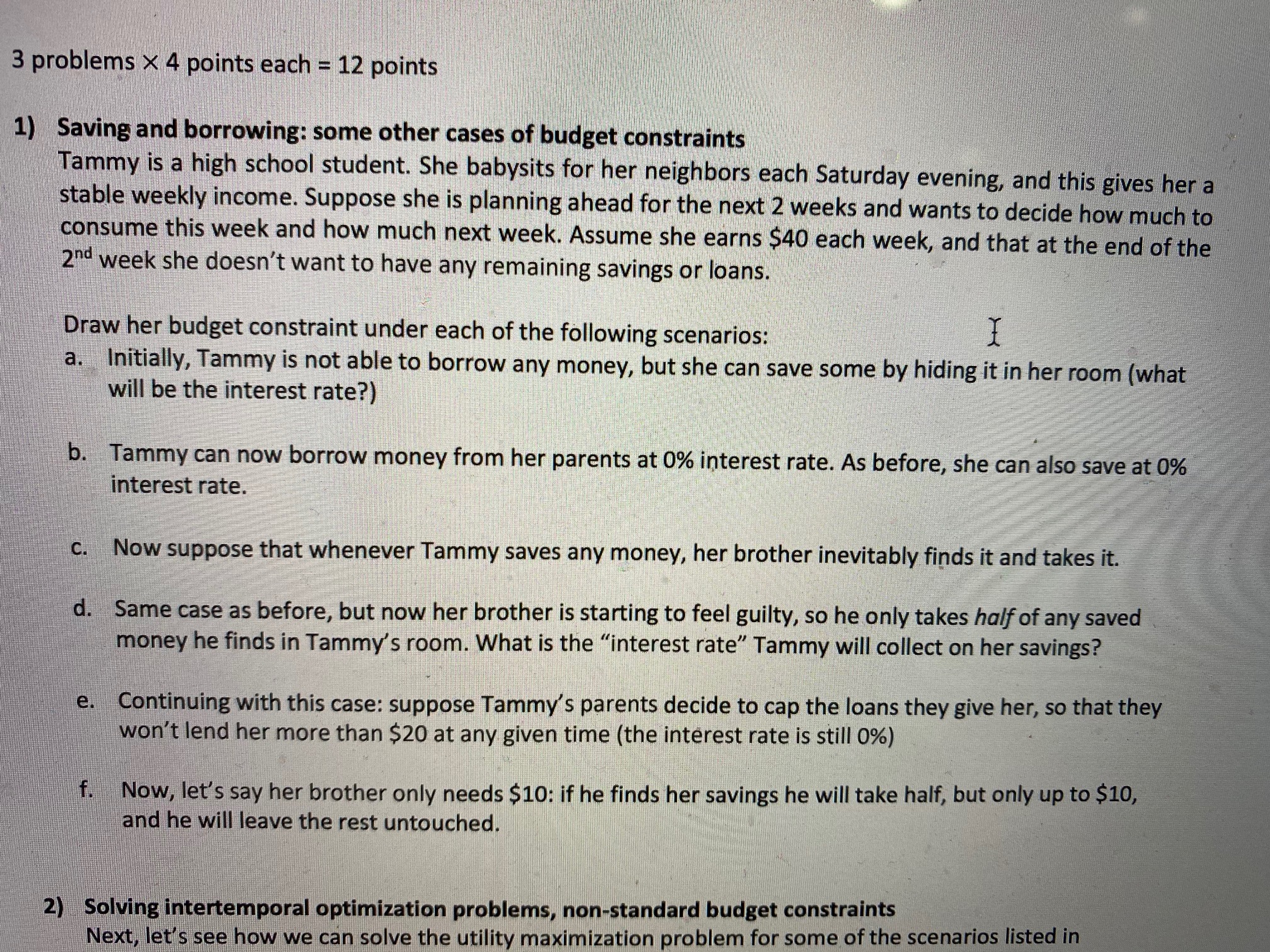
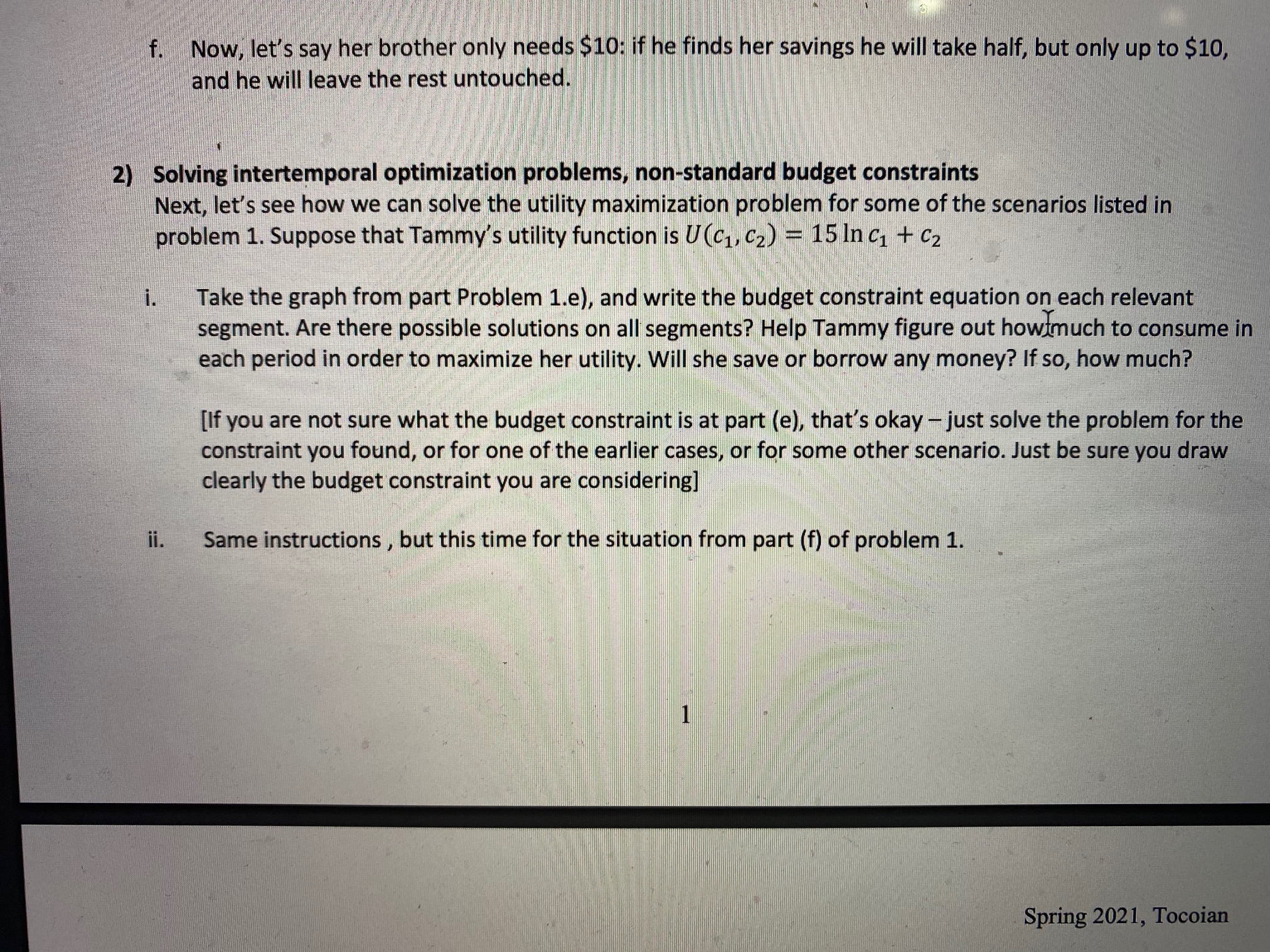
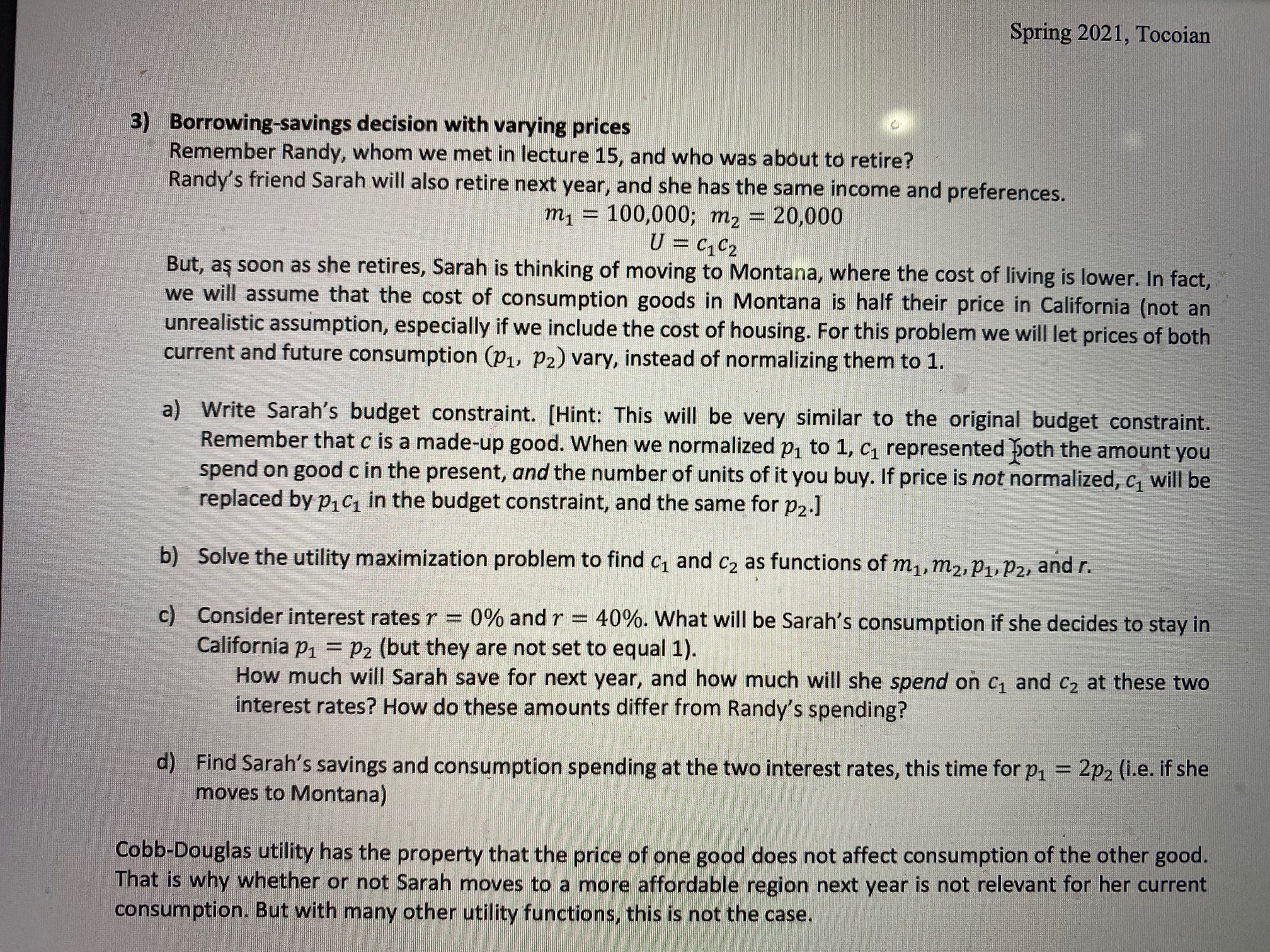
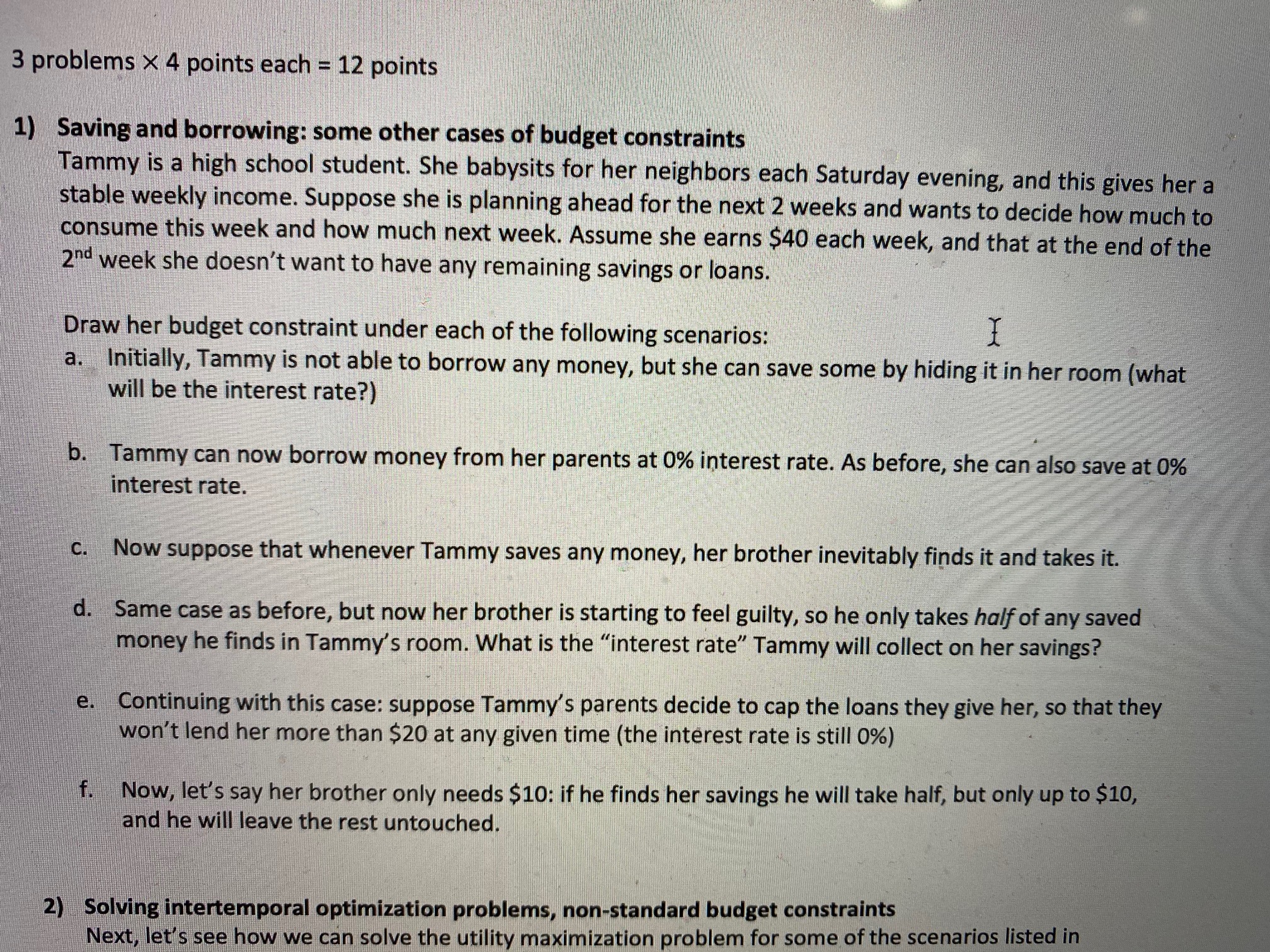
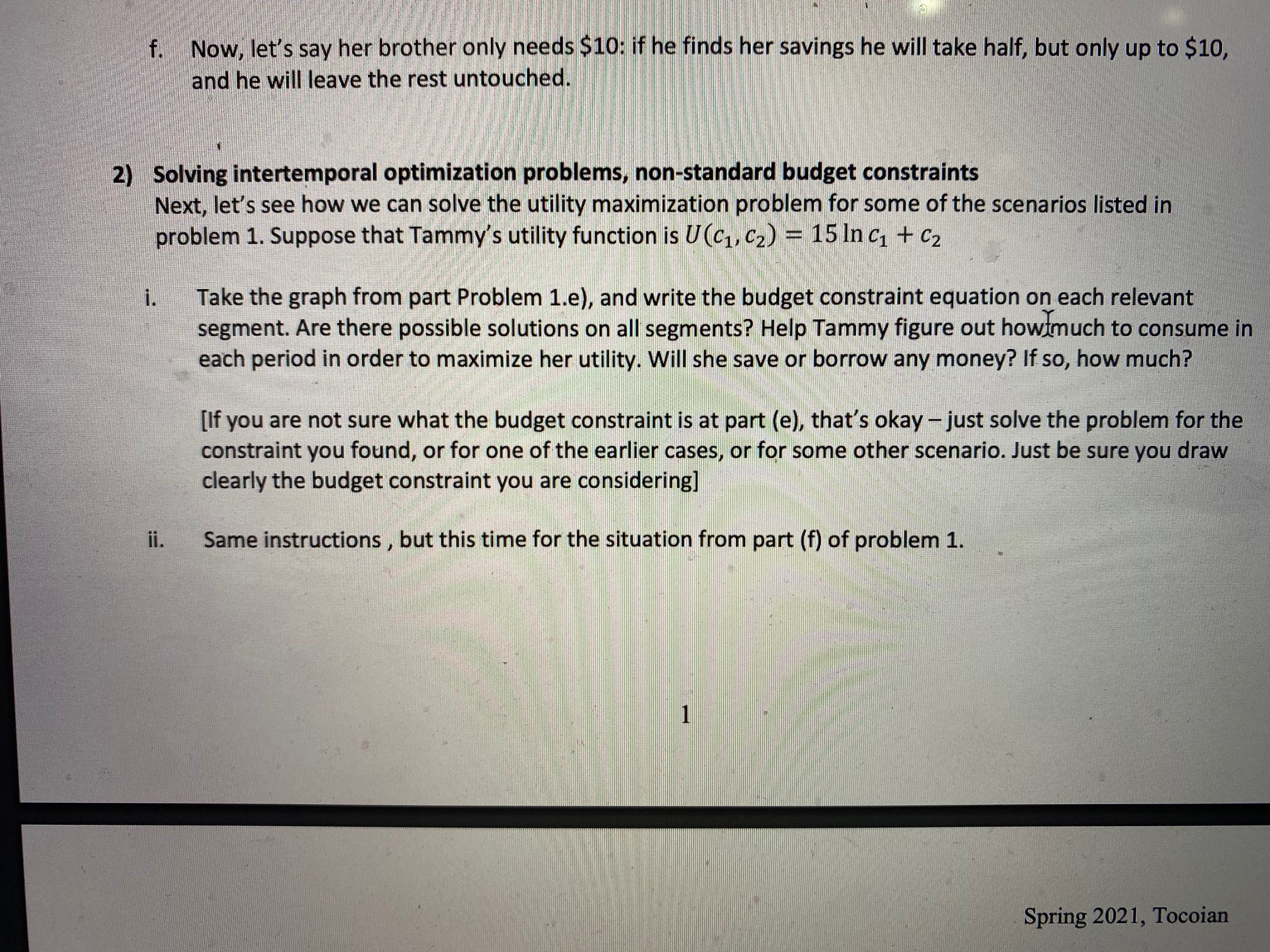
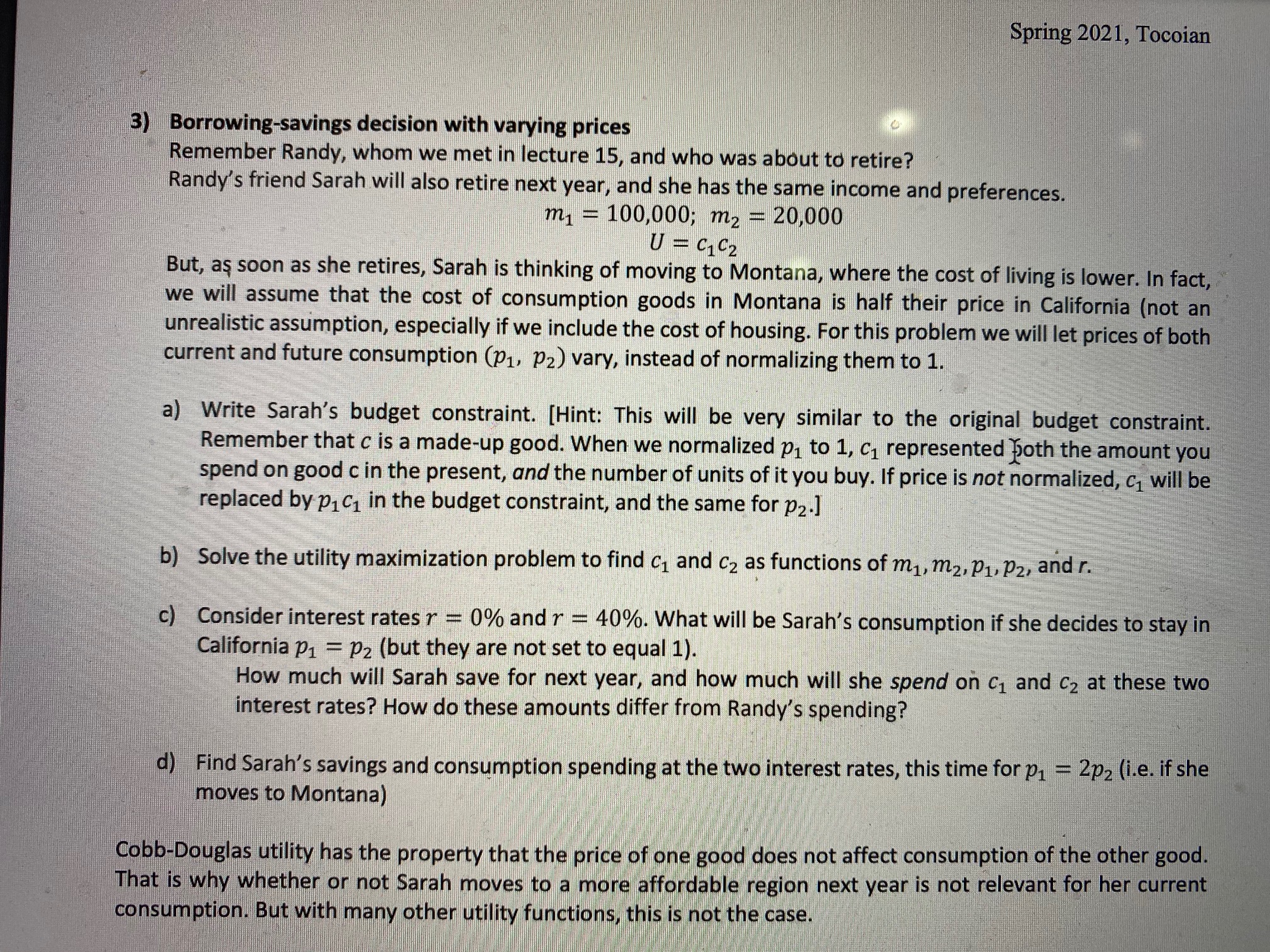
3 problems x 4 points each = 12 points 1) Saving and borrowing: some other cases of budget constraints Tammy is a high school student. She babysits for her neighbors each Saturday evening, and this gives her a stable weekly income. Suppose she is planning ahead for the next 2 weeks and wants to decide how much to consume this week and how much next week. Assume she earns $40 each week, and that at the end of the 2nd week she doesn't want to have any remaining savings or loans. Draw her budget constraint under each of the following scenarios: a. Initially, Tammy is not able to borrow any money, but she can save some by hiding it in her room (what will be the interest rate?) b. Tammy can now borrow money from her parents at 0% interest rate. As before, she can also save at 0% interest rate. c. Now suppose that whenever Tammy saves any money, her brother inevitably finds it and takes it. d. Same case as before, but now her brother is starting to feel guilty, so he only takes half of any saved money he finds in Tammy's room. What is the "interest rate" Tammy will collect on her savings? e. Continuing with this case: suppose Tammy's parents decide to cap the loans they give her, so that they won't lend her more than $20 at any given time (the interest rate is still 0%) .Now, let's say her brother only needs $10: if he finds her savings he will take half, but only up to $10, and he will leave the rest untouched. 2) Solving intertemporal optimization problems, non-standard budget constraints Next, let's see how we can solve the utility maximization problem for some of the scenarios listed inf. Now, let's say her brother only needs $10: if he finds her savings he will take half, but only up to $10, and he will leave the rest untouched. 2) Solving intertemporal optimization problems, non-standard budget constraints Next, let's see how we can solve the utility maximization problem for some of the scenarios listed in problem 1. Suppose that Tammy's utility function is U (c1, C2) = 15 Inc, + C2 i. Take the graph from part Problem 1.e), and write the budget constraint equation on each relevant segment. Are there possible solutions on all segments? Help Tammy figure out howmuch to consume in each period in order to maximize her utility. Will she save or borrow any money? If so, how much? [If you are not sure what the budget constraint is at part (e), that's okay - just solve the problem for the constraint you found, or for one of the earlier cases, or for some other scenario. Just be sure you draw clearly the budget constraint you are considering] ii. Same instructions , but this time for the situation from part (f) of problem 1. Spring 2021, TocoianSpring 2021, Tocoian 3) Borrowing-savings decision with varying prices Remember Randy, whom we met in lecture 15, and who was about to retire? Randy's friend Sarah will also retire next year, and she has the same income and preferences. m1 = 100,000; mz = 20,000 U - C1C2 But, as soon as she retires, Sarah is thinking of moving to Montana, where the cost of living is lower. In fact, we will assume that the cost of consumption goods in Montana is half their price in California (not an unrealistic assumption, especially if we include the cost of housing. For this problem we will let prices of both current and future consumption (P1, P2) vary, instead of normalizing them to 1. a) Write Sarah's budget constraint. [Hint: This will be very similar to the original budget constraint. Remember that c is a made-up good. When we normalized p, to 1, c1 represented poth the amount you spend on good c in the present, and the number of units of it you buy. If price is not normalized, c, will be replaced by p1 1 in the budget constraint, and the same for p2.] b) Solve the utility maximization problem to find c, and c2 as functions of my, mz, P1, P2, and r. c) Consider interest rates r = 0% and r = 40%. What will be Sarah's consumption if she decides to stay in California P1 = P2 (but they are not set to equal 1). How much will Sarah save for next year, and how much will she spend on c1 and C2 at these two interest rates? How do these amounts differ from Randy's spending? d) Find Sarah's savings and consumption spending at the two interest rates, this time for p1 = 2p2 (i.e. if she moves to Montana) Cobb-Douglas utility has the property that the price of one good does not affect consumption of the other good. That is why whether or not Sarah moves to a more affordable region next year is not relevant for her current consumption. But with many other utility functions, this is not the case
Step by Step Solution
There are 3 Steps involved in it

Get step-by-step solutions from verified subject matter experts
 Study Help