







Question: could you please help with both 2 and 3 and explain the answers. thank you! 2. Why do sodium borohydride and lithium tri-sec-butylborohydride produce the
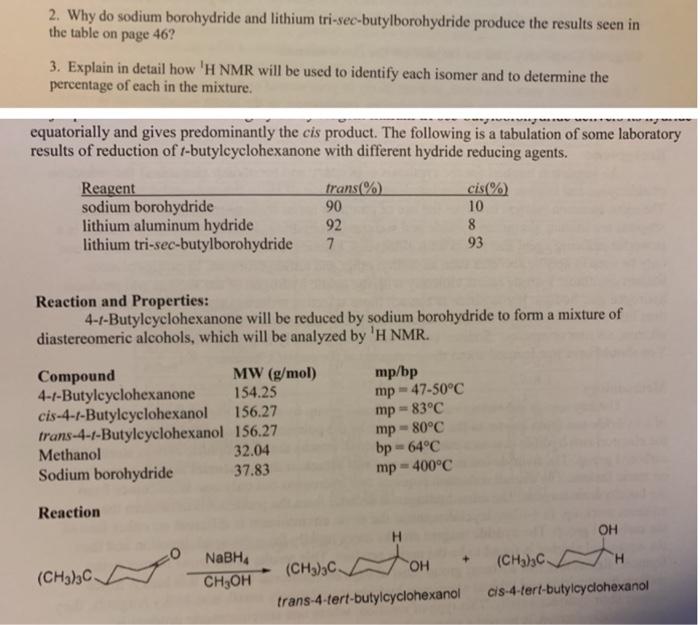
2. Why do sodium borohydride and lithium tri-sec-butylborohydride produce the results seen in the table on page 46? 3. Explain in detail how 'H NMR will be used to identify each isomer and to determine the percentage of each in the mixture. equatorially and gives predominantly the cis product. The following is a tabulation of some laboratory results of reduction of t-butylcyclohexanone with different hydride reducing agents. Reagent sodium borohydride lithium aluminum hydride lithium tri-sec-butylborohydride trans(%) 90 92 7 cis(%) 10 8 93 a Reaction and Properties: 4-1-Butylcyclohexanone will be reduced by sodium borohydride to form a mixture of diastereomeric alcohols, which will be analyzed by 'H NMR. mp/bp Compound MW (g/mol) 4-1-Butylcyclohexanone 154.25 cis-4-1-Butylcyclohexanol 156.27 trans-4-1-Butylcyclohexanol 156.27 Methanol 32.04 Sodium borohydride 37.83 mp = 47-50C mp = 83C mp - 80C bp - 64C mp - 400C Reaction OH + (CH3)3C NaBHA CH3OH (CH3), trans-4-tert-butylcyclohexanol (CH3), cis-4-tert-butylcyclohexanol
Step by Step Solution
There are 3 Steps involved in it

Get step-by-step solutions from verified subject matter experts
 Study Help