



Question: Could you please write it on paper, thanks a lot (c) Define O := Zier Muiv; . Assume the following facts (try to understand why
Could you please write it on paper, thanks a lot
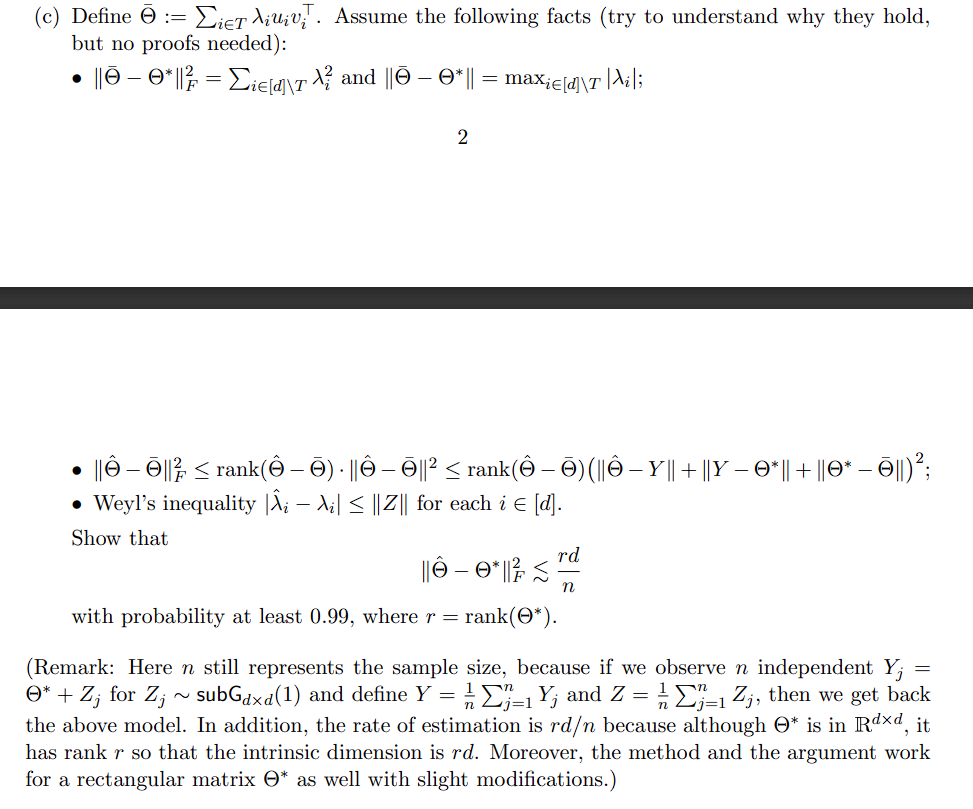
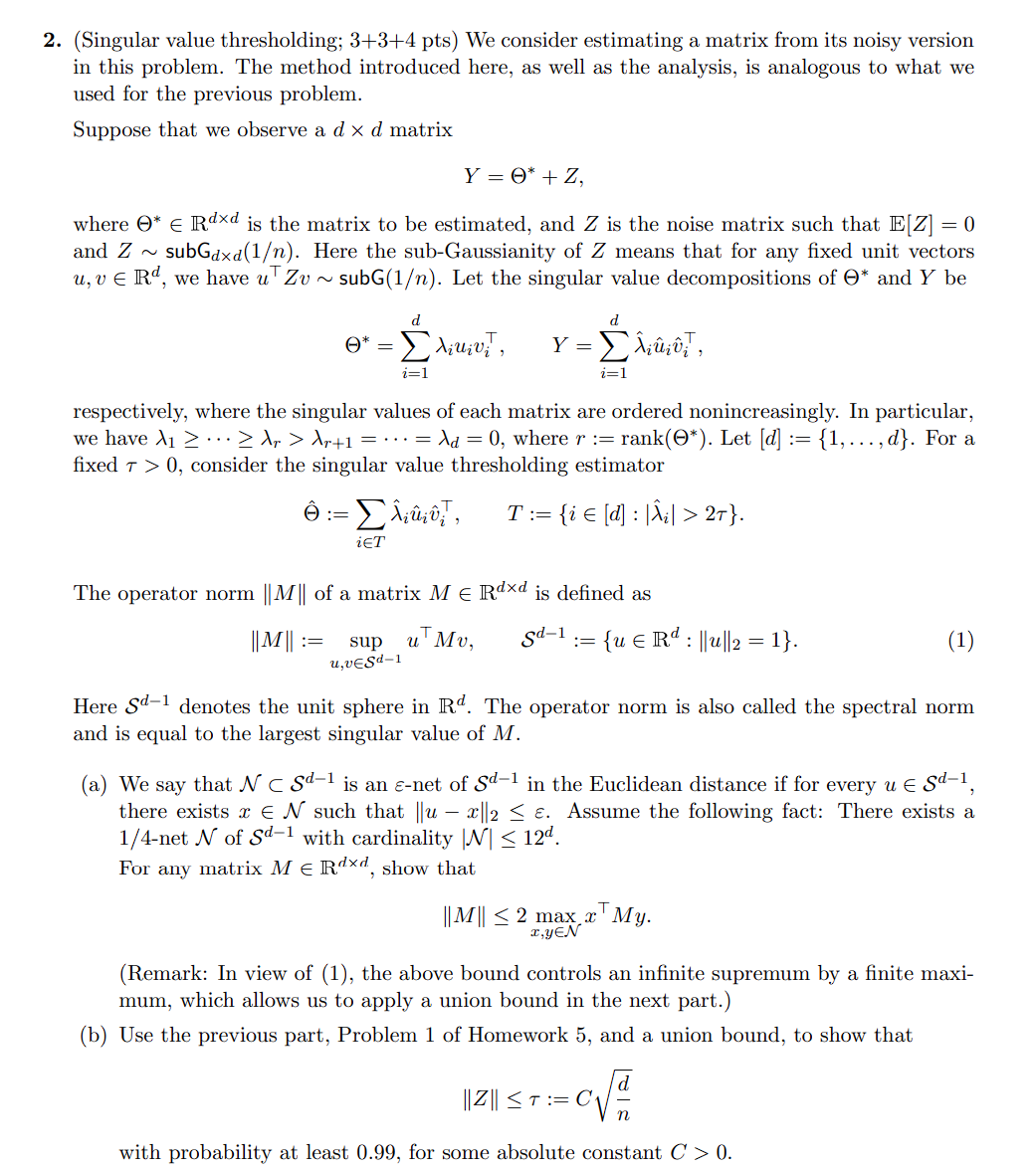
(c) Define O := Zier Muiv; . Assume the following facts (try to understand why they hold, but no proofs needed): . 10 -0*17 = Eiga 7 A? and |0 - 0*1| = maxiEla\\Til; 2 :(lle- ell+ le- xil+ llx-ell)(e-e)quer Salle-ell. (e-e)quer Elle-ell . . Weyl's inequality |di - Ail >}_, Y, and Z = > >"_ Z,, then we get back the above model. In addition, the rate of estimation is rd because although O* is in Rdxd, it has rank r so that the intrinsic dimension is rd. Moreover, the method and the argument work for a rectangular matrix (* as well with slight modifications.)2. (Singular value thresholding; 3+3+4 pts) We consider estimating a matrix from its noisy version in this problem. The method introduced here, as well as the analysis, is analogous to what we used for the previous problem. Suppose that we observe a d x d matrix Y = 0* +Z, where * E Roxd is the matrix to be estimated, and Z is the noise matrix such that E[Z] = 0 and Z ~ subGaxa(1). Here the sub-Gaussianity of Z means that for any fixed unit vectors u, ve Rd, we have u Zu ~ subG(1). Let the singular value decompositions of O* and Y be 9 * ExUUT, Y = CANT, respectively, where the singular values of each matrix are ordered nonincreasingly. In particular, we have 1 2 . . . 2 Ar > Artl = . .. = >d =0, where r := rank(0*). Let [d] := {1, ..., d}. For a fixed T > 0, consider the singular value thresholding estimator 6 := [Nun, T := field] : Wil > 27}. iET The operator norm ||MI| of a matrix M E Rdxd is defined as IM| := sup u Mv, sd-1 := {u ERd : [lul/2 = 1}. (1) u,vESd-1 Here Sd-1 denotes the unit sphere in R . The operator norm is also called the spectral norm and is equal to the largest singular value of M. (a) We say that / c Sd-1 is an E-net of Sd-1 in the Euclidean distance if for every u e Sd-1 there exists x E N such that lu - x/2 0
Step by Step Solution
There are 3 Steps involved in it

Get step-by-step solutions from verified subject matter experts