







Question: // COURSE: Database II - Master of Computer Science // Please read carefully This assignment is about Extendible Hashing. For more information on this topic
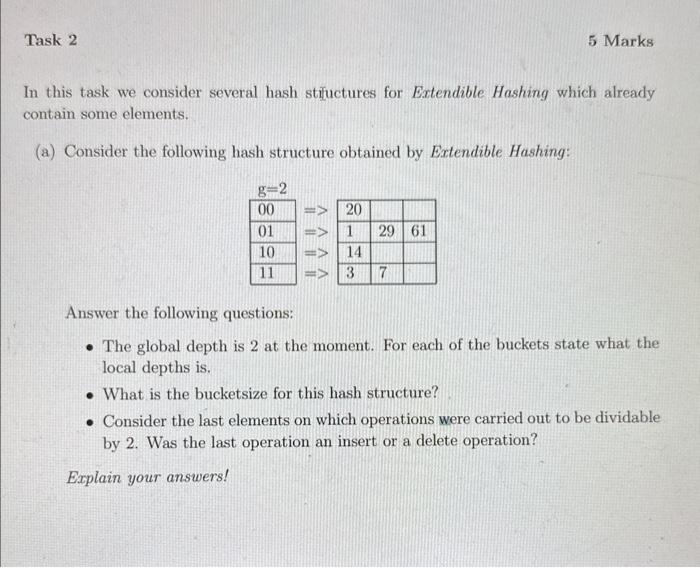
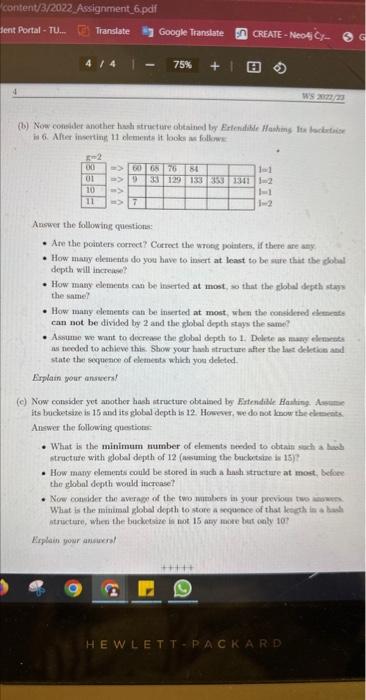
In this task we consider several hash suctures for Extendible Hashing which already contain some elements. (a) Consider the following hash structure obtained by Extendible Hashing: Answer the following questions: - The global depth is 2 at the moment. For each of the buckets state what the local depths is. - What is the bucketsize for this hash structure? - Consider the last elements on which operations were carried out to be dividable by 2. Was the last operation an insert or a delete operation? Explain your answers! (b) Now conosider ancother hashi structare obtainet ly Frienilade Hawing fis lecketaior is 6. After inserting 11 olements it looks as folliwk Answer the following questions: - Are the poubters corroct? Correct the wrotes poiaters, if there are say - How many elenenta do you have to insert at lenst to be aure that the chobal depth will increiose? - How many elements can be inoctied at most, so that the elobel depele stays the same? - How many clesnests can be inserted at most, when the conchlered eberneato can not be divided by 2 and the globel depth stays the same? - Assume wo want to decrease the globol depeh to 1. Dolrte as mary elmonet as necded to achieve this. Show your hath itracture affer the Lot deletion atid state ther seguence of elements which you deleted. Eirolain gour answersi? (c) Now consider yet another hash atructure obtained tw Fifenilial Haaling Alsirec its bucketsine is 16 and its global depth is 12 . However, we do not lanow the elermiate. Answer the following questiotas - What is the minimum number of elements noecled to obitain sach a hack structure with globel depth of 12 (asiaming the barlortsioe an 15)? - How rany olements comld be stored in auch a hash stracture at most, bofore the global depth would incroase? - Now convider the average of the two numbers ia your powioen two anowns. What is the minimal plobal depth to atore a sequence of that keenh in a bach atructure, when the bucketaine in not 15 ary menee bet only 19 ? Erplain your anicueral
Step by Step Solution
There are 3 Steps involved in it

Get step-by-step solutions from verified subject matter experts
 Study Help