







Question: COURSE: Database II - Master of Computer Science please i am looking for the answer of Task 2 tgat cotain (a,b) this is tge
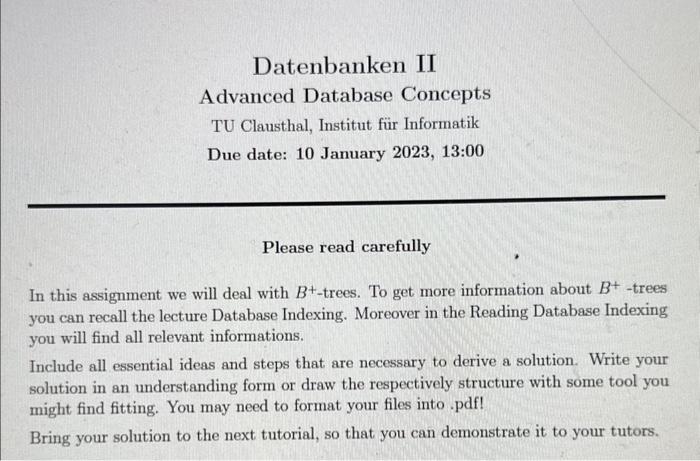
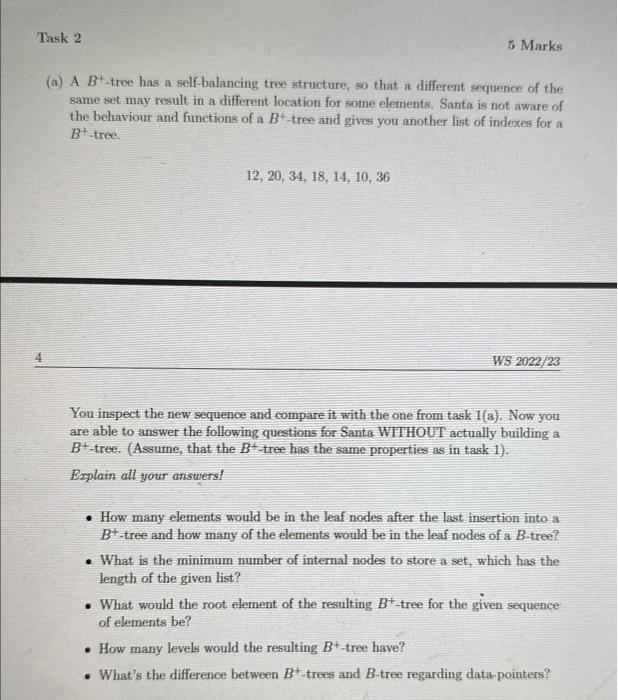
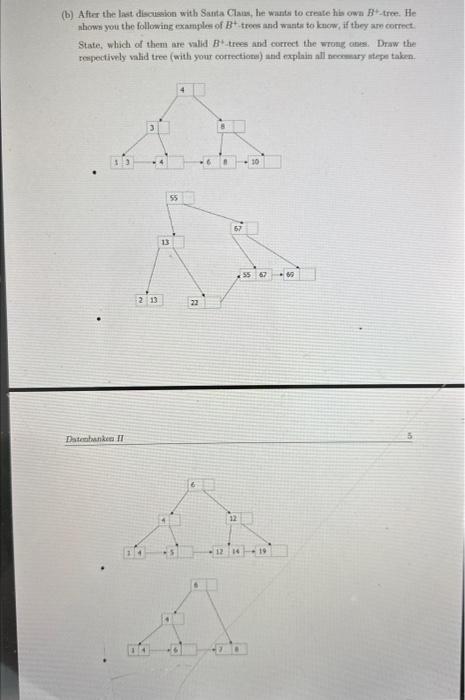
Datenbanken II Advanced Database Concepts TU Clausthal, Institut fr Informatik Due date: 10 January 2023, 13:00 Please read carefully In this assignment we will deal with B+-trees. To get more information about B+-trees you can recall the lecture Database Indexing. Moreover in the Reading Database Indexing you will find all relevant informations. Include all essential ideas and steps that are necessary to derive a solution. Write your solution in an understanding form or draw the respectively structure with some tool you might find fitting. You may need to format your files into .pdf! Bring your solution to the next tutorial, so that you can demonstrate it to your tutors. (a) A B+-tree has a self-balancing tree structure, so that a different sequence of the same set may result in a different location for some elements. Santa is not aware of the behaviour and functions of a B+-tree and gives you another list of indexes for a B+-tree. 12,20,34,18,14,10,36 4 WS 2022/23 You inspect the new sequence and compare it with the one from task 1(a). Now you are able to answer the following questions for Santa WHTHOUT actually building a B+-tree. (Assume, that the B+-tree has the same properties as in task 1). Explain all your answers! - How many elements would be in the leaf nodes after the last insertion into a B+-tree and how many of the elements would be in the leaf nodes of a B-tree? - What is the minimum number of internal nodes to store a set, which has the length of the given list? - What would the root element of the resulting B+-tree for the given sequence of elements be? - How many levels would the resulting B+-tree have? - What's the difference between B+-trees and B-tree regarding data-pointers? (b) After the laat discuseion with Santa Clais, he wants to create his own Bt-troe. He nhows you the following examples of B+- troes and wants to know, if they am correct. State, which of them are valid B-trees and correct the vrong ones. Draw the respoctively valid tree (with your cortections) and explain all nermeary atrpe taken
Step by Step Solution
There are 3 Steps involved in it

Get step-by-step solutions from verified subject matter experts
 Study Help