Question: COURSE NAME: OPERATIONS MANAGEMENT FALL SEMESTER: 2020-21 CASE STUDY (TOTAL WEIGHTAGE: 15) LO-2 +LO-3 = 10+5 = 15% LO-2: Explain the basic tools and techniques
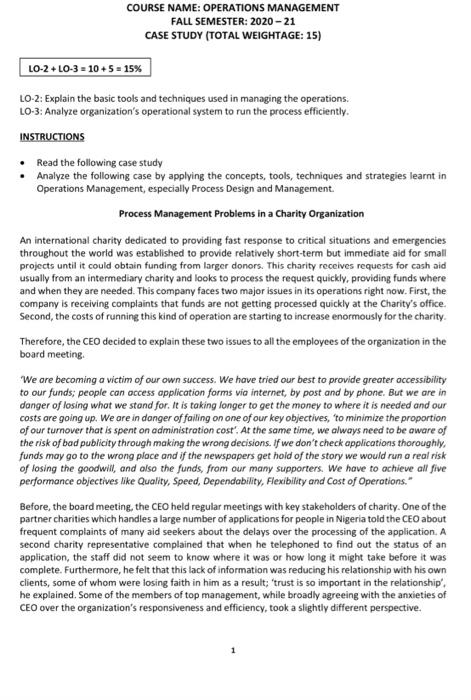
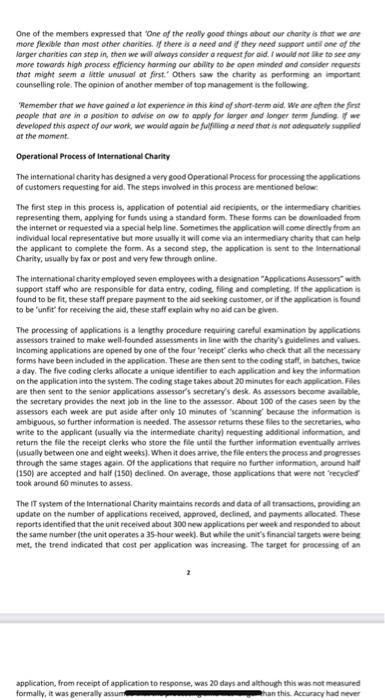
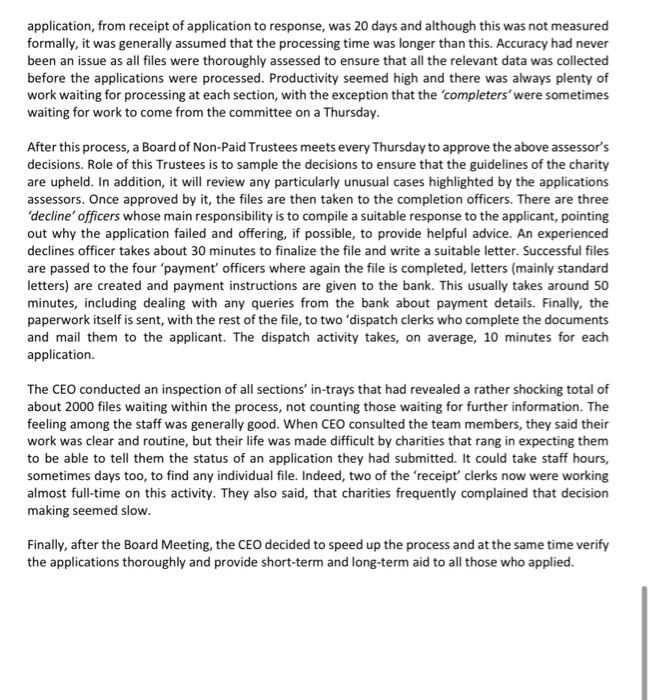
COURSE NAME: OPERATIONS MANAGEMENT FALL SEMESTER: 2020-21 CASE STUDY (TOTAL WEIGHTAGE: 15) LO-2 +LO-3 = 10+5 = 15% LO-2: Explain the basic tools and techniques used in managing the operations. LO-3: Analyze organization's operational system to run the process efficiently. INSTRUCTIONS Read the following case study Analyze the following case by applying the concepts, tools, techniques and strategies learnt in Operations Management, especially Process Design and Management. Process Management Problems in a Charity Organization An international charity dedicated to providing fast response to critical situations and emergencies throughout the world was established to provide relatively short-term but immediate aid for small projects until it could obtain funding from larger donors. This charity receives requests for cash aid usually from an intermediary charity and looks to process the request quickly, providing funds where and when they are needed. This company faces two major issues in its operations right now. First, the company is receiving complaints that funds are not getting processed quickly at the Charity's office. Second, the costs of running this kind of operation are starting to increase enormously for the charity Therefore, the CEO decided to explain these two issues to all the employees of the organization in the board meeting. We are becoming a victim of our own success. We have tried our best to provide greater accessibility to our funds, people can access application forms via internet, by post and by phone. But we are in danger of losing what we stand for. It is taking longer to get the money to where it is needed and our costs are going up. We are in danger of failing on one of our key objectives, to minimize the proportion of our turnover that is spent on administration cost'. At the same time, we always need to be aware of the risk of bad publicity through making the wrong decisions. If we don't check applications thoroughly, funds may go to the wrong place and if the newspapers get hold of the story we would run a real risk of losing the goodwill, and also the funds, from our many supporters. We have to achieve all five performance objectives like Quality, Speed, Dependability, Flexibility and Cost of Operations." Before, the board meeting, the CEO held regular meetings with key stakeholders of charity. One of the partner charities which handles a large number of applications for people in Nigeria told the CEO about frequent complaints of many aid seekers about the delays over the processing of the application. A second charity representative complained that when he telephoned to find out the status of an application, the staff did not seem to know where it was or how long it might take before it was complete. Furthermore, he felt that this lack of information was reducing his relationship with his own clients, some of whom were losing faith in him as a result: 'trust is so important in the relationship'. he explained. Some of the members of top management, while broadly agreeing with the anxieties of CEO over the organization's responsiveness and efficiency, took a slightly different perspective. 1 One of the members expressed that one of the really good things about our charity is that we are more flexible than most other charities. If there is a need and they need support until one of the larger charities can step in, then we will always consider a request for aid. I would not like to see any more towards high process efficiency horming our ability to be open minded and consider requests that might seem a little unusual at first. Others saw the charity as performing an important counselling role. The opinion of another member of top management is the following Remember that we have gained a lot experience in this kind of short-term aid. We are often the first people that are in a position to advise on ow to apply for larger and longer term funding if we developed this aspect of our work, we would again be fulfilling a need that is not adequately supplied at the moment Operational Process of International Charity The international charity has designed a very good Operational Process for processing the applications of customers requesting for aid. The steps involved in this process are mentioned below. The first step in this process is application of potential aid recipients, or the intermediary charities representing them, applying for funds using a standard form. These forms can be downloaded from the internet or requested via a special help line. Sometimes the application will come directly from a individual local representative but more usually it will come via an intermediary charity that can help the applicant to complete the form. As a second step, the application is sent to the International Charity, usually by fax or post and very few through online The International charity employed seven employees with a designation Applications Assessors with support staff who are responsible for data entry, coding filing and completing. If the application is found to be fit, these staff prepare payment to the aid seeking customer, or if the application is found to be unfit for receiving the aid, these staff explain why no aid can be given The processing of applications is a lengthy procedure requiring careful examination by applications assessors trained to make well-founded assessments in line with the charity's guidelines and values Incoming applications are opened by one of the four receipt clerks who check that all the necessary forms have been included in the application. These are then sent to the coding staft,in batches, twice a day. The five coding clerks allocate a unique identifier to each application and key the information on the application into the system. The coding stage takes about 20 minutes for each application Files are then sent to the senior applications assessor's secretary's desk. As assessors become abble the secretary provides the next job in the line to the assessor. About 100 of the cases seen by the assessors each week are put aside after only 10 minutes of 'scanning because the information is ambiguous, so further information is needed. The assessor returns these files to the secretaries, who write to the applicant (usually via the intermediate charity requesting additional information and return the file the receipt clerks who store the file until the further information eventually arrives (usually between one and eight weeks). When it does arrive, the file enters the process and progresses through the same stages again of the applications that require no further information, around half (150) are accepted and half (150) declined. On average, those applications that were not recycled took around 60 minutes to assess The IT system of the International Charity maintains records and data of all transactions, providingan update on the number of applications received, approved, declined, and payments allocated. These reports identified that the unit received about 300 new applications per week and responded to about the same number (the unit operates a 3-hour week). But while the unit's financial targets were being met, the trend indicated that cost per application was increasing. The target for processing of an application from receipt of application to response, was 20 days and although this was not measured formally, it was generally assume han this. Accuracy had never application, from receipt of application to response, was 20 days and although this was not measured formally, it was generally assumed that the processing time was longer than this. Accuracy had never been an issue as all files were thoroughly assessed to ensure that all the relevant data was collected before the applications were processed. Productivity seemed high and there was always plenty of work waiting for processing at each section, with the exception that the completers' were sometimes waiting for work to come from the committee on a Thursday. After this process, a Board of Non-Paid Trustees meets every Thursday to approve the above assessor's decisions. Role of this Trustees is to sample the decisions to ensure that the guidelines of the charity are upheld. In addition, it will review any particularly unusual cases highlighted by the applications assessors. Once approved by it, the files are then taken to the completion officers. There are three 'decline' officers whose main responsibility is to compile a suitable response to the applicant, pointing out why the application failed and offering, if possible, to provide helpful advice. An experienced declines officer takes about 30 minutes to finalize the file and write a suitable letter. Successful files are passed to the four payment officers where again the file is completed, letters (mainly standard letters) are created and payment instructions are given to the bank. This usually takes around 50 minutes, including dealing with any queries from the bank about payment details. Finally, the paperwork itself is sent, with the rest of the file, to two 'dispatch clerks who complete the documents and mail them to the applicant. The dispatch activity takes, on average, 10 minutes for each application. The CEO conducted an inspection of all sections' in-trays that had revealed a rather shocking total of about 2000 files waiting within the process, not counting those waiting for further information. The feeling among the staff was generally good. When CEO consulted the team members, they said their work was clear and routine, but their life was made difficult by charities that rang in expecting them to be able to tell them the status of an application they had submitted. It could take staff hours, sometimes days too, to find any individual file. Indeed, two of the 'receipt' clerks now were working almost full-time on this activity. They also said, that charities frequently complained that decision making seemed slow. Finally, after the Board Meeting, the CEO decided to speed up the process and at the same time verify the applications thoroughly and provide short-term and long-term aid to all those who applied. COURSE NAME: OPERATIONS MANAGEMENT FALL SEMESTER: 2020-21 CASE STUDY (TOTAL WEIGHTAGE: 15) LO-2 +LO-3 = 10+5 = 15% LO-2: Explain the basic tools and techniques used in managing the operations. LO-3: Analyze organization's operational system to run the process efficiently. INSTRUCTIONS Read the following case study Analyze the following case by applying the concepts, tools, techniques and strategies learnt in Operations Management, especially Process Design and Management. Process Management Problems in a Charity Organization An international charity dedicated to providing fast response to critical situations and emergencies throughout the world was established to provide relatively short-term but immediate aid for small projects until it could obtain funding from larger donors. This charity receives requests for cash aid usually from an intermediary charity and looks to process the request quickly, providing funds where and when they are needed. This company faces two major issues in its operations right now. First, the company is receiving complaints that funds are not getting processed quickly at the Charity's office. Second, the costs of running this kind of operation are starting to increase enormously for the charity Therefore, the CEO decided to explain these two issues to all the employees of the organization in the board meeting. We are becoming a victim of our own success. We have tried our best to provide greater accessibility to our funds, people can access application forms via internet, by post and by phone. But we are in danger of losing what we stand for. It is taking longer to get the money to where it is needed and our costs are going up. We are in danger of failing on one of our key objectives, to minimize the proportion of our turnover that is spent on administration cost'. At the same time, we always need to be aware of the risk of bad publicity through making the wrong decisions. If we don't check applications thoroughly, funds may go to the wrong place and if the newspapers get hold of the story we would run a real risk of losing the goodwill, and also the funds, from our many supporters. We have to achieve all five performance objectives like Quality, Speed, Dependability, Flexibility and Cost of Operations." Before, the board meeting, the CEO held regular meetings with key stakeholders of charity. One of the partner charities which handles a large number of applications for people in Nigeria told the CEO about frequent complaints of many aid seekers about the delays over the processing of the application. A second charity representative complained that when he telephoned to find out the status of an application, the staff did not seem to know where it was or how long it might take before it was complete. Furthermore, he felt that this lack of information was reducing his relationship with his own clients, some of whom were losing faith in him as a result: 'trust is so important in the relationship'. he explained. Some of the members of top management, while broadly agreeing with the anxieties of CEO over the organization's responsiveness and efficiency, took a slightly different perspective. 1 One of the members expressed that one of the really good things about our charity is that we are more flexible than most other charities. If there is a need and they need support until one of the larger charities can step in, then we will always consider a request for aid. I would not like to see any more towards high process efficiency horming our ability to be open minded and consider requests that might seem a little unusual at first. Others saw the charity as performing an important counselling role. The opinion of another member of top management is the following Remember that we have gained a lot experience in this kind of short-term aid. We are often the first people that are in a position to advise on ow to apply for larger and longer term funding if we developed this aspect of our work, we would again be fulfilling a need that is not adequately supplied at the moment Operational Process of International Charity The international charity has designed a very good Operational Process for processing the applications of customers requesting for aid. The steps involved in this process are mentioned below. The first step in this process is application of potential aid recipients, or the intermediary charities representing them, applying for funds using a standard form. These forms can be downloaded from the internet or requested via a special help line. Sometimes the application will come directly from a individual local representative but more usually it will come via an intermediary charity that can help the applicant to complete the form. As a second step, the application is sent to the International Charity, usually by fax or post and very few through online The International charity employed seven employees with a designation Applications Assessors with support staff who are responsible for data entry, coding filing and completing. If the application is found to be fit, these staff prepare payment to the aid seeking customer, or if the application is found to be unfit for receiving the aid, these staff explain why no aid can be given The processing of applications is a lengthy procedure requiring careful examination by applications assessors trained to make well-founded assessments in line with the charity's guidelines and values Incoming applications are opened by one of the four receipt clerks who check that all the necessary forms have been included in the application. These are then sent to the coding staft,in batches, twice a day. The five coding clerks allocate a unique identifier to each application and key the information on the application into the system. The coding stage takes about 20 minutes for each application Files are then sent to the senior applications assessor's secretary's desk. As assessors become abble the secretary provides the next job in the line to the assessor. About 100 of the cases seen by the assessors each week are put aside after only 10 minutes of 'scanning because the information is ambiguous, so further information is needed. The assessor returns these files to the secretaries, who write to the applicant (usually via the intermediate charity requesting additional information and return the file the receipt clerks who store the file until the further information eventually arrives (usually between one and eight weeks). When it does arrive, the file enters the process and progresses through the same stages again of the applications that require no further information, around half (150) are accepted and half (150) declined. On average, those applications that were not recycled took around 60 minutes to assess The IT system of the International Charity maintains records and data of all transactions, providingan update on the number of applications received, approved, declined, and payments allocated. These reports identified that the unit received about 300 new applications per week and responded to about the same number (the unit operates a 3-hour week). But while the unit's financial targets were being met, the trend indicated that cost per application was increasing. The target for processing of an application from receipt of application to response, was 20 days and although this was not measured formally, it was generally assume han this. Accuracy had never application, from receipt of application to response, was 20 days and although this was not measured formally, it was generally assumed that the processing time was longer than this. Accuracy had never been an issue as all files were thoroughly assessed to ensure that all the relevant data was collected before the applications were processed. Productivity seemed high and there was always plenty of work waiting for processing at each section, with the exception that the completers' were sometimes waiting for work to come from the committee on a Thursday. After this process, a Board of Non-Paid Trustees meets every Thursday to approve the above assessor's decisions. Role of this Trustees is to sample the decisions to ensure that the guidelines of the charity are upheld. In addition, it will review any particularly unusual cases highlighted by the applications assessors. Once approved by it, the files are then taken to the completion officers. There are three 'decline' officers whose main responsibility is to compile a suitable response to the applicant, pointing out why the application failed and offering, if possible, to provide helpful advice. An experienced declines officer takes about 30 minutes to finalize the file and write a suitable letter. Successful files are passed to the four payment officers where again the file is completed, letters (mainly standard letters) are created and payment instructions are given to the bank. This usually takes around 50 minutes, including dealing with any queries from the bank about payment details. Finally, the paperwork itself is sent, with the rest of the file, to two 'dispatch clerks who complete the documents and mail them to the applicant. The dispatch activity takes, on average, 10 minutes for each application. The CEO conducted an inspection of all sections' in-trays that had revealed a rather shocking total of about 2000 files waiting within the process, not counting those waiting for further information. The feeling among the staff was generally good. When CEO consulted the team members, they said their work was clear and routine, but their life was made difficult by charities that rang in expecting them to be able to tell them the status of an application they had submitted. It could take staff hours, sometimes days too, to find any individual file. Indeed, two of the 'receipt' clerks now were working almost full-time on this activity. They also said, that charities frequently complained that decision making seemed slow. Finally, after the Board Meeting, the CEO decided to speed up the process and at the same time verify the applications thoroughly and provide short-term and long-term aid to all those who applied









 Study Help