





Question: CPM (Critical Path Method) determines the longest path and the critical activities along this path in a project network; the project completion time can't be
CPM (Critical Path Method) determines the longest

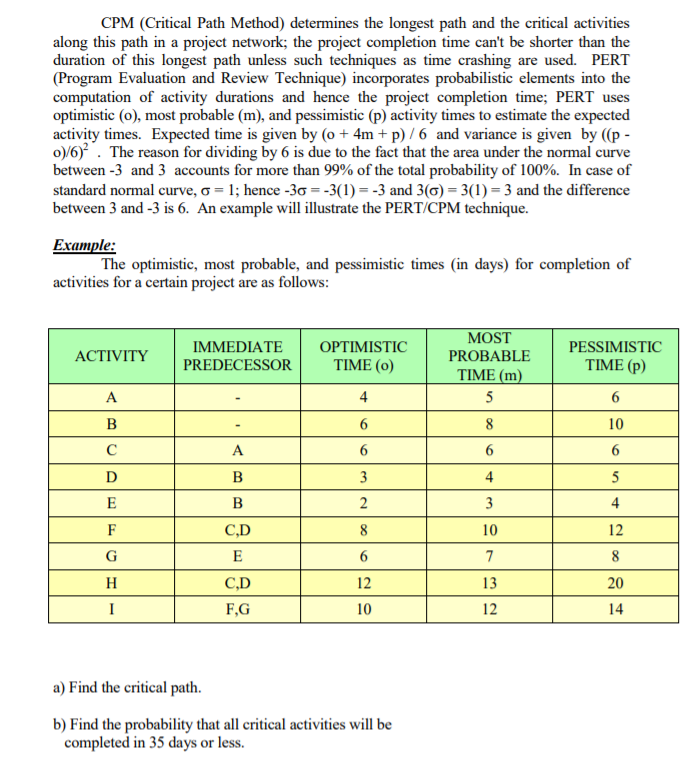
CPM (Critical Path Method) determines the longest path and the critical activities along this path in a project network; the project completion time can't be shorter than the duration of this longest path unless such techniques as time crashing are used. PERT (Program Evaluation and Review Technique) incorporates probabilistic elements into the computation of activity durations and hence the project completion time; PERT uses optimistic (0), most probable (m), and pessimistic (p) activity times to estimate the expected activity times. Expected time is given by (o + 4m + p)/6 and variance is given by ((p - 0)/6). The reason for dividing by 6 is due to the fact that the area under the normal curve between -3 and 3 accounts for more than 99% of the total probability of 100%. In case of standard normal curve, o = 1; hence -36 = -3(1) = -3 and 3(0) = 3(1) = 3 and the difference between 3 and -3 is 6. An example will illustrate the PERT/CPM technique. Example: The optimistic, most probable, and pessimistic times (in days) for completion of activities for a certain project are as follows: ACTIVITY IMMEDIATE PREDECESSOR OPTIMISTIC TIME (O) MOST PROBABLE TIME (m) 5 8 A 4 PESSIMISTIC TIME (p) 6 10 6 B 6 A 6 6 D B 3 4 5 E B 2 3 4 F C,D 8 10 12 G E 6 8 7 13 H 12 CD F G 20 14 I 10 12 a) Find the critical path. b) Find the probability that all critical activities will be completed in 35 days or less

Step by Step Solution

There are 3 Steps involved in it

1 Expert Approved Answer
Step: 1 Unlock blur-text-image

Question Has Been Solved by an Expert!

Get step-by-step solutions from verified subject matter experts

Step: 2 Unlock
Step: 3 Unlock

Students Have Also Explored These Related General Management Questions!