







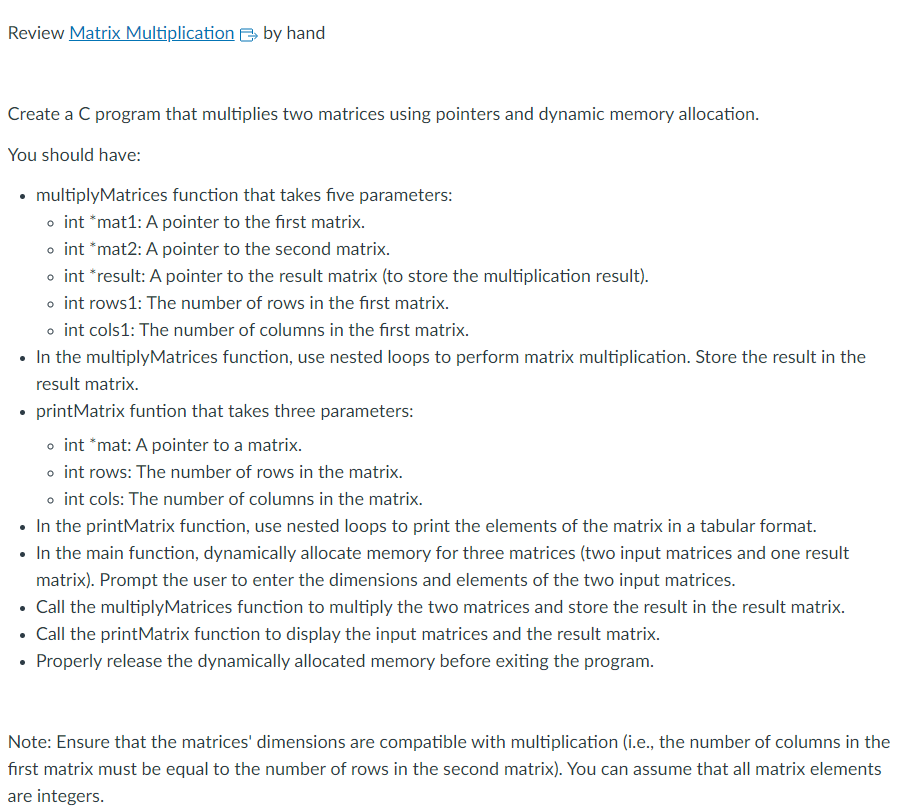
Question: Create a C program that multiplies two matrices using pointers and dynamic memory allocation. You should have: multiplyMatrices function that takes five parameters: int *
Create a C program that multiplies two matrices using pointers and dynamic memory allocation.
You should have:
multiplyMatrices function that takes five parameters:
int mat: A pointer to the first matrix.
int mat: A pointer to the second matrix.
int result: A pointer to the result matrix to store the multiplication result
int rows: The number of rows in the first matrix.
int cols: The number of columns in the first matrix.
In the multiplyMatrices function, use nested loops to perform matrix multiplication. Store the result in the
result matrix.
printMatrix funtion that takes three parameters:
@ int mat: A pointer to a matrix.
int rows: The number of rows in the matrix.
int cols: The number of columns in the matrix.
In the printMatrix function, use nested loops to print the elements of the matrix in a tabular format.
In the main function, dynamically allocate memory for three matrices two input matrices and one result
matrix Prompt the user to enter the dimensions and elements of the two input matrices.
Call the multiplyMatrices function to multiply the two matrices and store the result in the result matrix.
Call the printMatrix function to display the input matrices and the result matrix.
Properly release the dynamically allocated memory before exiting the program.
Note: Ensure that the matrices' dimensions are compatible with multiplication ie the number of columns in the
first matrix must be equal to the number of rows in the second matrix You can assume that all matrix elements
are integers.
Step by Step Solution
There are 3 Steps involved in it
1 Expert Approved Answer
Step: 1 Unlock

Question Has Been Solved by an Expert!
Get step-by-step solutions from verified subject matter experts
Step: 2 Unlock
Step: 3 Unlock
 Study Help