







Question: create a conclusion based on this image Chronic obstructive pulmonary disease (COPD) is a preventable and curable pulmonary condition marked by persistent airflow restriction that
create a conclusion based on this image
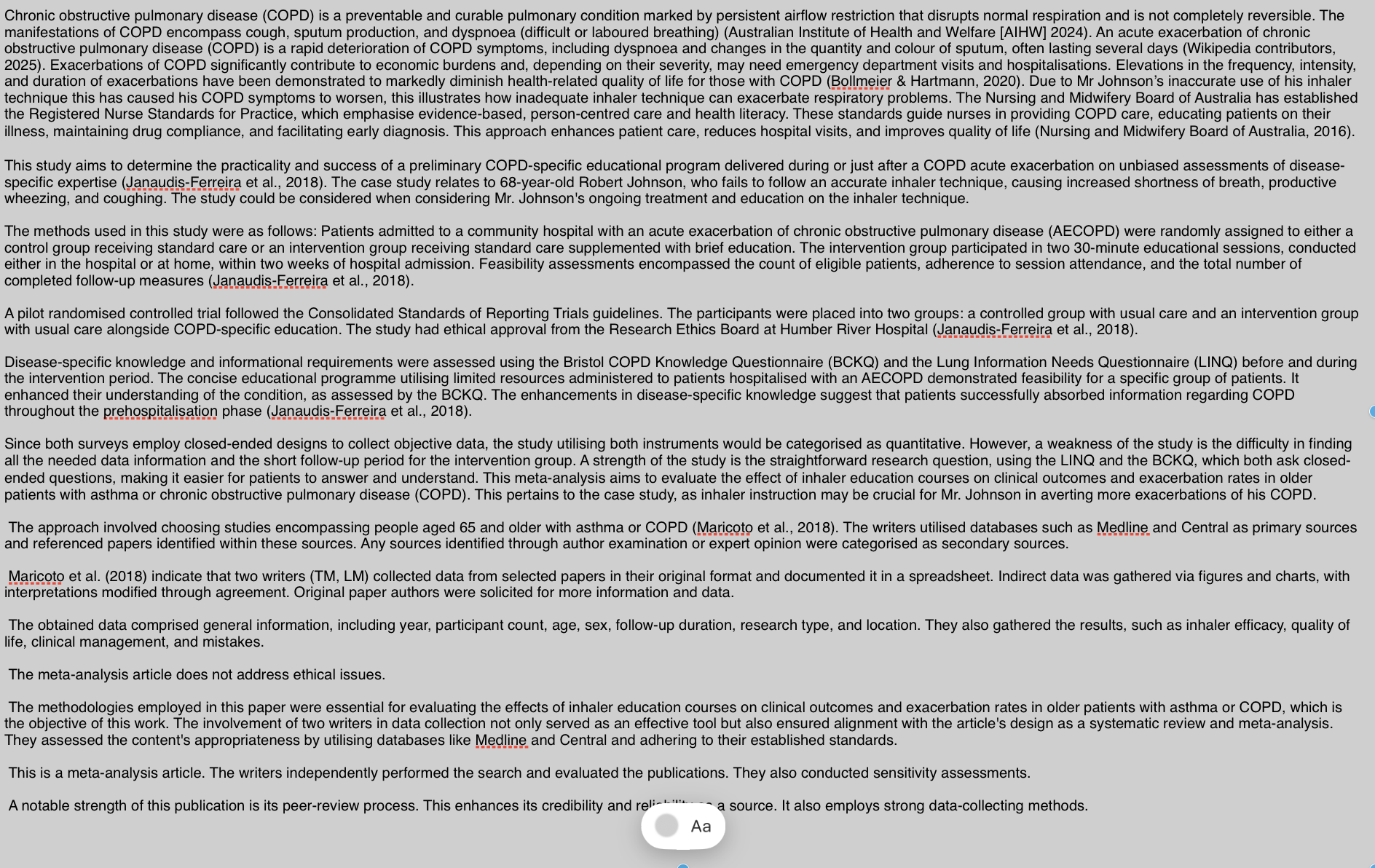
Chronic obstructive pulmonary disease (COPD) is a preventable and curable pulmonary condition marked by persistent airflow restriction that disrupts normal respiration and is not completely reversible. The manifestations of COPD encompass cough, sputum production, and dyspnoea (difficult or laboured breathing) (Australian Institute of Health and Welfare [AIHW] 2024). An acute exacerbation of chronic obstructive pulmonary disease (COPD) is a rapid deterioration of COPD symptoms, including dyspnoea and changes in the quantity and colour of sputum, often lasting several days (Wikipedia contributors, 2025). Exacerbations of COPD significantly contribute to economic burdens and, depending on their severity, may need emergency department visits and hospitalisations. Elevations in the frequency, intensity, and duration of exacerbations have been demonstrated to markedly diminish health-related quality of life for those with COPD (Bollmeier & Hartmann, 2020). Due to Mr Johnson's inaccurate use of his inhaler technique this has caused his COPD symptoms to worsen, this illustrates how inadequate inhaler technique can exacerbate respiratory problems. The Nursing and Midwifery Board of Australia has established the Registered Nurse Standards for Practice, which emphasise evidence-based, person-centred care and health literacy. These standards guide nurses in providing COPD care, educating patients on their illness, maintaining drug compliance, and facilitating early diagnosis. This approach enhances patient care, reduces hospital visits, and improves quality of life (Nursing and Midwifery Board of Australia, 2016). This study aims to determine the practicality and success of a preliminary COPD-specific educational program delivered during or just after a COPD acute exacerbation on unbiased assessments of disease- specific expertise (Janaudis-Ferreira et al., 2018). The case study relates to 68-year-old Robert Johnson, who fails to follow an accurate inhaler technique, causing increased shortness of breath, productive wheezing, and coughing. The study could be considered when considering Mr. Johnson's ongoing treatment and education on the inhaler technique. The methods used in this study were as follows: Patients admitted to a community hospital with an acute exacerbation of chronic obstructive pulmonary disease (AECOPD) were randomly assigned to either a control group receiving standard care or an intervention group receiving standard care supplemented with brief education. The intervention group participated in two 30-minute educational sessions, conducted either in the hospital or at home, within two weeks of hospital admission. Feasibility assessments encompassed the count of eligible patients, adherence to session attendance, and the total number of completed follow-up measures (Janaudis-Ferreira et al., 2018). A pilot randomised controlled trial followed the Consolidated Standards of Reporting Trials guidelines. The participants were placed into two groups: a controlled group with usual care and an intervention group with usual care alongside COPD-specific education. The study had ethical approval from the Research Ethics Board at Humber River Hospital (Janaudis-Ferreira et al., 2018). Disease-specific knowledge and informational requirements were assessed using the Bristol COPD Knowledge Questionnaire (BCKQ) and the Lung Information Needs Questionnaire (LINQ) before and during the intervention period. The concise educational programme utilising limited resources administered to patients hospitalised with an AECOPD demonstrated feasibility for a specific group of patients. It enhanced their understanding of the condition, as assessed by the BCKQ. The enhancements in disease-specific knowledge suggest that patients successfully absorbed information regarding COPD throughout the prehospitalisation phase (Janaudis-Ferreira et al., 2018). Since both surveys employ closed-ended designs to collect objective data, the study utilising both instruments would be categorised as quantitative. However, a weakness of the study is the difficulty in finding all the needed data information and the short follow-up period for the intervention group. A strength of the study is the straightforward research question, using the LINQ and the BCKQ, which both ask closed- ended questions, making it easier for patients to answer and understand. This meta-analysis aims to evaluate the effect of inhaler education courses on clinical outcomes and exacerbation rates in older patients with asthma or chronic obstructive pulmonary disease (COPD). This pertains to the case study, as inhaler instruction may be crucial for Mr. Johnson in averting more exacerbations of his COPD. The approach involved choosing studies encompassing people aged 65 and older with asthma or COPD (Maricoto et al., 2018). The writers utilised databases such as Medline and Central as primary sources and referenced papers identified within these sources. Any sources identified through author examination or expert opinion were categorised as secondary sources. Maricoto et al. (2018) indicate that two writers (TM, LM) collected data from selected papers in their original format and documented it in a spreadsheet. Indirect data was gathered via figures and charts, with nterpretations modified through agreement. Original paper authors were solicited for more information and data. The obtained data comprised general information, including year, participant count, age, sex, follow-up duration, research type, and location. They also gathered the results, such as inhaler efficacy, quality of life, clinical management, and mistakes. The meta-analysis article does not address ethical issues. The methodologies employed in this paper were essential for evaluating the effects of inhaler education courses on clinical outcomes and exacerbation rates in older patients with asthma or COPD, which is the objective of this work. The involvement of two writers in data collection not only served as an effective tool but also ensured alignment with the article's design as a systematic review and meta-analysis. They assessed the content's appropriateness by utilising databases like Medline and Central and adhering to their established standards. This is a meta-analysis article. The writers independently performed the search and evaluated the publications. They also conducted sensitivity assessments. A notable strength of this publication is its peer-review process. This enhances its credibility and reli- a source. It also employs strong data-collecting methods. Aa
Step by Step Solution
There are 3 Steps involved in it

Get step-by-step solutions from verified subject matter experts
 Study Help