







Question: Create a DAG that defines a linear ordering (topological sort) for the following computer science courses. Courses numbered 500, 501, 502, and 512 must be
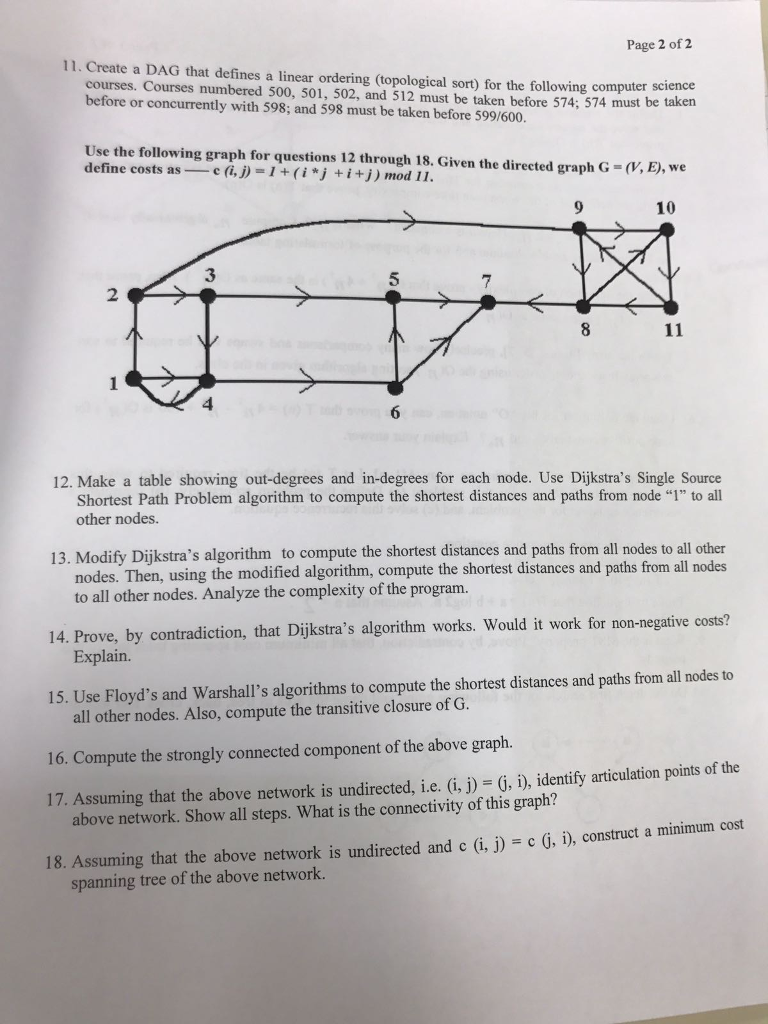
Create a DAG that defines a linear ordering (topological sort) for the following computer science courses. Courses numbered 500, 501, 502, and 512 must be taken before 574: 574 must be taken before or concurrently with 598: and 598 must be taken before 599/600. Use the following graph for questions 12 through 18. Given the directed graph G = (V, E), we define costs as - c(I, j) = 1 + (i * j + i + j) mod 11. Make a table showing out-degrees and in-degrees for each node. Use Dijkstra's Single Source Shortest Path Problem algorithm to compute the shortest distances and paths from node "1" to all other nodes. Modify Dijkstra's algorithm to compute the shortest distances and paths from all nodes to all other nodes. Then, using the modified algorithm, compute the shortest distances and paths from all nodes to all other nodes. Analyze the complexity of the program. Prove, by contradiction, that Dijkstra's algorithm works. Would it work for non-negative costs? Explain. Use Floyd's and Warshall's algorithms to compute the shortest distances and paths from all nodes to all other nodes. Also, compute the transitive closure G. Compute the strongly connected component of the above graph. Assuming that the above network is undirected, i.e. (i, j) = (j, i), identify articulation points of the above network. Show all steps. What is the connectivity of this graph? Assuming that the above network is undirected and c (i, j) = c (j, i), construct a minimum cost spanning tree of the above network
Step by Step Solution
There are 3 Steps involved in it

Get step-by-step solutions from verified subject matter experts
 Study Help