







Question: Create a logical ERD for each of the problems on the following pages using the crowsfoot notation discussed in class. Be sure that each entity
Create a logical ERD for each of the problems on the following pages using the crowsfoot notation discussed in class. Be sure that each entity has the entity name at the top of the box, the primary key attribute or attributes in the middle of the box, and the non-primary key attributes in the bottom of the box. Lines should separate each part of the entity box. Follow these instructions about each ERD: The ERD should not have any many-to-many (M:N) relationships. Seriously. No M:N relationships. All attributes should be placed within an entity. Each entity must have a primary key defined. A primary key may consist of one or more attributes. Each relationship must have a foreign key. Denote the foreign key(s) with the notation (FK) on the ERD. It is not necessary to number the foreign keys. Each relationship must include both a maximum and minimum cardinality for both sides of the relationship. Each relationship must have a relationship verb. Keep in mind that 1:1 relationships are rare. Make sure that you carefully scrutinize any 1:1 relationships to ensure that they are actually 1:1.
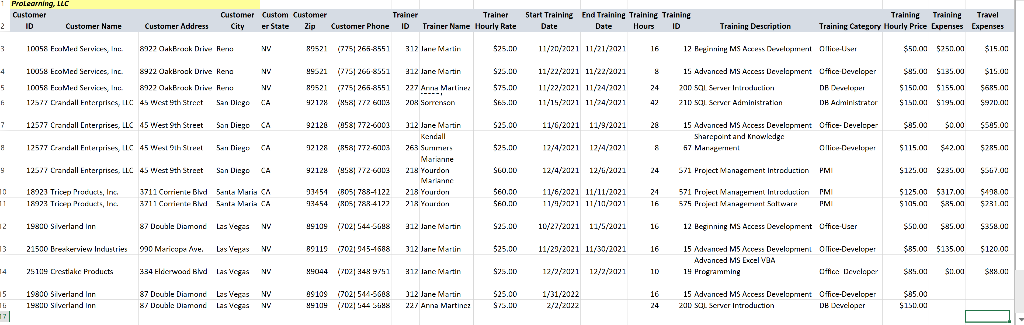
Question #1. Design a database for ProLearning, a company that provides training services. ProLearning plans to use this database to keep track of: customers and potential customers, trainers, training offered and training categories, scheduled training, and expenses related to a specific training event. Each row in the worksheet represents one training class (called a training event) conducted by ProLearning. There is currently no unique identifier for a training event, but it is recommended that you create one like an EventID. Here are some business rules about the sample data: A customer has only one address and phone number. A customer is an organization rather than an individual person. The hourly price of training is related to the Training Type. In other words, the hourly price does not change if different trainers conduct the same course. The training expenses and travel expenses fluctuate by each different training event. For example in the sample data, the training expenses for Beginning MS Access Development were $250 for one training event while they were $85 for a different offering of that same course. The database must store the training expenses and travel expenses for each training event, rather than for a type of training event. The hourly rate paid to a trainer is related to a trainer. A trainer only has one hourly rate. If the end training date is null on the spreadsheet, then the training event has not yet occurred but is scheduled to occur. The training category is related to the type of training (as made unique by the trainingID). The company keeps track of only one category per specific type of training class. Create sample data tables for your final data model showing how all the data in ProLearningData spreadsheet will be stored among your newly designed tables. Make sure you include data for foreign keys as necessary to support the relationships on your data model (ERD).
Step by Step Solution
There are 3 Steps involved in it

Get step-by-step solutions from verified subject matter experts
 Study Help