







Question: Create a visual representation as well as a description to show the potential energy of electrochemical gradients. 6. When the potential energy is harvested by
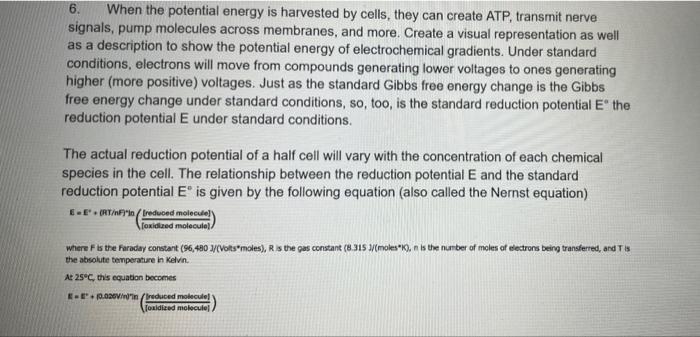
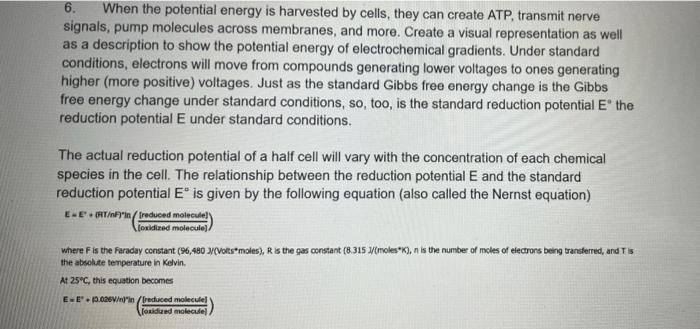
6. When the potential energy is harvested by cells, they can create ATP, transmit nerve signals, pump molecules across membranes, and more. Create a visual representation as well as a description to show the potential energy of electrochemical gradients. Under standard conditions, electrons will move from compounds generating lower voltages to ones generating higher (more positive) voltages. Just as the standard Gibbs free energy change is the Gibbs free energy change under standard conditions, so, too, is the standard reduction potential Ethe reduction potential E under standard conditions. The actual reduction potential of a half cell will vary with the concentration of each chemical species in the cell. The relationship between the reduction potential E and the standard reduction potential E is given by the following equation (also called the Nernst equation) E-FORT/FI/Ereduced molecule! Toxidized moleculel where is the Faraday constant (96,480 /(Volts*moles), is the gas constant (8.315 W/(moles, n is the number of moles of dectrons being transferred, and is the absolute temperature in Kelvin At 25C, this equation becomes -0.026Vind 'n reduced molecule Toxidized molecule 6. When the potential energy is harvested by cells, they can create ATP, transmit nerve signals, pump molecules across membranes, and more. Create a visual representation as well as a description to show the potential energy of electrochemical gradients. Under standard conditions, electrons will move from compounds generating lower voltages to ones generating higher (more positive) voltages. Just as the standard Gibbs free energy change is the Gibbs free energy change under standard conditions, so, too, is the standard reduction potential E' the reduction potential E under standard conditions. The actual reduction potential of a half cell will vary with the concentration of each chemical species in the cell. The relationship between the reduction potential E and the standard reduction potential E is given by the following equation (also called the Nernst equation) E-ET/Introduced molecule Coxidized molecule) where Fis the Faraday constant (96,480 [Vots+moles), R is the gas constant (8.315 Ymolesk, n is the number of moles of electrons being transferred, and T the absolute temperature in Kelvin At 25C, this equation becomes E.E'.."in reduced molecule Joxidued molecude 6. When the potential energy is harvested by cells, they can create ATP, transmit nerve signals, pump molecules across membranes, and more. Create a visual representation as well as a description to show the potential energy of electrochemical gradients. Under standard conditions, electrons will move from compounds generating lower voltages to ones generating higher (more positive) voltages. Just as the standard Gibbs free energy change is the Gibbs free energy change under standard conditions, so, too, is the standard reduction potential Ethe reduction potential E under standard conditions. The actual reduction potential of a half cell will vary with the concentration of each chemical species in the cell. The relationship between the reduction potential E and the standard reduction potential E is given by the following equation (also called the Nernst equation) E-FORT/FI/Ereduced molecule! Toxidized moleculel where is the Faraday constant (96,480 /(Volts*moles), is the gas constant (8.315 W/(moles, n is the number of moles of dectrons being transferred, and is the absolute temperature in Kelvin At 25C, this equation becomes -0.026Vind 'n reduced molecule Toxidized molecule 6. When the potential energy is harvested by cells, they can create ATP, transmit nerve signals, pump molecules across membranes, and more. Create a visual representation as well as a description to show the potential energy of electrochemical gradients. Under standard conditions, electrons will move from compounds generating lower voltages to ones generating higher (more positive) voltages. Just as the standard Gibbs free energy change is the Gibbs free energy change under standard conditions, so, too, is the standard reduction potential E' the reduction potential E under standard conditions. The actual reduction potential of a half cell will vary with the concentration of each chemical species in the cell. The relationship between the reduction potential E and the standard reduction potential E is given by the following equation (also called the Nernst equation) E-ET/Introduced molecule Coxidized molecule) where Fis the Faraday constant (96,480 [Vots+moles), R is the gas constant (8.315 Ymolesk, n is the number of moles of electrons being transferred, and T the absolute temperature in Kelvin At 25C, this equation becomes E.E'.."in reduced molecule Joxidued molecude
Step by Step Solution
There are 3 Steps involved in it

Get step-by-step solutions from verified subject matter experts
 Study Help