







Question: Create an algorithm that compares timings for functions and determines whether or not a string is an anagram: INSTRUCTIONS (Please read through all of this)
Create an algorithm that compares timings for functions and determines whether or not a string is an anagram:\
INSTRUCTIONS (Please read through all of this)
-The program should have anagram Solution1, 2, 3, and 4 represent these four strategies as included; checking letters off from a first string that occur within the second string; sorting and then comparing the two strings; comparing the first string with each possible permutation of the letters in the second string; and counting the frequency of each letter in each string.
-Write sentences and paragraphs in your .txt or .docx discussion file, your discussion should be no longer than one page long.
Also included in the instructions:
If you're going to help, PLEASEEE explain what your code is doing with #comments in the lines please!!!

https://pastebin.com/Sk2Jdyfw
import random #stringGenerator.py
import string
import time
from itertools import permutations
def anagramSolution1(s1,s2):
alist = list(s2)
pos1 = 0
stillOK = True
while pos1
pos2 = 0
found = False
while pos2
if s1[pos1] == alist[pos2]:
found = True
else:
pos2 = pos2 + 1
if found:
alist[pos2] = None
else:
stillOK = False
pos1 = pos1 + 1
return stillOK
def anagramSolution2(s1,s2):
alist1 = list(s1)
alist2 = list(s2)
alist1.sort()
alist2.sort()
pos = 0
matches = True
while pos
if alist1[pos]==alist2[pos]:
pos = pos + 1
else:
matches = False
return matches
#anagramSolutions3 is not implemented in Miller notes
def anagramSolution3(s1,s2):
perms = [''.join(p) for p in permutations(s2)]
found=False
for s in perms:
if s1 == s:
found = True
break
return found
def anagramSolution4(s1,s2):
c1 = [0]*26
c2 = [0]*26
for i in range(len(s1)):
pos = ord(s1[i])-ord('a')
c1[pos] = c1[pos] + 1
for i in range(len(s2)):
pos = ord(s2[i])-ord('a')
c2[pos] = c2[pos] + 1
j = 0
stillOK = True
while j
if c1[j]==c2[j]:
j = j + 1
else:
stillOK = False
return stillOK
def buildMyString(n):
s=""
for i in range(n):
aletter=random.choice(string.letters)
s=s+aletter
return(s)
#-- the root (main) program starts here
string.letters = 'abcdefghijklmopqrstuvwxyz'
n=11
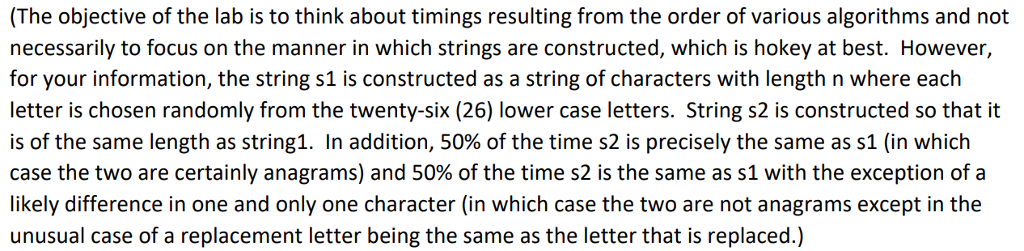
s1=buildMyString(n)
if random.uniform(0.0,1.0)<.5:>
r=random.randrange(0,n-1)
aletter = random.choice(string.letters)
s2=s1[0:r]+aletter+s1[r+1:n]
else:
s2=s1
print("s1 is: ",s1)
print("s2 is: ",s2)
print(" ...timing anagramSolution1 with n = ",n)
start=time.time()
print(anagramSolution1(s1,s2))
print(time.time()-start)
print(" ...timing anagramSolution2 with n = ",n)
start=time.time()
print(anagramSolution2(s1,s2))
print(time.time()-start)
print(" ...timing anagramSolution3 with n = ",n)
start=time.time()
print(anagramSolution3(s1,s2))
print(time.time()-start)
print(" ...timing anagramSolution4 with n = ",n)
start=time.time()
print(anagramSolution4(s1,s2))
print(time.time()-start)
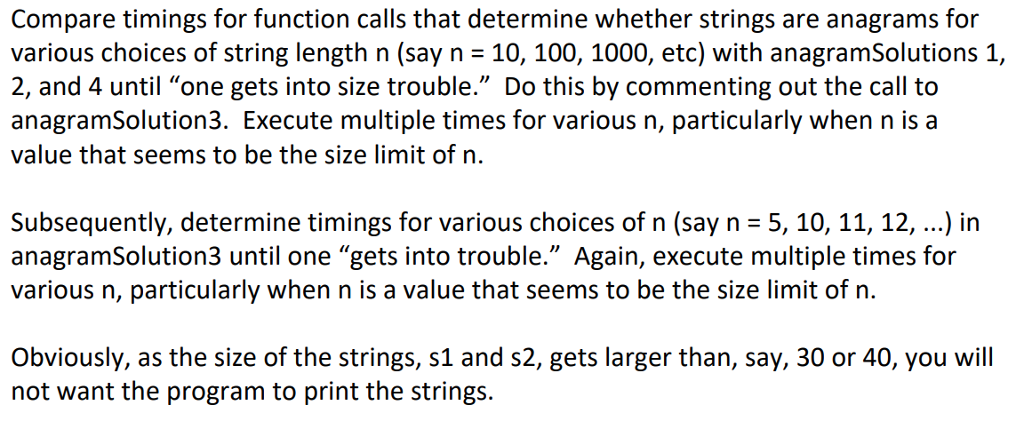
Compare timings for function calls that determine whether strings are anagrams for various choices of string length n (say n 10, 100, 1000, etc) with anagramSolutions 1, 2, and 4 until "one gets into size trouble." Do this by commenting out the call to anagramSolution3. Execute multiple times for various n, particularly when n is a value that seems to be the size limit of n Subsequently, determine timings for various choices of n (say n 5, 10, 11, 12,...) in anagramSolution3 until one "gets into trouble." Again, execute multiple times for various n, particularly when n is a value that seems to be the size limit of n. Obviously, as the size of the strings, s1 and s2, gets larger than, say, 30 or 40, you will not want the program to print the stringsStep by Step Solution
There are 3 Steps involved in it

Get step-by-step solutions from verified subject matter experts
 Study Help