







Question: Create an excel file for the word problem in the attached picture. Show me screenshots of the excel file including any formulas and the inputs
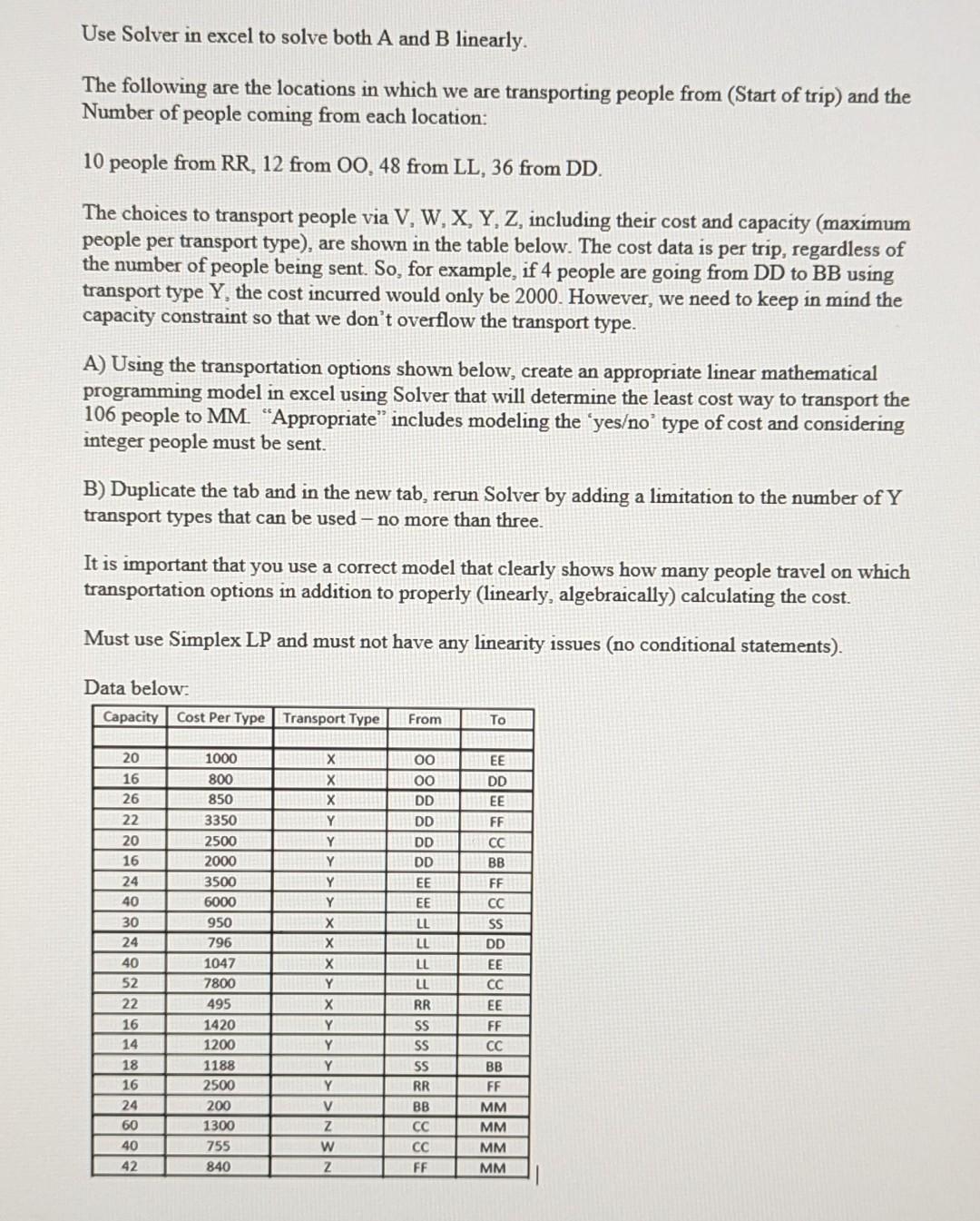
Create an excel file for the word problem in the attached picture. Show me screenshots of the excel file including any formulas and the inputs in solver.
Use Solver in excel to solve both A and B linearly. The following are the locations in which we are transporting people from (Start of trip) and the Number of people coming from each location: 10 people from RR, 12 from OO, 48 from LL, 36 from DD. The choices to transport people via V,W,X,Y,Z, including their cost and capacity (maximum people per transport type), are shown in the table below. The cost data is per trip, regardless of the number of people being sent. So, for example, if 4 people are going from DD to BB using transport type Y, the cost incurred would only be 2000 . However, we need to keep in mind the capacity constraint so that we don't overflow the transport type. A) Using the transportation options shown below, create an appropriate linear mathematical programming model in excel using Solver that will determine the least cost way to transport the 106 people to MM. "Appropriate" includes modeling the 'yeso' type of cost and considering integer people must be sent. B) Duplicate the tab and in the new tab, rerun Solver by adding a limitation to the number of Y transport types that can be used - no more than three. It is important that you use a correct model that clearly shows how many people travel on which transportation options in addition to properly (linearly, algebraically) calculating the cost. Must use Simplex LP and must not have any linearity issues (no conditional statements). Data below: Use Solver in excel to solve both A and B linearly. The following are the locations in which we are transporting people from (Start of trip) and the Number of people coming from each location: 10 people from RR, 12 from OO, 48 from LL, 36 from DD. The choices to transport people via V,W,X,Y,Z, including their cost and capacity (maximum people per transport type), are shown in the table below. The cost data is per trip, regardless of the number of people being sent. So, for example, if 4 people are going from DD to BB using transport type Y, the cost incurred would only be 2000 . However, we need to keep in mind the capacity constraint so that we don't overflow the transport type. A) Using the transportation options shown below, create an appropriate linear mathematical programming model in excel using Solver that will determine the least cost way to transport the 106 people to MM. "Appropriate" includes modeling the 'yeso' type of cost and considering integer people must be sent. B) Duplicate the tab and in the new tab, rerun Solver by adding a limitation to the number of Y transport types that can be used - no more than three. It is important that you use a correct model that clearly shows how many people travel on which transportation options in addition to properly (linearly, algebraically) calculating the cost. Must use Simplex LP and must not have any linearity issues (no conditional statements). Data below
Step by Step Solution
There are 3 Steps involved in it

Get step-by-step solutions from verified subject matter experts
 Study Help