







Question: create database AutoRentals go use AutoRentals go create table Customer (CID integer, CName varchar(20), Age integer, Resid_City varchar(20), BirthPlace varchar(20), Constraint PK_Customer Primary Key (CID))
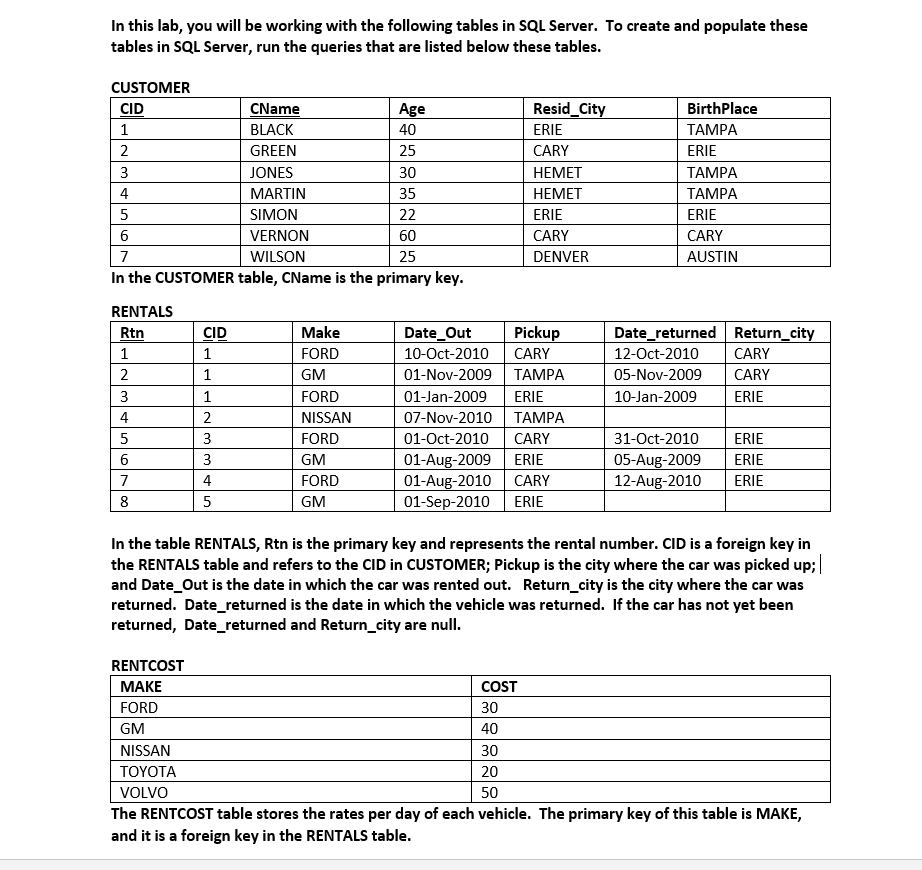
create database AutoRentals
go
use AutoRentals
go
create table Customer
(CID integer,
CName varchar(20),
Age integer,
Resid_City varchar(20),
BirthPlace varchar(20),
Constraint PK_Customer Primary Key (CID))
insert Customer
select 1, 'Black', 40, 'Erie', 'Tampa'
insert Customer
select 2, 'Green', 25, 'Cary', 'Erie'
insert Customer
select 3, 'Jones', 30, 'Hemet', 'Tampa'
insert Customer
select 4, 'Martin', 35, 'Hemet', 'Tampa'
insert Customer
select 5, 'Simon', 22, 'Erie', 'Erie'
insert Customer
select 6, 'Vernon', 60, 'Cary', 'Cary'
insert Customer
select 7, 'Wilson', 25, 'Denver', 'Austin'
create table Rentcost
(Make varchar(20),
Cost float,
constraint PK_Rentcost Primary Key (Make))
insert Rentcost
select 'Ford', 30
insert Rentcost
select 'GM', 40
insert Rentcost
select 'Nissan', 30
insert Rentcost
select 'Toyota', 20
insert Rentcost
select 'Volvo', 50
Create table Rentals
(Rtn integer,
CID integer,
Make varchar(20),
Date_Out smalldatetime,
Pickup varchar(20),
Date_returned smalldatetime,
Return_city varchar(20),
Constraint PK_Rentals Primary Key (Rtn),
Constraint FK_CustomerRentals Foreign Key (CID) References Customer,
Constraint FK_RentCostRentals Foreign Key (Make) References Rentcost)
insert Rentals
select 1, 1, 'Ford', '10/10/2010', 'Cary', '10/12/2010', 'Cary'
insert Rentals
select 2, 1, 'GM', '11/1/2009', 'Tampa', '11/5/2009', 'Cary'
insert Rentals
select 3, 1, 'Ford', '1/1/2009', 'Erie', '1/10/2009', 'Erie'
insert Rentals
select 4, 2, 'Nissan', '11/7/2010', 'Tampa', null, null
insert Rentals
select 5, 3, 'Ford', '10/1/2010', 'Cary', '10/31/2010', 'Erie'
insert Rentals
select 6, 3, 'GM', '8/1/2009', 'Erie', '8/5/2009', 'Erie'
insert Rentals
select 7, 4, 'Ford', '8/1/2010', 'Cary', '8/12/2010', 'Erie'
insert Rentals
select 8, 5, 'GM', '9/1/2010', 'Erie', null, null
Deliverables:
Write queries that will satisfy the following requirements. To receive credit for this assignment, all queries must be executed in SQL Server and be displayed appropriately. For each question:
TYPE the SQL query below the instructions.
Take a screenshot of your query that was executed in SQL server. Be sure to capture the query as well as the results in your screen shot.
Paste the screenshot below the typed query.
1. execute a query that will determine the total number of days that Black rented a GM on November 1, 2009.
You should have one cell: 4
2. execute a query that will determine the total cost of the automobile rented by Black on November 1, 2009.
You should have one cell: 160
3. execute a query that will determine the Total cost of all the automobiles that have ever been rented.
You should have one cell: 1880
4. execute a query that will determine the average number of days that automobiles are rented. Show your result broken out by makes. Do not include an automobile if it has not yet been returned.
You should have two rows: Ford and GM with average days rented 13 and 4, respectively
5. execute a query that will determine the average age of customers broken out by the city in which they reside. Note: Make sure that the average age is not truncated to an integer.
You should have 4 rows: Cary, Denver, Erie, and Hemet with average ages of 42.5, 25, 31, and 32.5
6. execute a query that will show a list of customers who reside in the same city in which they were born.
You should have 2 rows: Simon and Vern
7. Using a left outer join, execute a query that will display a unique list of the makes of automobiles that have never been rented.
You should have 2 rows: Toyota and Volvo
8. Using a Type I query, display a unique list of the makes of automobiles that have never been rented.
You should have 2 rows: Toyota and Volvo
9. Using a right outer join, execute a query that will display a unique list of customers who have never rented an automobile.
You should have two rows: Vernon and Wilson
10. Using a Type II query, display a unique list of customers who have never rented an automobile.
You should have two rows: Vernon and Wilson
11. execute a query that will display a list of the customers who picked up their rental from the same city in which they reside.
You should have 2 rows: Black and Simon
12. execute a query that will display a list of customers who have not returned their rentals.
You should have 2 rows: Green and Simon
13. Using a Type I query, show all of the names and ages of customers who have rented an automobile and returned it to Erie. Sort your results in ascending order by customer name.
You should have three rows: Black, Jones, Martin.
14. Using a Type II query, show all of the customers who rented an automobile and picked it up in Cary.
You should have three rows: Black, Jones, and Martin
15. execute a single query that will display all of the information in the Customer, Rentals, and Rentcost tables in a single resultset. Be sure to display each field only once in your output. Order your results in ascending order by Customer.CID and Rentcost.Make .
You should have 12 rows and 12 columns in your result.
Step by Step Solution
There are 3 Steps involved in it

Get step-by-step solutions from verified subject matter experts
 Study Help