Question: create Protect Line spring... x Case Study 2 THE REGENCY GRAND HOTEL The Regency Grand Hotel is a five-star hotel in Bangkok, Thailand. The hotel
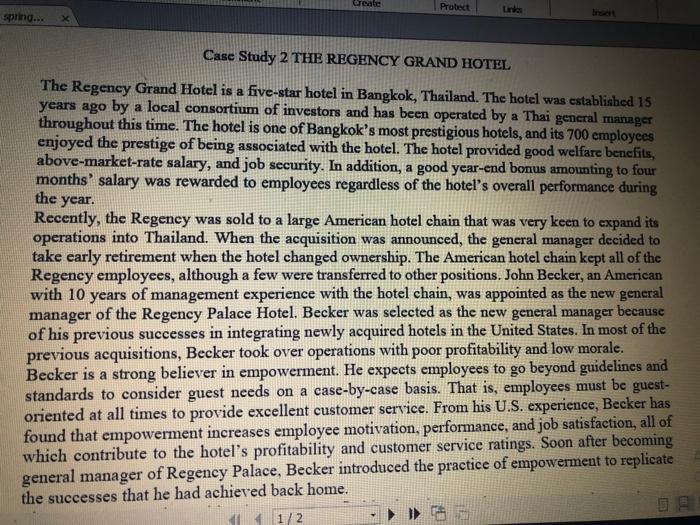
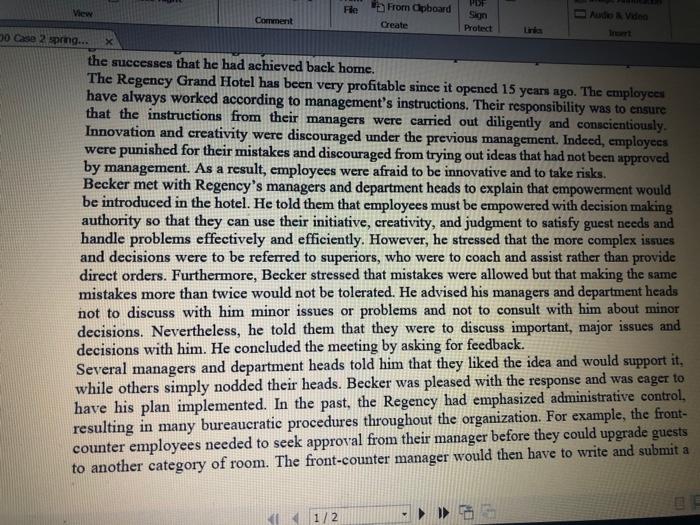
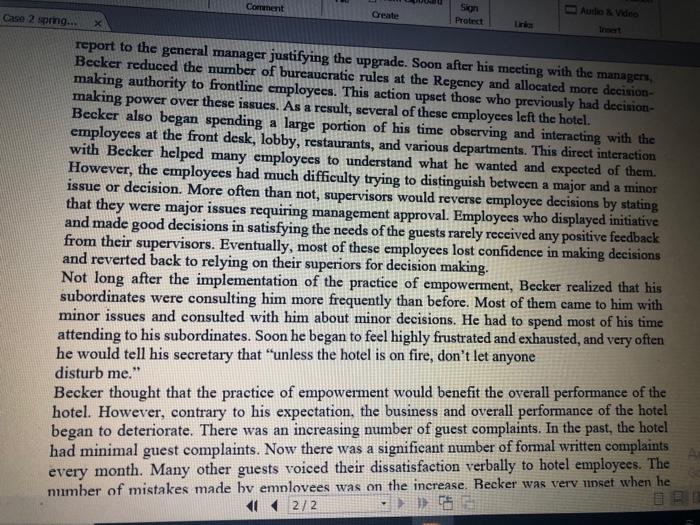
create Protect Line spring... x Case Study 2 THE REGENCY GRAND HOTEL The Regency Grand Hotel is a five-star hotel in Bangkok, Thailand. The hotel was established 15 years ago by a local consortium of investors and has been operated by a Thai general manager throughout this time. The hotel is one of Bangkok's most prestigious hotels, and its 700 employees enjoyed the prestige of being associated with the hotel. The hotel provided good welfare benefits, above-market-rate salary, and job security. In addition, a good year-end bonus amounting to four months' salary was rewarded to employees regardless of the hotel's overall performance during the year. Recently, the Regency was sold to a large American hotel chain that was very keen to expand its operations into Thailand. When the acquisition was announced, the general manager decided to take early retirement when the hotel changed ownership. The American hotel chain kept all of the Regency employees, although a few were transferred to other positions. John Becker, an American with 10 years of management experience with the hotel chain, was appointed as the new general manager of the Regency Palace Hotel. Becker was selected as the new general manager because of his previous successes in integrating newly acquired hotels in the United States. In most of the previous acquisitions, Becker took over operations with poor profitability and low morale. Becker is a strong believer in empowerment. He expects employees to go beyond guidelines and standards to consider guest needs on a case-by-case basis. That is, employees must be guest- oriented at all times to provide excellent customer service. From his U.S. experience, Becker has found that empowerment increases employee motivation, performance, and job satisfaction, all of which contribute to the hotel's profitability and customer service ratings. Soon after becoming general manager of Regency Palace, Becker introduced the practice of empowerment to replicate the successes that he had achieved back home. 1/2 View HOT Sign Protect Comment Audio Video Linia X File From Opboard Create 20 Case 2 peng... the successes that he had achieved back home. The Regency Grand Hotel has been very profitable since it opened 15 years ago. The employees have always worked according to management's instructions. Their responsibility was to ensure that the instructions from their managers were carried out diligently and conscientiously. Innovation and creativity were discouraged under the previous management. Indeed, employees were punished for their mistakes and discouraged from trying out ideas that had not been approved by management. As a result, employees were afraid to be innovative and to take risks. Becker met with Regency's managers and department heads to explain that empowerment would be introduced in the hotel. He told them that employees must be empowered with decision making authority so that they can use their initiative, creativity, and judgment to satisfy guest needs and handle problems effectively and efficiently. However, he stressed that the more complex issues and decisions were to be referred to superiors, who were to coach and assist rather than provide direct orders. Furthermore, Becker stressed that mistakes were allowed but that making the same mistakes more than twice would not be tolerated. He advised his managers and department heads not to discuss with him minor issues or problems and not to consult with him about minor decisions. Nevertheless, he told them that they were to discuss important, major issues and decisions with him. He concluded the meeting by asking for feedback. Several managers and department heads told him that they liked the idea and would support it, while others simply nodded their heads. Becker was pleased with the response and was eager to have his plan implemented. In the past, the Regency had emphasized administrative control, resulting in many bureaucratic procedures throughout the organization. For example, the front- counter employees needed to seek approval from their manager before they could upgrade guests to another category of room. The front-counter manager would then have to write and submit a 1/2 Comment Create Auto & Video X Protect Line Case 2 spring... report to the general manager justifying the upgrade. Soon after his meeting with the managers, Becker reduced the number of bureaucratic rules at the Regeney and allocated more decision- making authority to frontline employees. This action upset those who previously had decision- making power over these issues. As a result, several of these employees left the hotel. Becker also began spending a large portion of his time observing and interacting with the employees at the front desk, lobby, restaurants, and various departments. This direct interaction with Becker helped many employees to understand what he wanted and expected of them. However, the employees had much difficulty trying to distinguish between a major and a minor issue or decision. More often than not, supervisors would reverse employee decisions by stating that they were major issues requiring management approval. Employees who displayed initiative and made good decisions in satisfying the needs of the guests rarely received any positive feedback from their supervisors. Eventually, most of these employees lost confidence in making decisions and reverted back to relying on their superiors for decision making. Not long after the implementation of the practice of empowerment, Becker realized that his subordinates were consulting him more frequently than before. Most of them came to him with minor issues and consulted with him about minor decisions. He had to spend most of his time attending to his subordinates. Soon he began to feel highly frustrated and exhausted, and very often he would tell his secretary that "unless the hotel is on fire, don't let anyone disturb me." Becker thought that the practice of empowerment would benefit the overall performance of the hotel. However, contrary to his expectation, the business and overall performance of the hotel began to deteriorate. There was an increasing number of guest complaints. In the past, the hotel had minimal guest complaints. Now there was a significant number of formal written complaints every month. Many other guests voiced their dissatisfaction verbally to hotel employees. The number of mistakes made by emplovees was on the increase. Becker was very upset when he 12/2 3. What kinds of programs or policies should be used and implemented to create more employees' satisfaction? Discuss Active Go to










 Study Help