







Question: Critical Thinking Assignment 2 Pls help me to answer all the questions. I dont want copy and paste work. Thanks QUESTIONS: QUESTION 1 A) Name
Critical Thinking Assignment 2 Pls help me to answer all the questions. I dont want copy and paste work. Thanks
QUESTIONS:
QUESTION 1
A) Name of Stakeholder (2)
B) Work Role of Stakeholder (2)
C) Feedback (2)
QUESTION 2: SOLUTION PROPOSAL BRIEF (Version 1)
A) Possible solutions (2)
B) Advantages. This refers to benefits that can be received from pursuing the possible solution for the complex workplace issue. (2)
C) Limitations. This refers to disadvantages or restrictions that will be encountered. (2)
D) Selected Solution. Solutions identified must be the most viable out of all possible solutions outlined. Solutions are the most viable if its advantages heavily outweigh its limitations. This must be based on the advantages and limitations identified during the evaluation of all possible solutions outlined. The version 1 solution proposal must have the scope for improvement.
QUESTION 3: EVALUATION OF CRITICAL THINKING TECHNIQUES
A) Critical Thinking Technique Used (2)
B) What went well
C) Areas of improvement
D) Other Critical Thinking Techniques That Could Be Used
QUESTION 4: EVALUATION OF CREATIVE THINKING TECHNIQUES
A) Creative Thinking Technique Used (2)
B) What went well
C) Areas of improvement
D) Other Creative Thinking Techniques That Could Be Used
QUESTION 5:
QUESTION 6: FEEDBACK REGISTER
A) SUMMARY OF MODIFICATIONS
QUESTION 7: REFINED SOLUTION PROPOSAL BRIEF
A) Importance of the issue or problem
B) Selected Solution. Solutions identified must be the most viable out of all possible solutions outlined. Solutions are the most viable if its advantages heavily outweigh its limitations. This must be based on the advantages and limitations identified during the evaluation of all possible solutions outlined.
C) Name of stake holders (2)
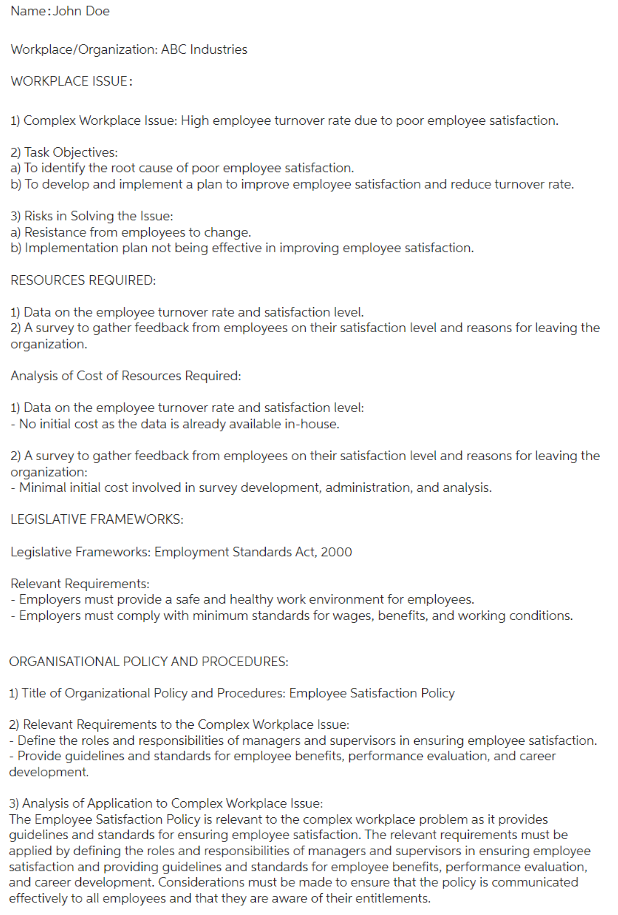
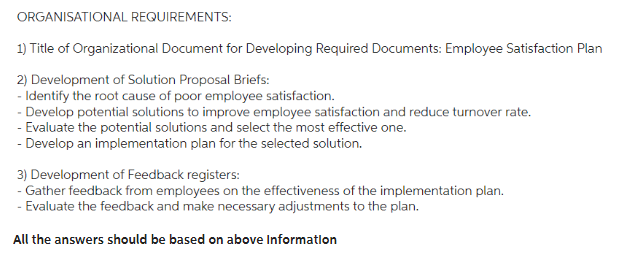
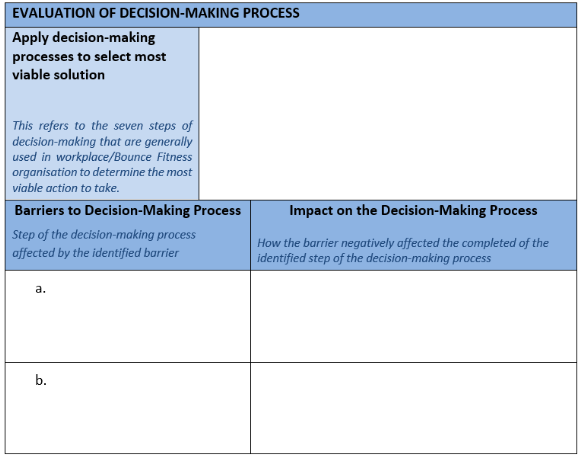
Name:John Doe Workplace/Organization: ABC Industries WORKPLACE ISSUE: 1) Complex Workplace Issue: High employee turnover rate due to poor employee satisfaction. 2) Task Objectives: a) To identify the root cause of poor employee satisfaction. b) To develop and implement a plan to improve employee satisfaction and reduce turnover rate. 3) Risks in Solving the Issue: a) Resistance from employees to change. b) Implementation plan not being effective in improving employee satisfaction. RESOURCES REQUIRED: 1) Data on the employee turnover rate and satisfaction level. 2) A survey to gather feedback from employees on their satisfaction level and reasons for leaving the organization. Analysis of Cost of Resources Required: 1) Data on the employee turnover rate and satisfaction level: - No initial cost as the data is already available in-house. 2) A survey to gather feedback from employees on their satisfaction level and reasons for leaving the organization: - Minimal initial cost involved in survey development, administration, and analysis. LEGISLATIVE FRAMEWORKS: Legislative Frameworks: Employment Standards Act, 2000 Relevant Requirements: - Employers must provide a safe and healthy work environment for employees. - Employers must comply with minimum standards for wages, benefits, and working conditions. ORGANISATIONAL POLICY AND PROCEDURES: 1) Title of Organizational Policy and Procedures: Employee Satisfaction Policy 2) Relevant Requirements to the Complex Workplace Issue: - Define the roles and responsibilities of managers and supervisors in ensuring employee satisfaction. - Provide guidelines and standards for employee benefits, performance evaluation, and career development. 3) Analysis of Application to Complex Workplace Issue: The Employee Satisfaction Policy is relevant to the complex workplace problem as it provides guidelines and standards for ensuring employee satisfaction. The relevant requirements must be applied by defining the roles and responsibilities of managers and supervisors in ensuring employee satisfaction and providing guidelines and standards for employee benefits, performance evaluation, and career development. Considerations must be made to ensure that the policy is communicated effectively to all employees and that they are aware of their entitlements. ORGANISATIONAL REQUIREMENTS: 1) Title of Organizational Document for Developing Required Documents: Employee Satisfaction Plan 2) Development of Solution Proposal Briefs: - Identify the root cause of poor employee satisfaction. - Develop potential solutions to improve employee satisfaction and reduce turnover rate. - Evaluate the potential solutions and select the most effective one. - Develop an implementation plan for the selected solution. 3) Development of Feedback registers: - Gather feedback from employees on the effectiveness of the implementation plan. - Evaluate the feedback and make necessary adjustments to the plan. All the answers should be based on above Information EVALUATION OF DECISION-MAKING PROCESS Apply decision-making processes to select most viable solution This refers to the seven steps of decision-making that are generally used in workplace/Bounce Fitness organisation to determine the most viable action to take. \begin{tabular}{|c|c|} \hline BarrierstoDecision-MakingProcessStepofthedecision-makingprocessaffectedbytheidentifiedbarrier & \multicolumn{1}{|c|}{ImpactontheDecision-MakingProcessHowthebarriernegativelyaffectedthecompletedoftheidentifiedstepofthedecision-makingprocess} \\ \hline a. & \\ \hline b. & \\ \hline \end{tabular}
Step by Step Solution
There are 3 Steps involved in it

Get step-by-step solutions from verified subject matter experts
 Study Help