Critically consider Business Decision 14.1 (MTL, 349) and answer the associated discussion questions.
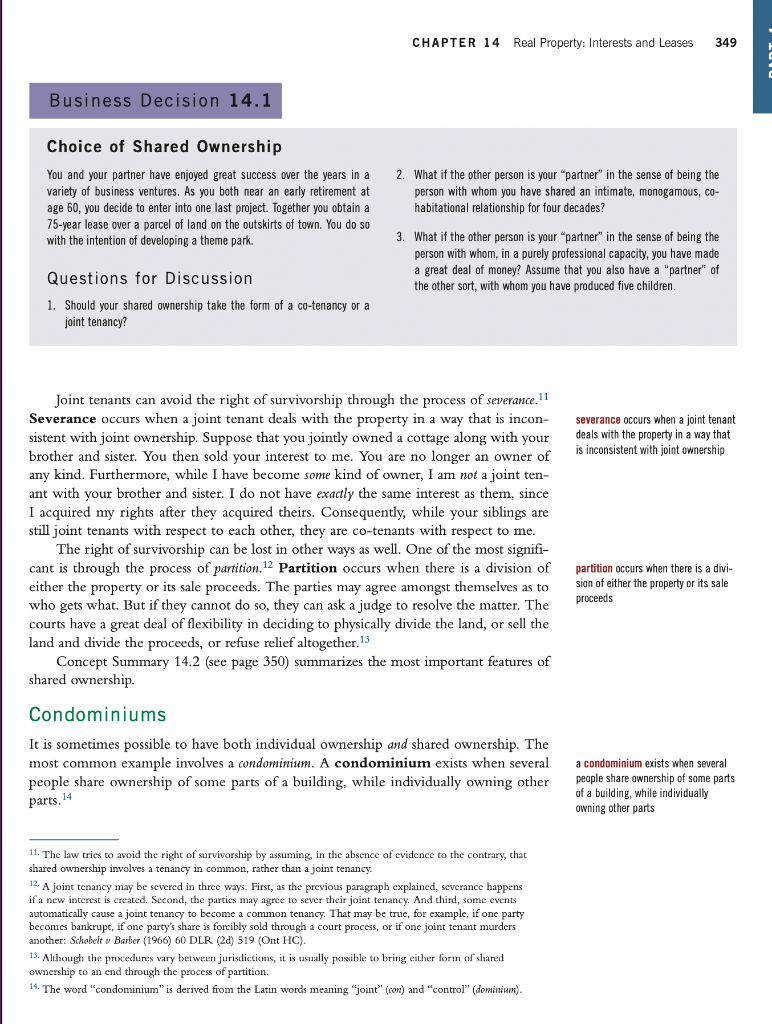
CHAPTER 14 Real Property: Interests and Leases 349 Choice of Shared Ownership 1. Should your shared ownership take the form of a co-tenancy or a joint tenancy? Joint tenants can avoid the right of survivorship through the process of severance. 11 Severance occurs when a joint tenant deals with the property in a way that is incon- severance occurs when a joint tenant sistent with joint ownership. Suppose that you jointly owned a cottage along with your deals with the property in a way that brother and sister. You then sold your interest to me. You are no longer an owner of is inconsistent with joint ownership any kind. Furthermore, while I have become some kind of owner, I am not a joint tenant with your brother and sister. I do not have exactly the same interest as them, since I acquired my rights after they acquired theirs. Consequently, while your siblings are still joint tenants with respect to each other, they are co-tenants with respect to me. The right of survivorship can be lost in other ways as well. One of the most significant is through the process of partition. 12 Partition occurs when there is a division of partition occurs when there is a divieither the property or its sale proceeds. The parties may agree amongst themselves as to sion of either the property or its sale who gets what. But if they cannot do so, they can ask a judge to resolve the matter. The courts have a great deal of flexibility in deciding to physically divide the land, or sell the land and divide the proceeds, or refuse relief altogether. 13 Concept Summary 14.2 (see page 350) summarizes the most important features of shared ownership. Condominiums It is sometimes possible to have both individual ownership and shared ownership. The most common example involves a condominium. A condominium exists when several a condominium exists when several people share ownership of some parts of a building, while individually owning other people share ownership of same parts parts. 14 owning other parts 11. The law tries to avoid the right of survivorship by assuming, in the absence of evidence to the contrary, that shared ownership involves a tenancy in common, rather than a joint tenancy. 12. A joint tenancy may be severed in three ways. First, as the previous paragraph explained, severance happens if a new interest is created. Second, the parties may agree to sever their joint tenancy. And chird, some events automatically cause a joint tenancy to become a common tenancy. That may be true, for example, if one party becomes bankrupt, if one party's share is forcibly sold through a court process, or if one joint tenant murders another: Schobeit v Barber (1966) 60 DLR (2d) 519 (Ont HC). 13. Although the procedures vary between jurisdictions, it is usually possible to bring either form of shared ownership to an end through the process of partition. 14. The word "condominium" is derived from the Latin words meaning "joint" (con) and "control" (dominium)




