







Question: Crytolography (1 point) Note: The notation from this problem is from Understanding Cryptography by Paar and Petzl. Consider the LFSR represented by the polynomial a*
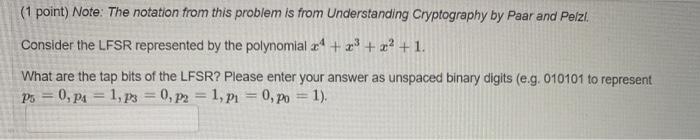

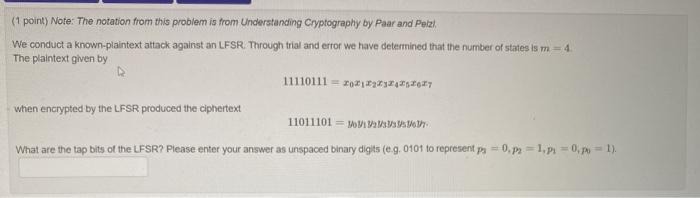
(1 point) Note: The notation from this problem is from Understanding Cryptography by Paar and Petzl. Consider the LFSR represented by the polynomial a* + x3 + xp? +1. What are the tap bits of the LFSR? Please enter your answer as unspaced binary digits (e.g. 010101 to represent PS 0, pa = 1,3 = 0,P2 = 1, P1 = 0, po = 1). (1 point) Note: The notation from this problem is from understanding Cryptography by Paar and Pelzi. Consider the LFSR represented by the polynomial r4+ 3 + + 1. What are the tap bits of the LFSR? Please enter your answer as unspaced binary digits (eg. 010101 to represent Ps= 0,4 1,p3 0,P2 = 1, P1 = 0, PO = 1). (1 point) Note: The notation from this problem is from understanding Cryptography by Paar and Petzl We conduct a known plaintext attack against an LFSR. Through trial and error we have determined that the number of states is m = 4 The plaintext given by 11110111 7475767 when encrypted by the LFSR produced the ciphertext 11011101 = 13:35 What are the tap bits of the LFSR? Please enter your answer as unspaced binary digits (eg. 0101 to represent ps = 0, p=1, P1 = 0;p=1)
Step by Step Solution
There are 3 Steps involved in it

Get step-by-step solutions from verified subject matter experts
 Study Help