







Question: CSE 232 Fall 2017 Programming Project #7 This project focuses on the use of maps. It is worth 50 points (5% of your overall grade).
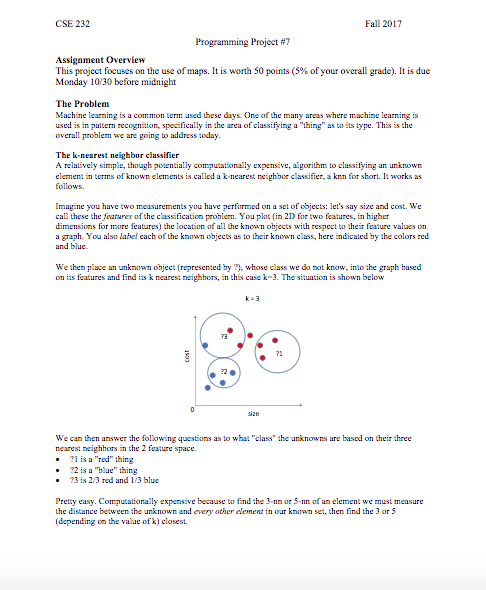
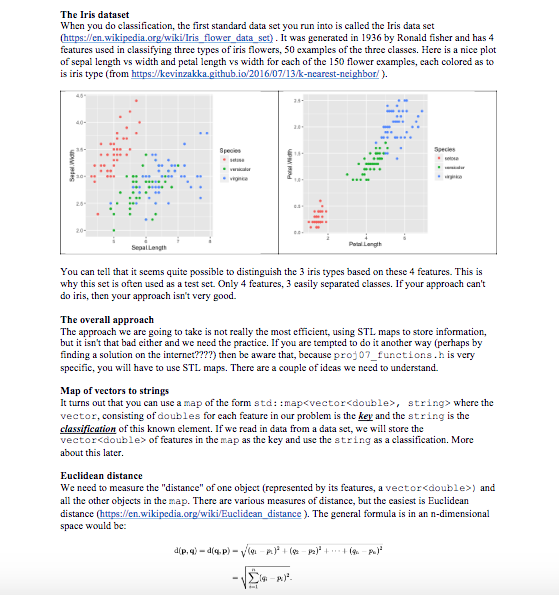
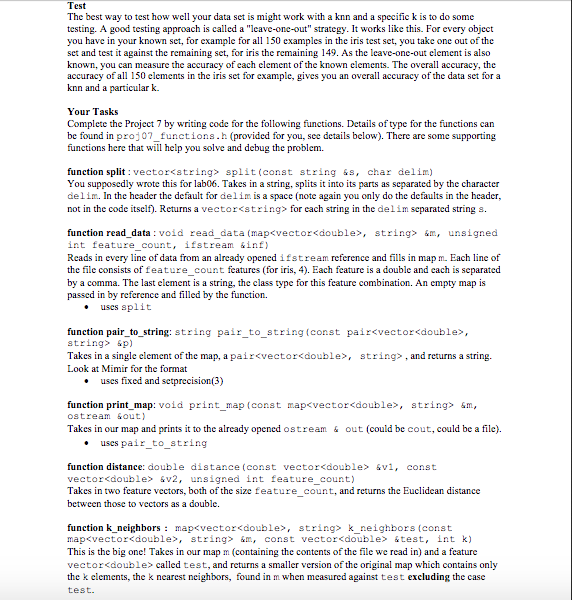
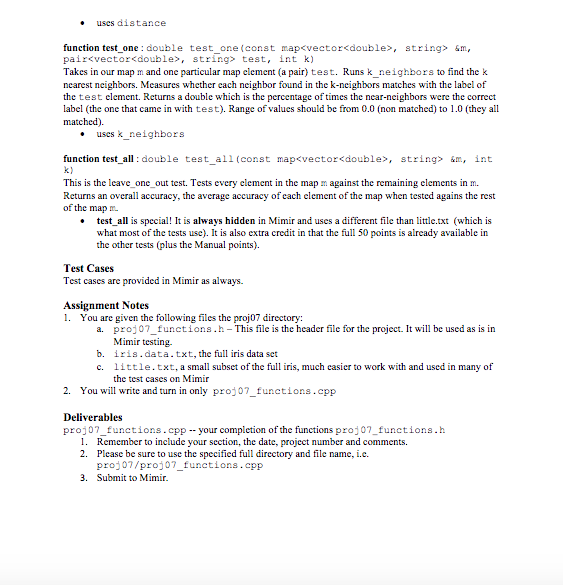
CSE 232 Fall 2017 Programming Project #7 This project focuses on the use of maps. It is worth 50 points (5% of your overall grade). It is due Monday 1030 before midnight The Problem Machine learning is a common term used these days One of the many areas where machine learning is used is in pattern recognition, specifically in the area of classifying a "hing" as to its type. This is the overall problem we are going to address today The k-nearest neighbor classifier A relatively simple, though potentially computationaly expensive, algorithm to classifying an unknown elerment in terms of known elements is called a k nearest neighbor classifier, a knn for short It works as follows Imagine you have two measurements you have performed on a set of ects: let's say size and cost, we call these the features of the classification problem. Yo poin 2D for two features, in higher dimensions for more features) the location of all the known objects with respect to their feature values on a graph You also label each of the knoaobjects as to their known class, here indicated by the colors red and blue We then place an unknown objeet (represented by ) whose class we do not know, into the graph based on its features and find its k nearest neighbors, in this case k3. The situation is shown below 22 0 We can then answer the following questions as to what"class the unknowns are based on their three nearest neighbors in the 2 feature space. 1 is a"redthing 2 is a b thing 3 is 2/3 red and 1/3 blue Pretty easy. Computationally expensive because to find the 3-nor 5-nn of an element we must measure the distance between the unknown and every other element in our knoan se, then find the 3 or 5 (depending on the value of k) closest. CSE 232 Fall 2017 Programming Project #7 This project focuses on the use of maps. It is worth 50 points (5% of your overall grade). It is due Monday 1030 before midnight The Problem Machine learning is a common term used these days One of the many areas where machine learning is used is in pattern recognition, specifically in the area of classifying a "hing" as to its type. This is the overall problem we are going to address today The k-nearest neighbor classifier A relatively simple, though potentially computationaly expensive, algorithm to classifying an unknown elerment in terms of known elements is called a k nearest neighbor classifier, a knn for short It works as follows Imagine you have two measurements you have performed on a set of ects: let's say size and cost, we call these the features of the classification problem. Yo poin 2D for two features, in higher dimensions for more features) the location of all the known objects with respect to their feature values on a graph You also label each of the knoaobjects as to their known class, here indicated by the colors red and blue We then place an unknown objeet (represented by ) whose class we do not know, into the graph based on its features and find its k nearest neighbors, in this case k3. The situation is shown below 22 0 We can then answer the following questions as to what"class the unknowns are based on their three nearest neighbors in the 2 feature space. 1 is a"redthing 2 is a b thing 3 is 2/3 red and 1/3 blue Pretty easy. Computationally expensive because to find the 3-nor 5-nn of an element we must measure the distance between the unknown and every other element in our knoan se, then find the 3 or 5 (depending on the value of k) closest
Step by Step Solution
There are 3 Steps involved in it

Get step-by-step solutions from verified subject matter experts
 Study Help