







Question: CSSSISOCJ'STAT 221: Statistical Concepts and Methods for the Social Sciences e. P(T'I CC): Clinicians refer to this probability as the specicity of a test or
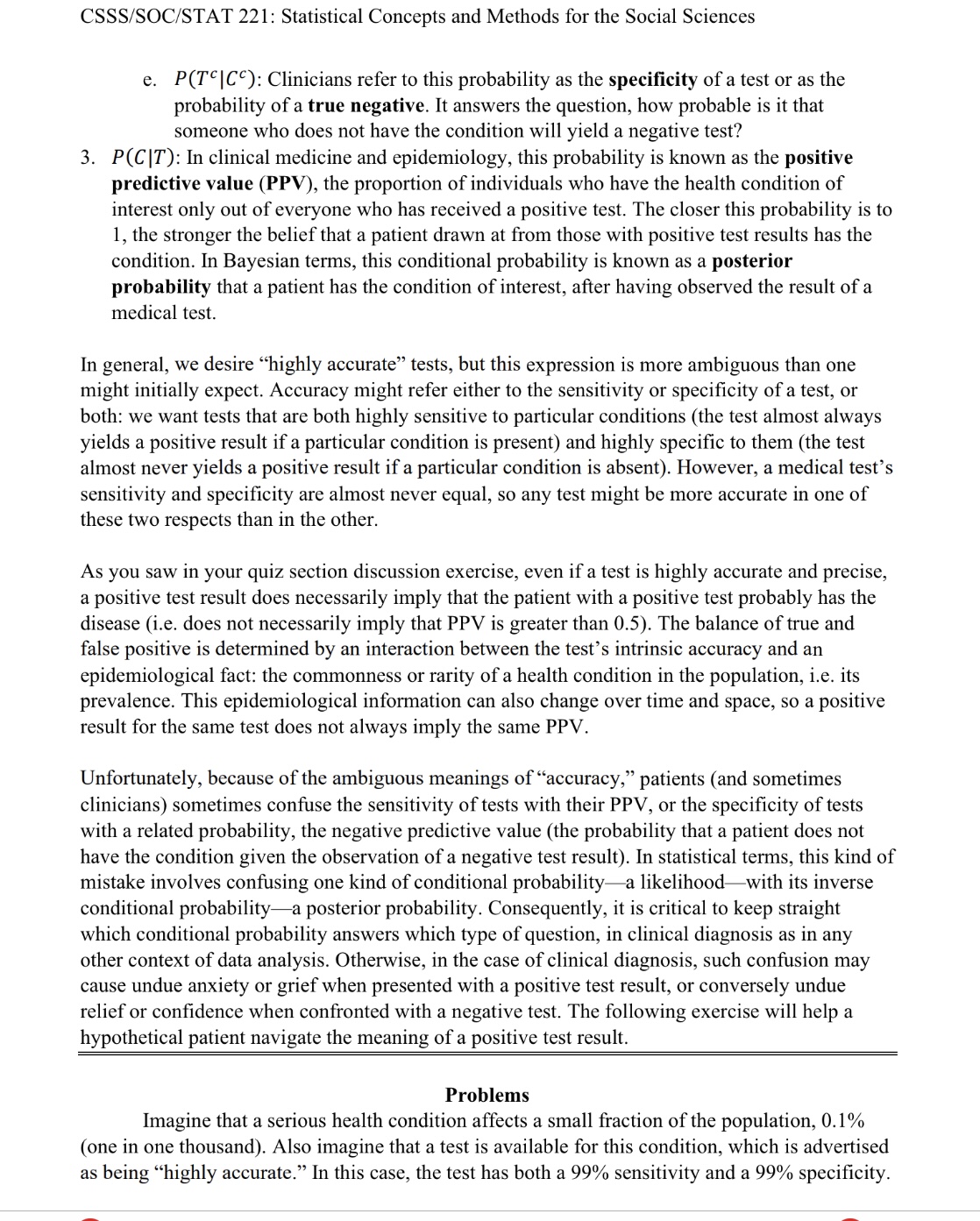
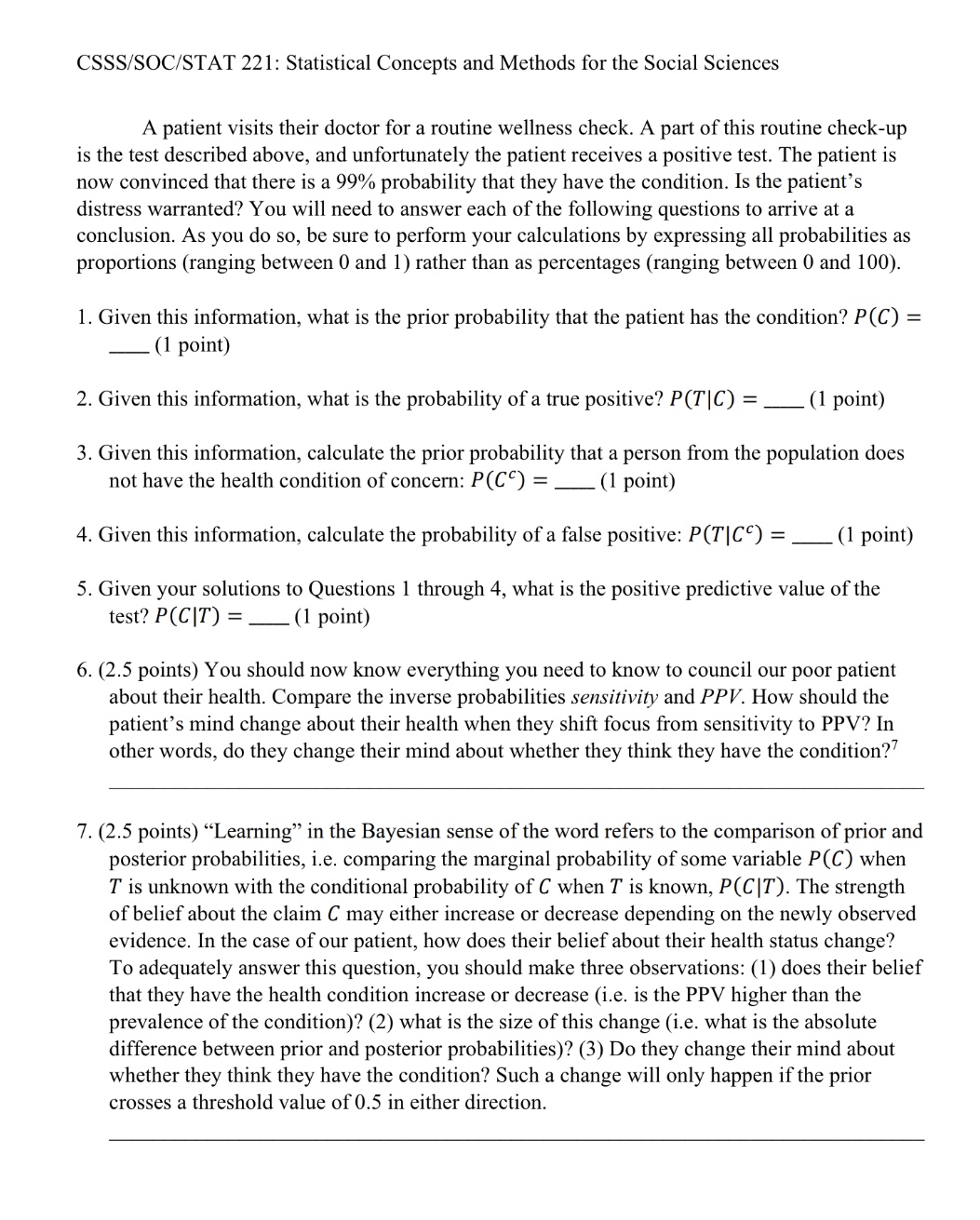
CSSSISOCJ'STAT 221: Statistical Concepts and Methods for the Social Sciences e. P(T'I CC): Clinicians refer to this probability as the specicity of a test or as the probability of a true negative. It answers the question, how probable is it that someone who does not have the condition will yield a negative test? 3. P(C |T): In clinical medicine and epidemiology, this probability is known as the positive predictive value (PPV), the proportion of individuals who have the health condition of interest only out of everyone who has received a positive test. The closer this probability is to l, the stronger the belicfthat a patient drawn at from those with positive test results has the condition. In Bayesian terms, this conditional probability is known as a posterior probability that a patient has the condition of interest, after having observed the result of a medical test. In general, we desire \"highly accurate\" tests, but this expression is more ambiguous than one might initially expect. Accuracy might refer either to the sensitivity or specicity ofa test, or both: we want tests that are both highly sensitive to particular conditions (the test almost always yields a positive result if a particular condition is present) and highly specic to them (the test almost never yields a positive result if a particular condition is absent). However, a medical test's sensitivity and specicity are almost never equal, so any test might be more accurate in one of these two respects than in the other. As you saw in your quiz section discussion exercise, even ifa test is highly accurate and precise, a positive test result does necessarily imply that the patient with a positive test probably has the disease (i.e. does not necessarily imply that PPV is greater than 0.5). The balance of true and false positive is determined by an interaction between the test's intrinsic accuracy and an epidemiological fact: the cornmonness or rarity of a health condition in the population, i.e. its prevalence. This epidemiological information can also change over time and space, so a positive reSult for the same test does not always imply the same PPV. Unfortunately, because of the ambiguous meanings of \"accuracy," patients (and sometimes clinicians") sometimes confuse the sensitivity of tests with their PPV, or the specicity of tests with a related probability, the negative predictive value (the probability that a patient does not have the condition given the observation of a negative test result). In statistical terms, this kind of mistake involves confusing one kind of conditional probabilitya likelihoodwith its inverse conditional probabilitya posterior probability. Consequently, it is critical to keep straight which conditional probability answers which type of question, in clinical diagnosis as in any other context of data analysis. Otherwise, in the case of clinical diagnosis, such confusion may cause undue anxiety or grief when presented with a positive test result, or conversely undue relief or condence when confronted with a negative test. The following exercise will help a hypothetical patient navigate the meaning of a positive test result. Problems Imagine that a serious health condition affects a small fraction of the population, 0.1% (one in one thousand). Also imagine that a test is available for this condition, which is advertised as being \"highly accurate.\" In this case, the test has both a 99% sensitivity and a 99% specicity. CSSSESOCISTAT 22]: Statistical Concepts and Methods for the Social Sciences A patient visits their doctor for a routine wellness check. A part ofthis routine check-up is the test described above, and unfortunately the patient receives a positive test. The patient is now convinced that there is a 99% probability that they have the condition. Is the patient's distress warranted? You will need to answer each of the following questions to arrive at a conclusion. As you do so, be sure to perform your calculations by expressing all probabilities as proportions (ranging between 0 and 1) rather than as percentages (ranging between 0 and 100). 1. Given this information, what is the prior probability that the patient has the condition? PUT) = (1 point) 2. Given this information, what is the probability ofa true positive? P(T|C) : (1 point) 3. Given this information, calculate the prior probability that a person from the population does not have the health condition ofconcern: FUSE) = (1 point) 4. Given this information, calculate the probability ofa false positive: P(T|C') = (1 point) 5. Given your solutions to Questions 1 through 4, what is the positive predictive value of the test? P(C|T) = (1 point) 6. (2.5 points) You should now know everything you need to know to council our poor patient about their health. Compare the inverse probabilities seim'n'vinr and PP V. How should the patient's mind change about their health when they shift focus from sensitivity to PPV? In other words, do they change their mind about whether they think they have the condition?7 7. (2.5 points) \"Learning\" in the Bayesian sense of the word refers to the comparison ofprior and posterior probabilities, i.e. comparing the marginal probability of some variable FCC) when T is unknown with the conditional probability of C when T is known, P(C |T). The strength of belief aboat the claim (3' may either increase or decrease depending on the newly observed evidence. In the case of our patient, how does their belief about their health status change? To adequately answer this question, you should make three observations: ( 1) does their belief that they have the health condition increase or decrease (i.e. is the PPV higher than the prevalence of the condition)? (2) what is the size of this change (i.e. what is the absolute difference between prior and posterior probabilities)? (3) Do they change their mind about whether they think they have the condition? Such a change will only happen if the prior crosses a threshold value of 0.5 in either direction
Step by Step Solution
There are 3 Steps involved in it

Get step-by-step solutions from verified subject matter experts
 Study Help