







Question: Current Loop Main Unit Magnet Assembly 0.01 gram Lab Stand Balance Figure 2.1 Equipment Setup012-04046C Current Balance and Accessory | Experiment 3: Force versus Magnetic
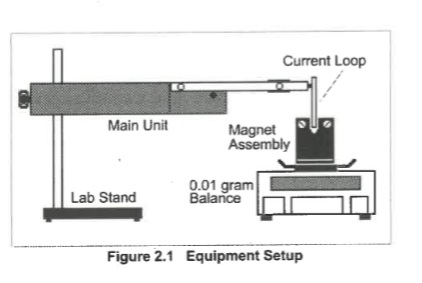
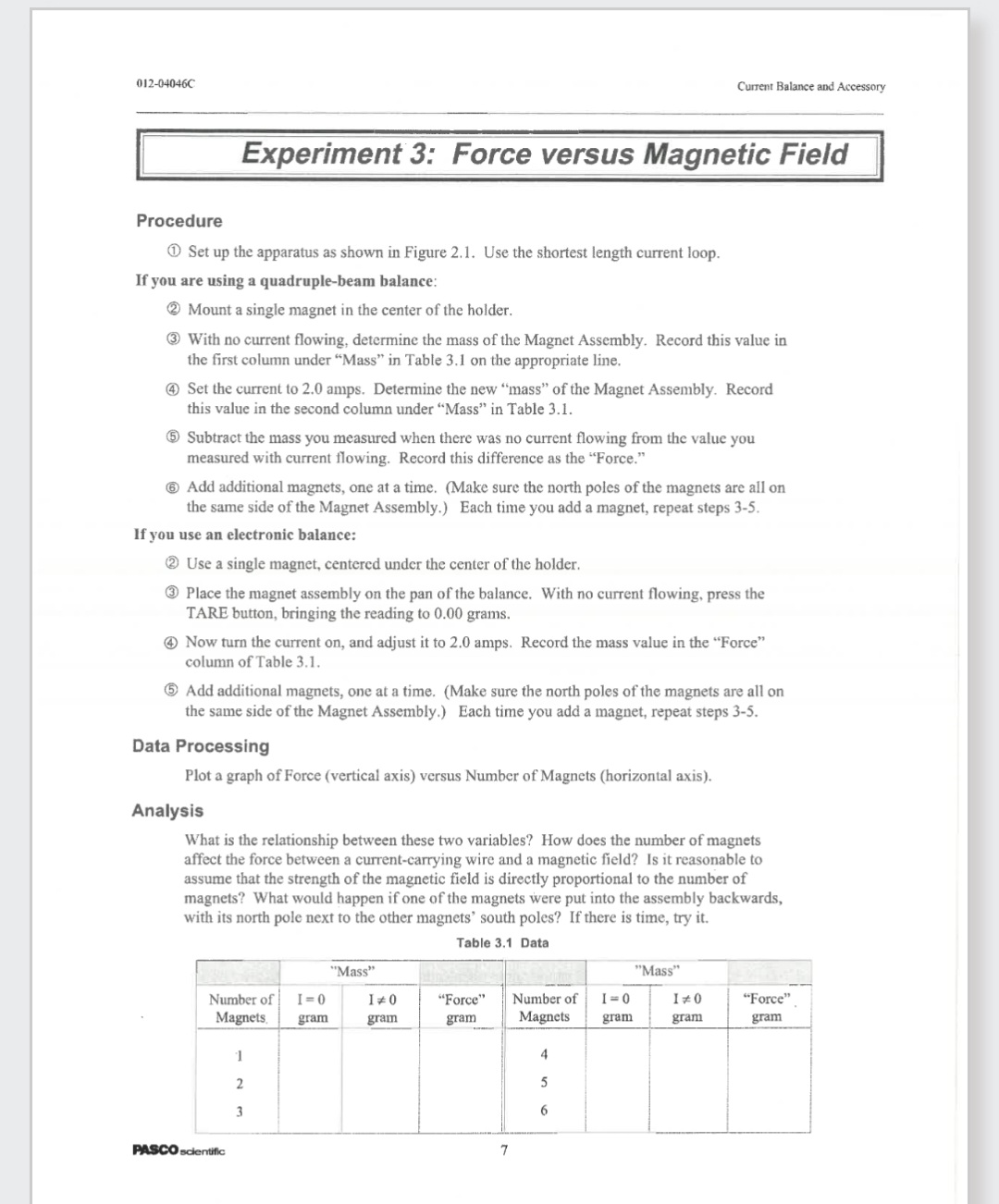
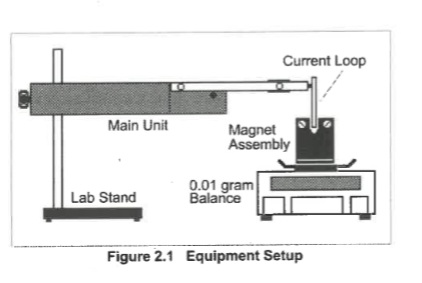
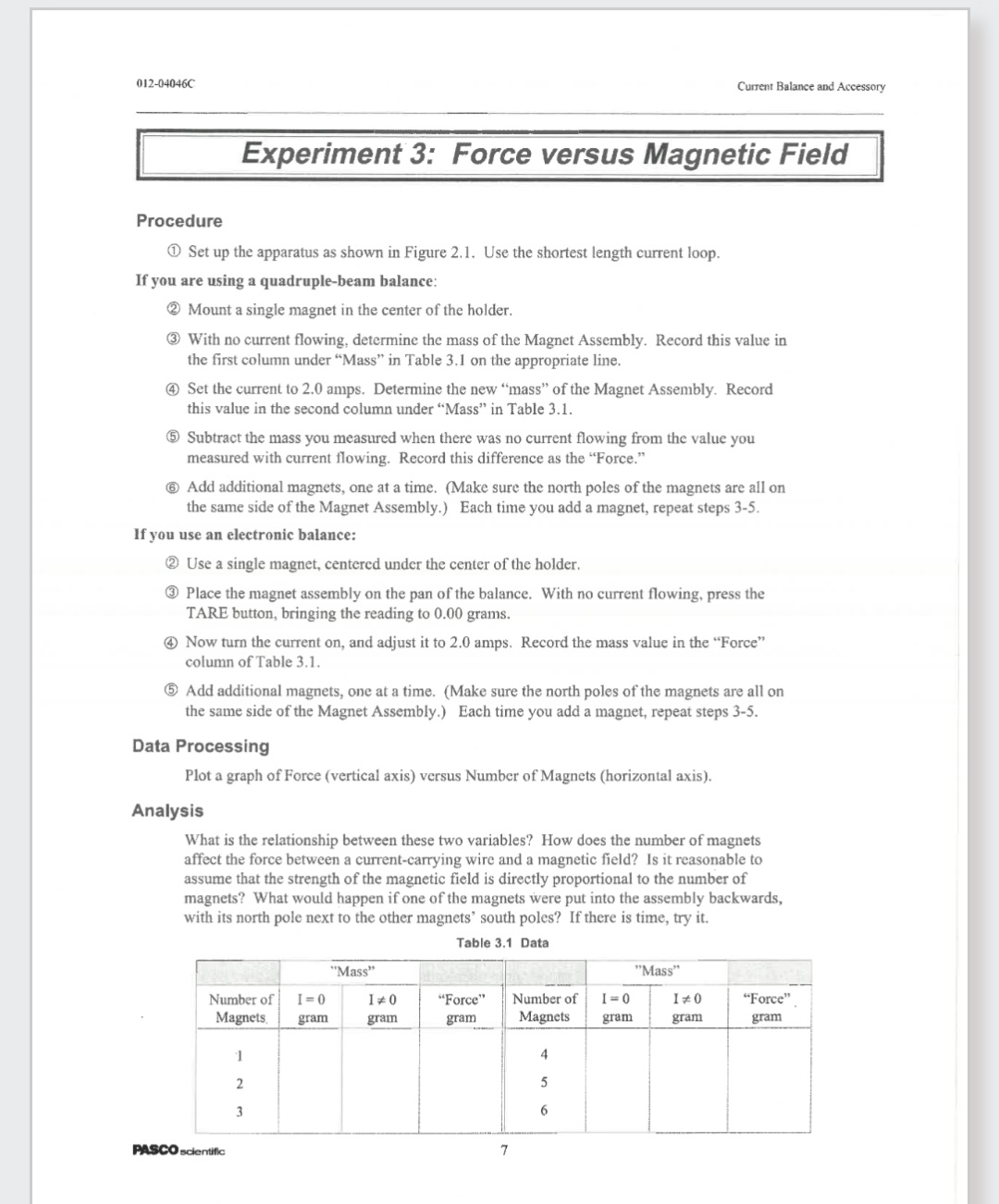
Current Loop Main Unit Magnet Assembly 0.01 gram Lab Stand Balance Figure 2.1 Equipment Setup012-04046C Current Balance and Accessory | Experiment 3: Force versus Magnetic Field | Procedure @ Set up the apparatus as shown in Figure 2.1. Use the shortest length current loop. If you are using a quadruple-beam balance: @ Mount a single magnet in the center of the holder. @ With no current flowing, determine the mass of the Magnet Assembly. Record this value in the first column under \"Mass in Table 3.1 on the appropriate line. @ Set the current to 2.0 amps. Determine the new \"mass\" of the Magnet Assembly. Record this value in the second column under \"Mass in Table 3.1. Subtract the mass you measured when there was no current flowing from the value you measured with current flowing. Record this difference as the \"Force.\" Add additional magnets, one at a time. (Make sure the north poles of the magnets are all on the same side of the Magnet Assembly.) Each time you add a magnet, repeat steps 3-5. If you use an electronic balance: @ Use a single magnet, centered under the center of the holder. @ Place the magnet assembly on the pan of the balance. With no current flowing, press the TARE button, bringing the reading to 0.00 grams. @ Now turn the current on, and adjust it to 2,0 amps. Record the mass value in the \"Force\" column of Table 3.1. Add additional magnets, one at a time. (Make sure the north poles of the magnets are all on the same side of the Magnet Assembly.) Each time you add a magnet, repeat steps 3-5. Data Processing Plot a graph of Force (vertical axis) versus Number of Magnets (horizontal axis). Analysis What is the relationship between these two variables? How does the number of magnets affect the force between a current-carrying wire and a magnetic field? Is it reasonable to assume that the strength of the magnetic field is directly proportional to the number of magnets? What would happen if one of the magnets were put into the assembly backwards, with its north pole next to the other magnets' south poles? If there is time, try it. Table 3.1 Data o] ey Rt et Number of I=0 120 \"Force\" Number of | I=0 | 120 | \"Force\" N, | o L _wl_m__- 1 | ! | | | i 1 i | | 4 ? - | i i [ | I 2 | | 5 | | | | | ; | | | 3 \\ 6 | ! | ! I : : J PASCO scic-rmific: 7
Step by Step Solution
There are 3 Steps involved in it

Get step-by-step solutions from verified subject matter experts
 Study Help