







Question: Currently struggling with a lecture problem, please explain thoroughly if possible, thank you! Problem 1: Twenty dice (six-sided) are thrown. What is the probability that
Currently struggling with a lecture problem, please explain thoroughly if possible, thank you!
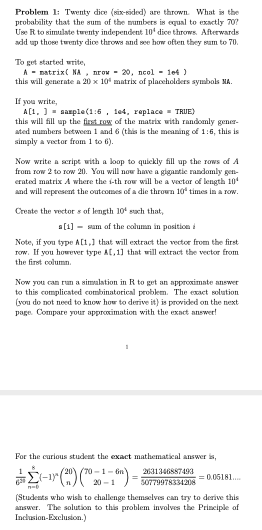
Problem 1: Twenty dice (six-sided) are thrown. What is the probability that the sum of the numbers is equal to exactly 70? Use R to simulate twenty independent 104 dice throws Afterwards add up there twenty dice throws and see how often they sam to 70. To get started write, A - matrix ( NA , now = 20, ncol = 104 ) this will generate a 20 x 10" matrix of placeholders symbols NA. If you write, A[1, ] . sample (1:6 , 194, replace TRUE) this will fill up the first row of the matrix with randomly genes- ated numbers between 1 and 6 (this is the meaning of 1:6, this is simply a vector from 1 to 6). Now write a script with a loop to quickly fill up the rows of A from row 2 to row 20. You will now have a gigantic madamly gen- crated matrix A where the f-th row will be a vector of length 10 and will represent the outcomes of a die thrown 10' times in a row. Create the victor s of length 10' each that, a [1] - sam of the column in position Note, if you type A [1, ] that will extract the vector from the first row. If you however type A[. 1] that will extract the vector from the first column. Now you can run a simulation in R to get an approximate answer to this complicated combinatorical problem. The exact solution [you do not need to know how to derive it) is provided on the next page. Compare your approximation with the exact answer! For the curious student the exact mathematical answer is, 2070 - 1 - 6my 231346857493 20 - 1 50779978334204 =105181.... (Students who wish to challenge themselves can try to derive this answer. The solution to this problem involves the Principle of Inclusion-Exclusion.)
Step by Step Solution
There are 3 Steps involved in it

Get step-by-step solutions from verified subject matter experts
 Study Help