







Question: Cylindrical coordinates Problem 6. Consider the scalar field f(x, y, 2) = e- sin(vx] + y) (a) (4 pts.) Convert this scalar field into a
Cylindrical coordinates
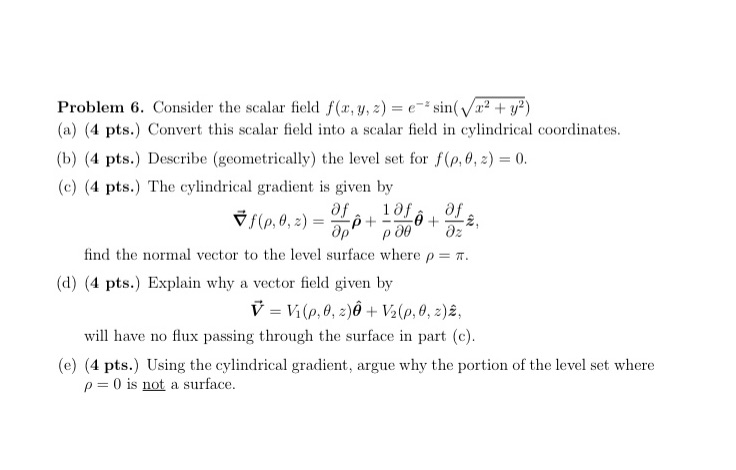
Problem 6. Consider the scalar field f(x, y, 2) = e- sin(vx] + y") (a) (4 pts.) Convert this scalar field into a scalar field in cylindrical coordinates. (b) (4 pts.) Describe (geometrically) the level set for f(p, 0, 2) = 0. (c) (4 pts.) The cylindrical gradient is given by of Vf ( p, 0, 2 ) = appt p 20 of find the normal vector to the level surface where p = 7. (d) (4 pts.) Explain why a vector field given by V = Vi(p, 0, = )0 + Vz(p, 0, =)2. will have no flux passing through the surface in part (c). (e) (4 pts.) Using the cylindrical gradient, argue why the portion of the level set where p = 0 is not a surface
Step by Step Solution
There are 3 Steps involved in it
1 Expert Approved Answer
Step: 1 Unlock

Question Has Been Solved by an Expert!
Get step-by-step solutions from verified subject matter experts
Step: 2 Unlock
Step: 3 Unlock
 Study Help