



Question: (d) From the above sensitivity report, answer the following questions. (i) If the profit contribution of an ounce of food A is reduced to
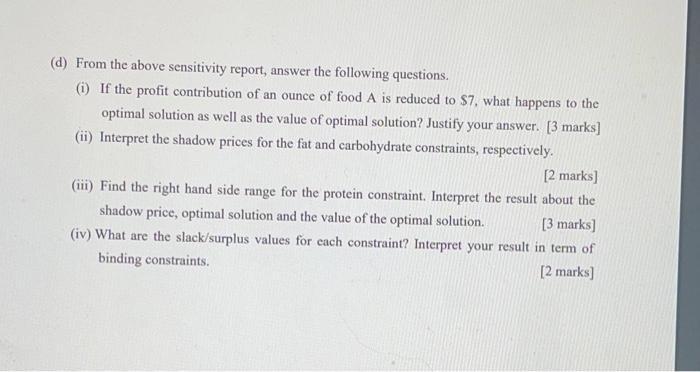
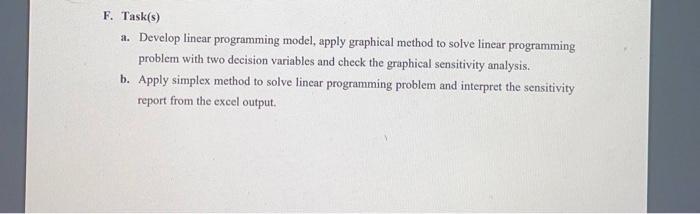
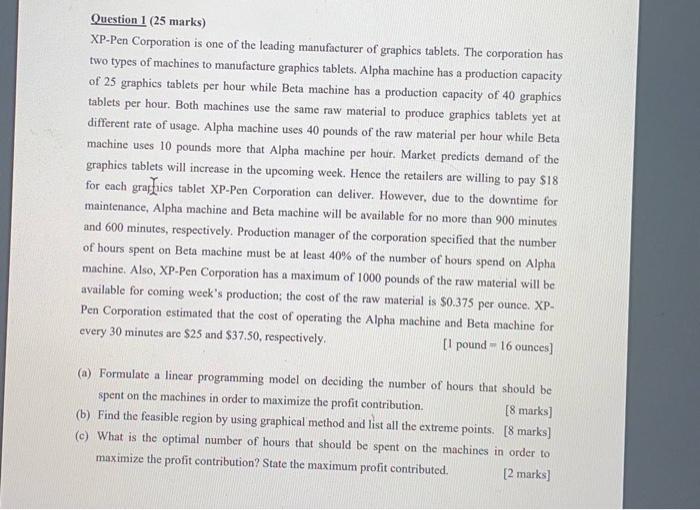
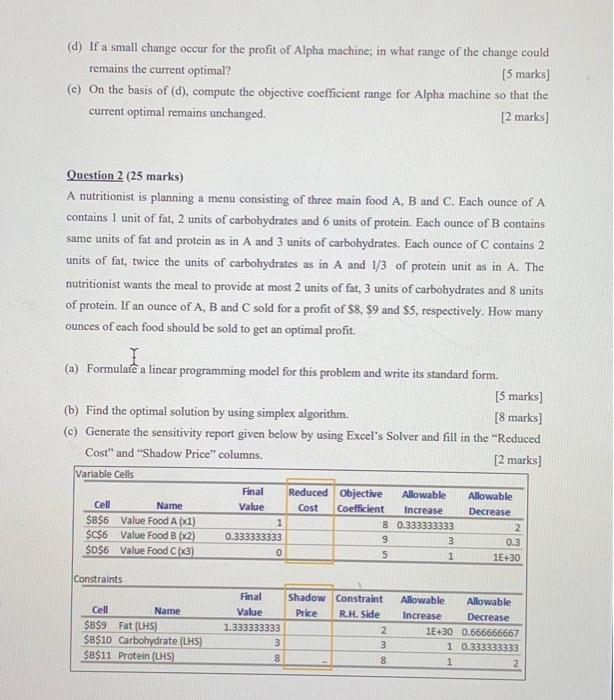
(d) From the above sensitivity report, answer the following questions. (i) If the profit contribution of an ounce of food A is reduced to $7, what happens to the optimal solution as well as the value of optimal solution? Justify your answer. [3 marks] (ii) Interpret the shadow prices for the fat and carbohydrate constraints, respectively. [2 marks] (iii) Find the right hand side range for the protein constraint. Interpret the result about the shadow price, optimal solution and the value of the optimal solution. [3 marks] (iv) What are the slack/surplus values for each constraint? Interpret your result in term of binding constraints. [2 marks] F. Task(s) a. Develop linear programming model, apply graphical method to solve linear programming problem with two decision variables and check the graphical sensitivity analysis. b. Apply simplex method to solve linear programming problem and interpret the sensitivity report from the excel output. Question 1 (25 marks) XP-Pen Corporation is one of the leading manufacturer of graphics tablets. The corporation has two types of machines to manufacture graphics tablets. Alpha machine has a production capacity of 25 graphics tablets per hour while Beta machine has a production capacity of 40 graphics tablets per hour. Both machines use the same raw material to produce graphics tablets yet at different rate of usage. Alpha machine uses 40 pounds of the raw material per hour while Beta machine uses 10 pounds more that Alpha machine per hour. Market predicts demand of the graphics tablets will increase in the upcoming week. Hence the retailers are willing to pay $18 for each graphics tablet XP-Pen Corporation can deliver. However, due to the downtime for maintenance, Alpha machine and Beta machine will be available for no more than 900 minutes and 600 minutes, respectively. Production manager of the corporation specified that the number of hours spent on Beta machine must be at least 40% of the number of hours spend on Alpha machine. Also, XP-Pen Corporation has a maximum of 1000 pounds of the raw material will be available for coming week's production; the cost of the raw material is $0.375 per ounce. XP- Pen Corporation estimated that the cost of operating the Alpha machine and Beta machine for every 30 minutes are $25 and $37.50, respectively. [1 pound 16 ounces] (a) Formulate a linear programming model on deciding the number of hours that should be spent on the machines in order to maximize the profit contribution. [8 marks] (b) Find the feasible region by using graphical method and list all the extreme points. [8 marks] (c) What is the optimal number of hours that should be spent on the machines in order to maximize the profit contribution? State the maximum profit contributed. [2 marks] (d) If a small change occur for the profit of Alpha machine; in what range of the change could remains the current optimal? [5 marks] (e) On the basis of (d), compute the objective coefficient range for Alpha machine so that the current optimal remains unchanged. [2 marks] Question 2 (25 marks) A nutritionist is planning a menu consisting of three main food A, B and C. Each ounce of A contains 1 unit of fat, 2 units of carbohydrates and 6 units of protein. Each ounce of B contains same units of fat and protein as in A and 3 units of carbohydrates. Each ounce of C contains 2 units of fat, twice the units of carbohydrates as in A and 1/3 of protein unit as in A. The nutritionist wants the meal to provide at most 2 units of fat, 3 units of carbohydrates and 8 units of protein. If an ounce of A, B and C sold for a profit of $8, $9 and $5, respectively. How many ounces of each food should be sold to get an optimal profit. (a) Formulare a linear programming model for this problem and write its standard form. [5 marks] [8 marks] (b) Find the optimal solution by using simplex algorithm. (c) Generate the sensitivity report given below by using Excel's Solver and fill in the "Reduced Cost" and "Shadow Price" columns. [2 marks] Variable Cells Cell Name $B$6 Value Food A (x1) $C$6 Value Food B (x2) $D$6 Value Food C (x3) Constraints Cell $B$9 Fat (LHS) $8$10 Carbohydrate (LHS) $B$11 Protein (LHS) Name Final Value 1 0.333333333 0 Final Value 1.333333333 3 00 8 Reduced Objective Allowable Coefficient Cost Increase 8 0.333333333 9 5 Shadow Constraint Price R.H. Side 2 3 8 Allowable Increase 3 1 Allowable Decrease 2 0.3 1E+30 Allowable Decrease 1E+30 0.666666667 1 0.333333333 1
Step by Step Solution
3.35 Rating (158 Votes )
There are 3 Steps involved in it
i If the profit contribution of an ounce of food A is reduced to 7 the optimal solution and the value of the optimal solution may change To justify this we need to look at the reduced cost of Food A i... View full answer

Get step-by-step solutions from verified subject matter experts