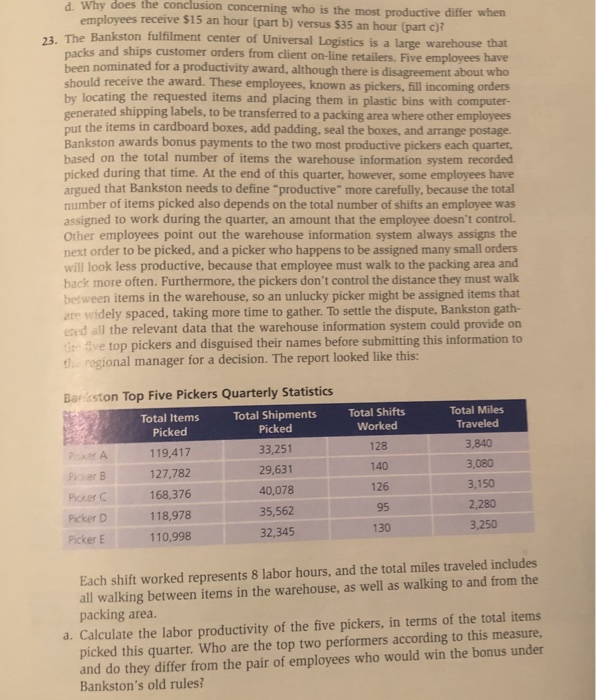
Question: d. Why does the conclusion concerning who is the most productive differ when employees receive $15 an hour (part b) versus $35 an hour (part
d. Why does the conclusion concerning who is the most productive differ when employees receive $15 an hour (part b) versus $35 an hour (part c)? The Bankston fulfilment center of Universal Logistics is a large warehouse that nacks and ships customer orders from client on-line retailers. Five emplovees have be nominated for a productivity award, although there is disagreement about who should receive the award. These employees, known as pickers, fill incoming orders by locating the requested items and placing them in plastic bins with computer- generated shipping labels, to be transferred to a packing area where other employees put the items in cardboard boxes, add padding, seal the boxes, and arrange postage. Bankston awards bonus payments to the two most productive pickers each quarter, based on the total number of items the warehouse information system recorded picked during that time. At the end of this quarter, however, some employees have argued that Bankston needs to define "productive more carefully, because the total number of items picked also depends on the total number of shifts an employee was assigned to work during the quarter, an amount that the employee Other employees point out the warehouse information system always assigns the next order to be picked, and a picker who happens to be assigned many small orders will look less productive, because that employee must walk to the packing area and back more often. Furthermore, the pickers don't control the distance they must walk between items in the warehouse, so an unlucky picker might be assigned items that are widely spaced, taking more time to gather. To settle the dispute, Bankston gath- card au the relevant data that the warehouse information system could provide on sve top pickers and disguised their names before submitting this information to regional manager for a decision. The report looked like this: Total Shifts Worked Total Miles Traveled 3,840 128 Barston Top Five Pickers Quarterly Statistics Total Items Total Shipments Picked Picked Per A 119,417 33,251 Prier B 127,782 29,631 Picker 168,376 40,078 Picker D 118,978 35,562 Picker E 110,998 32,345 140 126 3,080 3,150 2,280 3,250 95 130 Each shift worked represents 8 labor hours, and the total miles traveled includes all walking between items in the warehouse, as well as walking to and from the packing area. a. Calculate the labor productivity of the five pickers, in terms of the total items picked this quarter. Who are the top two performers according to this measure, and do they differ from the pair of employees who would win the bonus under Bankston's old rules