







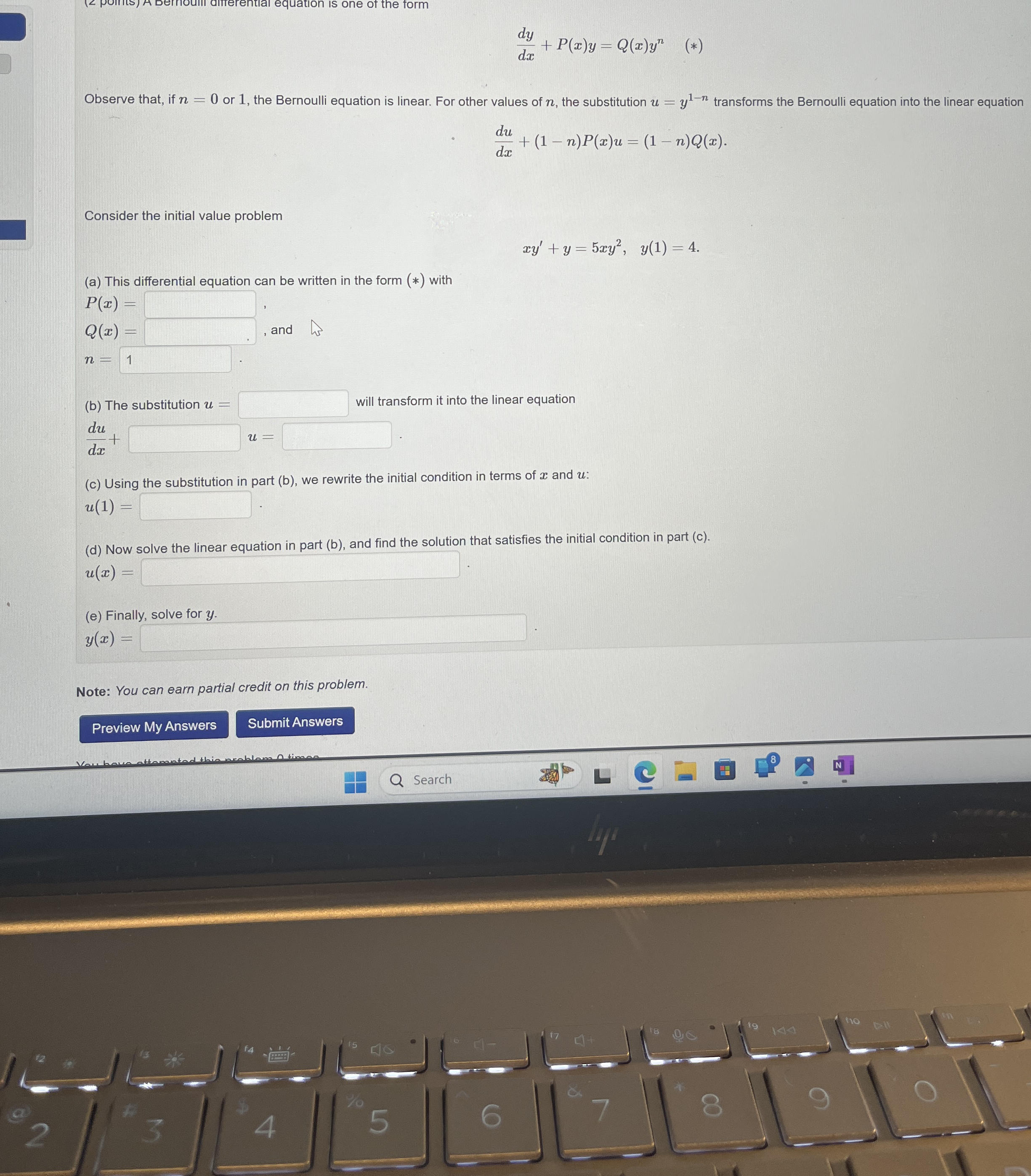
Question: d y d x P ( x ) y = Q ( x ) y n Observe that, if n = 0 or 1 ,
Observe that, if or the Bernoulli equation is linear. For other values of the substitution transforms the Bernoulli equation into the linear equation
Consider the initial value problem
a This differential equation can be written in the form with
and
b The substitution will transform it into the linear equation
c Using the substitution in part b we rewrite the initial condition in terms of and :
d Now solve the linear equation in part b and find the solution that satisfies the initial condition in part c
e Finally colve for
Note: You can earn partial credit on this problem.
Searc
Step by Step Solution
There are 3 Steps involved in it
1 Expert Approved Answer
Step: 1 Unlock

Question Has Been Solved by an Expert!
Get step-by-step solutions from verified subject matter experts
Step: 2 Unlock
Step: 3 Unlock
 Study Help