







Question: d21.arizona.edu 001 Untitled document - Google Docs Each solution should include: o The original question, along with any diagrams given in the question a How
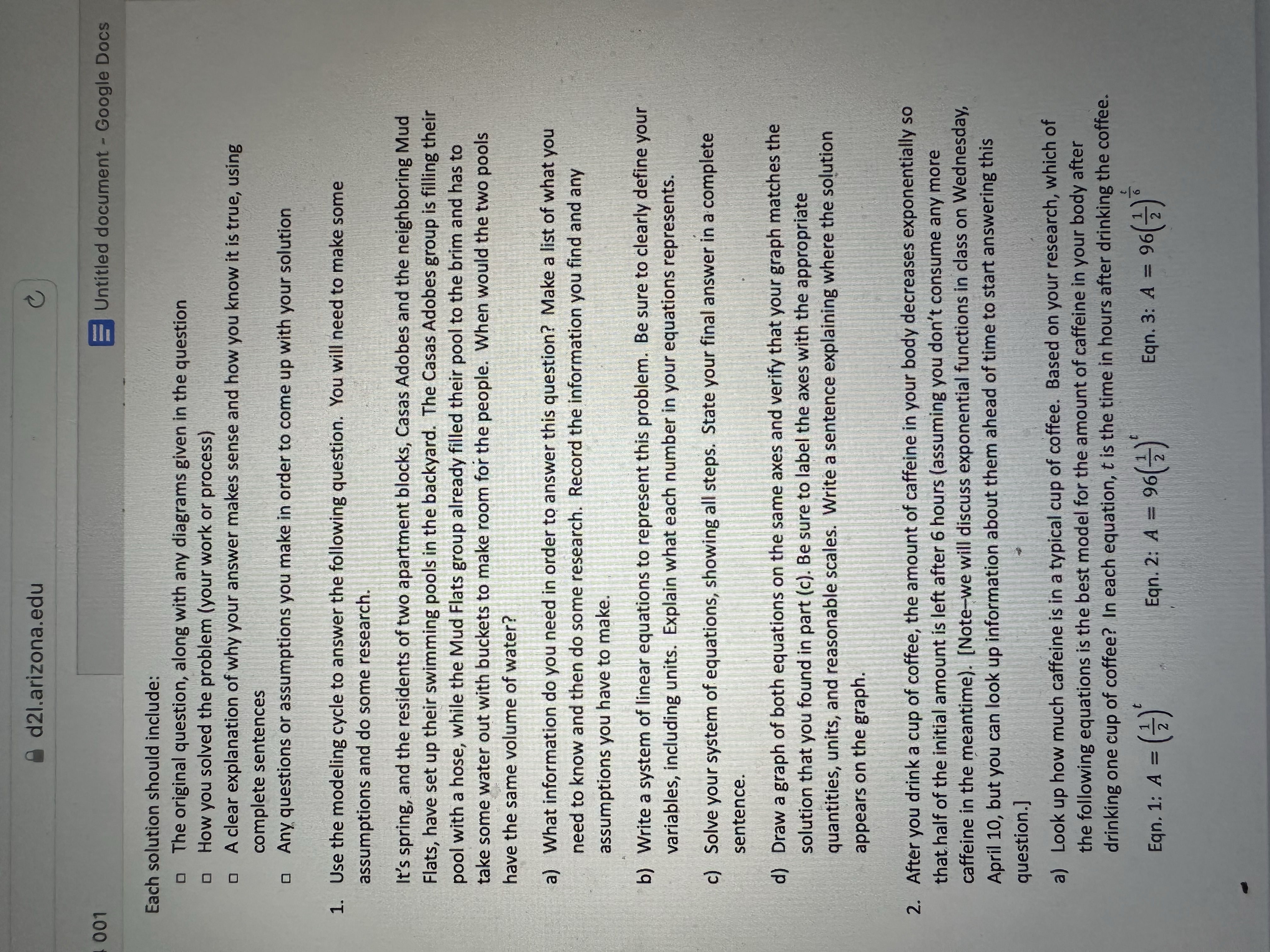
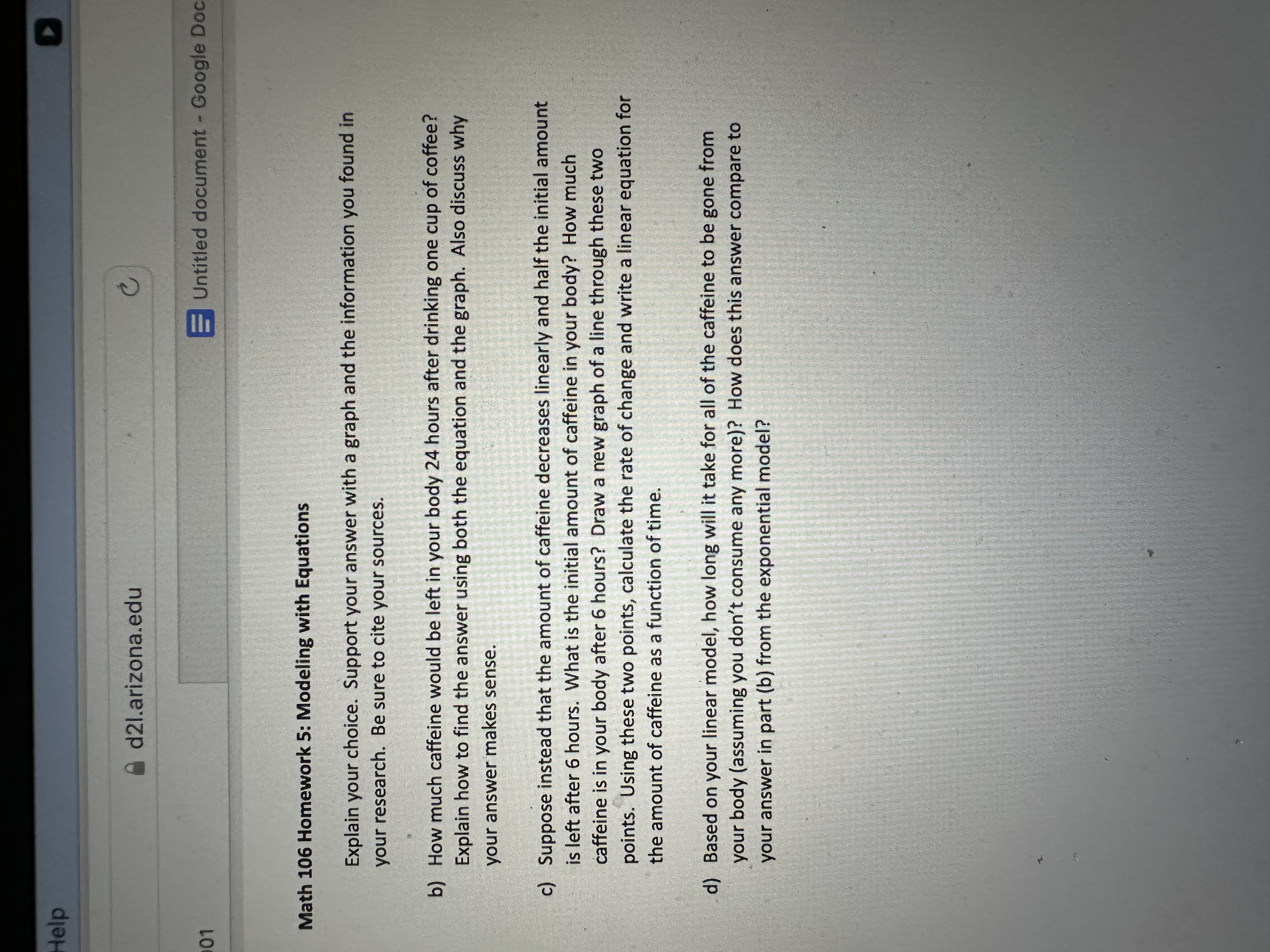
d21.arizona.edu 001 Untitled document - Google Docs Each solution should include: o The original question, along with any diagrams given in the question a How you solved the problem (your work or process) o A clear explanation of why your answer makes sense and how you know it is true, using complete sentences Any questions or assumptions you make in order to come up with your solution 1. Use the modeling cycle to answer the following question. You will need to make some assumptions and do some research. It's spring, and the residents of two apartment blocks, Casas Adobes and the neighboring Mud Flats, have set up their swimming pools in the backyard. The Casas Adobes group is filling their pool with a hose, while the Mud Flats group already filled their pool to the brim and has to take some water out with buckets to make room for the people. When would the two pools have the same volume of water? a) What information do you need in order to answer this question? Make a list of what you need to know and then do some research. Record the information you find and any assumptions you have to make b) Write a system of linear equations to represent this problem. Be sure to clearly define your variables, including units. Explain what each number in your equations represents. c) Solve your system of equations, showing all steps. State your final answer in a complete sentence. d) Draw a graph of both equations on the same axes and verify that your graph matches the solution that you found in part (c). Be sure to label the axes with the appropriate quantities, units, and reasonable scales. Write a sentence explaining where the solution appears on the graph. 2. After you drink a cup of coffee, the amount of caffeine in your body decreases exponentially so that half of the initial amount is left after 6 hours (assuming you don't consume any more caffeine in the meantime). [Note-we will discuss exponential functions in class on Wednesday, April 10, but you can look up information about them ahead of time to start answering this question.] a) Look up how much caffeine is in a typical cup of coffee. Based on your research, which of the following equations is the best model for the amount of caffeine in your body after drinking one cup of coffee? In each equation, t is the time in hours after drinking the coffee. Egn. 1: A = (2) Eqn. 2: A = 96(2) Eqn. 3: A = 96( 2) "Help d21.arizona.edu Untitled document - Google Doc Math 106 Homework 5: Modeling with Equations Explain your choice. Support your answer with a graph and the information you found in your research. Be sure to cite your sources. b) How much caffeine would be left in your body 24 hours after drinking one cup of coffee? Explain how to find the answer using both the equation and the graph. Also discuss why your answer makes sense. c) Suppose instead that the amount of caffeine decreases linearly and half the initial amount is left after 6 hours. What is the initial amount of caffeine in your body? How much caffeine is in your body after 6 hours? Draw a new graph of a line through these two points. Using these two points, calculate the rate of change and write a linear equation for the amount of caffeine as a function of time d) Based on your linear model, how long will it take for all of the caffeine to be gone from your body (assuming you don't consume any more)? How does this answer compare to your answer in part (b) from the exponential model
Step by Step Solution
There are 3 Steps involved in it

Get step-by-step solutions from verified subject matter experts
 Study Help