


Question: Data Case 477 DATA CASE You work in the corporate finance division of Nokia at the head office in Finland. Nokia manufactures mobile devices and
Data Case 477 DATA CASE You work in the corporate
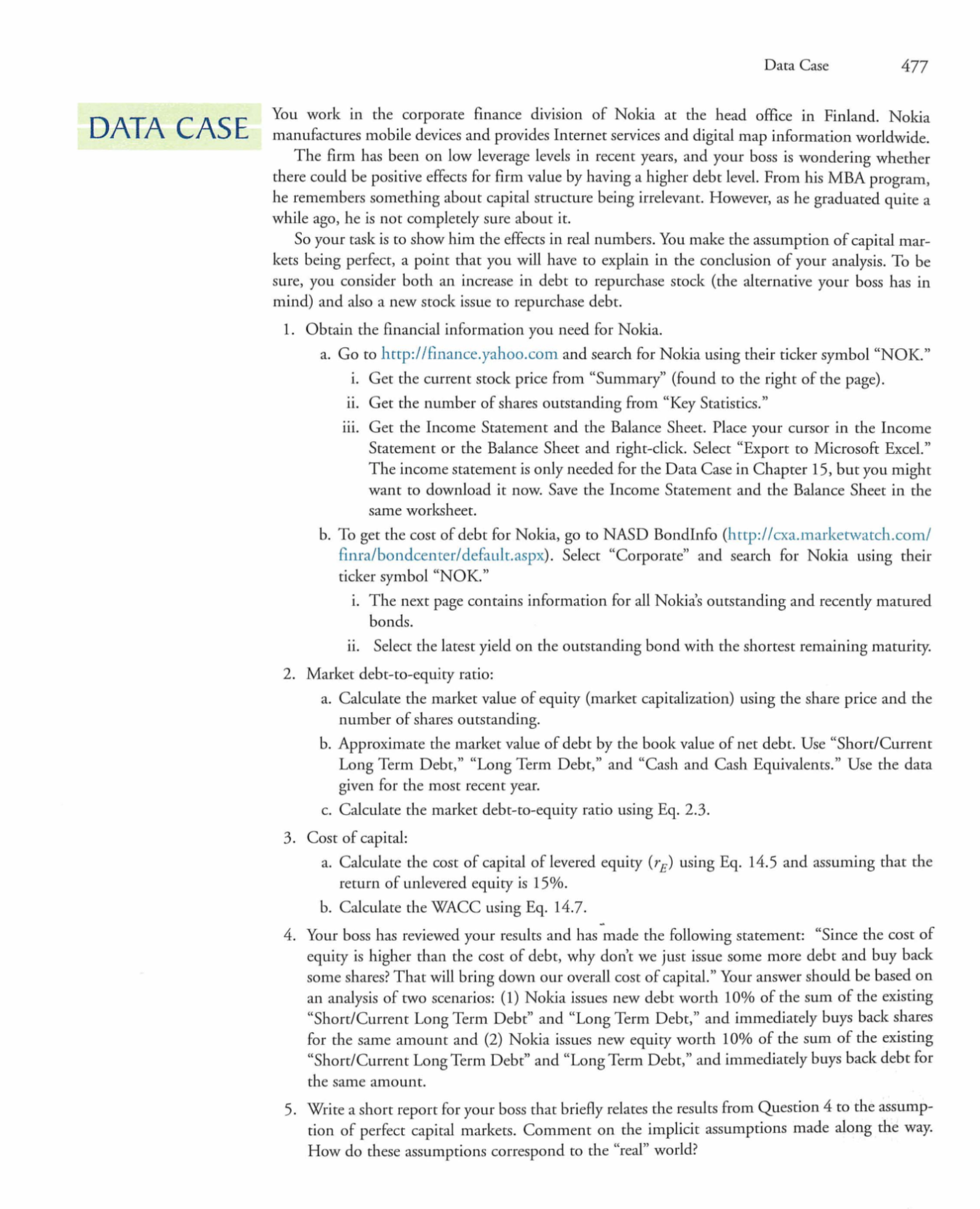
Data Case 477 DATA CASE You work in the corporate finance division of Nokia at the head office in Finland. Nokia manufactures mobile devices and provides Internet services and digital map information worldwide. The firm has been on low leverage levels in recent years, and your boss is wondering whether there could be positive effects for firm value by having a higher debt level. From his MBA program, he remembers something about capital structure being irrelevant. However, as he graduated quite a while ago, he is not completely sure about it. So your task is to show him the effects in real numbers. You make the assumption of capital mar- kets being perfect, a point that you will have to explain in the conclusion of your analysis. To be sure, you consider both an increase in debt to repurchase stock (the alternative your boss has in mind) and also a new stock issue to repurchase debt. 1. Obtain the financial information you need for Nokia. a. Go to http://finance.yahoo.com and search for Nokia using their ticker symbol "NOK." i. Get the current stock price from "Summary" (found to the right of the page). ii. Get the number of shares outstanding from "Key Statistics." iii. Get the Income Statement and the Balance Sheet. Place your cursor in the Income Statement or the Balance Sheet and right-click. Select "Export to Microsoft Excel." The income statement is only needed for the Data Case in Chapter 15, but you might want to download it now. Save the Income Statement and the Balance Sheet in the same worksheet. b. To get the cost of debt for Nokia, go to NASD BondInfo (http://cxa.marketwatch.com/ finra/bondcenter/default.aspx). Select "Corporate" and search for Nokia using their ticker symbol "NOK." i. The next page contains information for all Nokia's outstanding and recently matured bonds. ii. Select the latest yield on the outstanding bond with the shortest remaining maturity. 2. Market debt-to-equity ratio: a. Calculate the market value of equity (market capitalization) using the share price and the number of shares outstanding. b. Approximate the market value of debt by the book value of net debt. Use "Short/Current Long Term Debt," "Long Term Debt," and "Cash and Cash Equivalents." Use the data given for the most recent year. c. Calculate the market debt-to-equity ratio using Eq. 2.3. 3. Cost of capital: a. Calculate the cost of capital of levered equity () using Eq. 14.5 and assuming that the return of unlevered equity is 15%. b. Calculate the WACC using Eq. 14.7. 4. Your boss has reviewed your results and has made the following statement: "Since the cost of equity is higher than the cost of debt, why don't we just issue some more debt and buy back some shares? That will bring down our overall cost of capital." Your answer should be based on an analysis of two scenarios: (1) Nokia issues new debt worth 10% of the sum of the existing "Short/Current Long Term Debt" and "Long Term Debt," and immediately buys back shares for the same amount and (2) Nokia issues new equity worth 10% of the sum of the existing "Short/Current Long Term Debt" and "Long Term Debt," and immediately buys back debt for the same amount. 5. Write a short report for your boss that briefly relates the results from Question 4 to the assump- tion of perfect capital markets. Comment on the implicit assumptions made along the way. How do these assumptions correspond to the "real" world

Step by Step Solution

There are 3 Steps involved in it

1 Expert Approved Answer
Step: 1 Unlock blur-text-image

Question Has Been Solved by an Expert!

Get step-by-step solutions from verified subject matter experts

Step: 2 Unlock
Step: 3 Unlock

Students Have Also Explored These Related Finance Questions!