







Question: Data for Home Voltages and Generator Voltages Complete data set Day Home (volts) Generator (volts) Day Home (volts) Generator (volts) 123.2 124.4 21 123.5 124.0
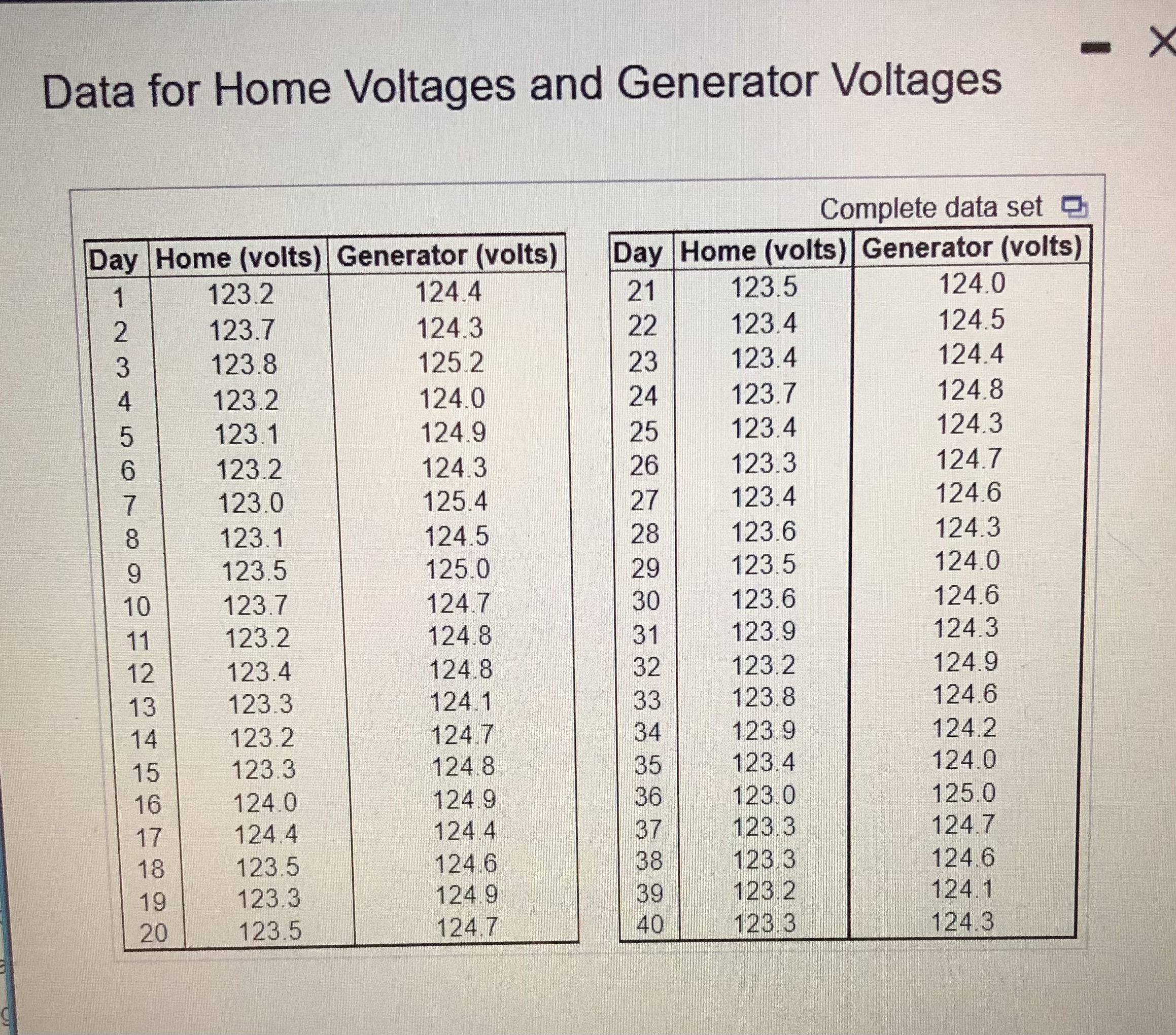
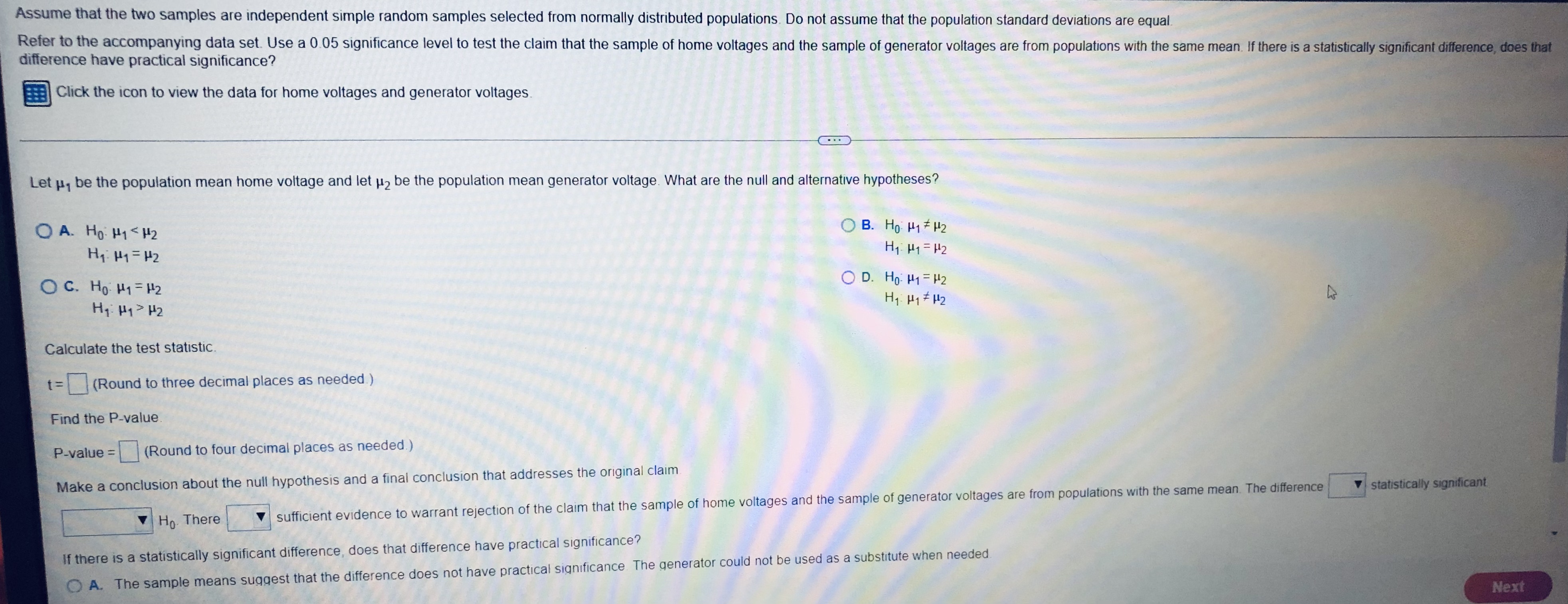
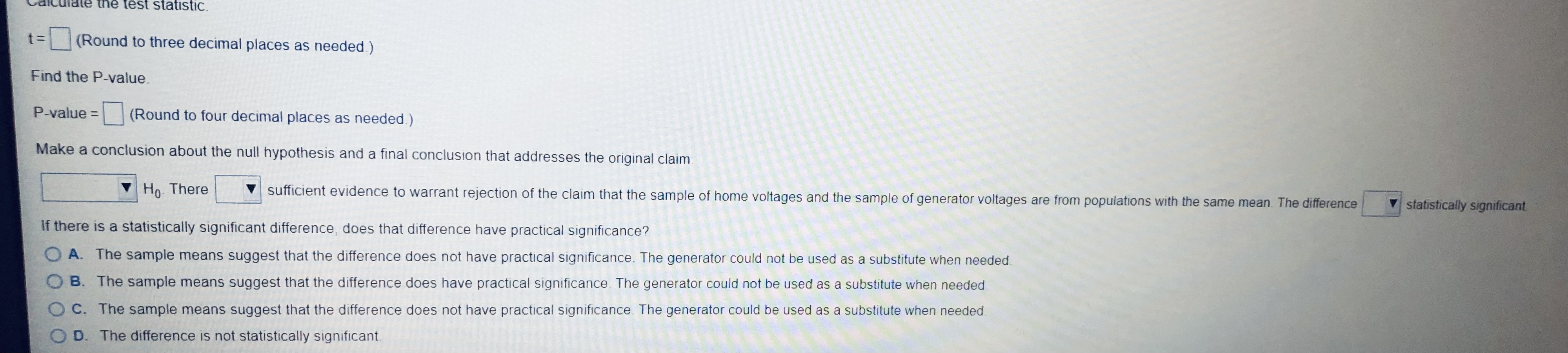
Data for Home Voltages and Generator Voltages Complete data set Day Home (volts) Generator (volts) Day Home (volts) Generator (volts) 123.2 124.4 21 123.5 124.0 123.7 124.3 22 123.4 124.5 123.8 125.2 23 123.4 124.4 123.2 124.0 24 123.7 124.8 COCO NOULAWN - 123.1 124.9 25 123.4 124.3 123.2 124.3 26 123.3 124.7 123.0 125.4 27 123.4 124.6 123.1 124.5 28 123.6 124.3 123.5 125.0 29 123.5 124.0 10 123.7 124.7 30 123.6 124.6 11 123.2 124.8 31 123.9 124.3 12 123.4 124.8 32 123.2 124.9 13 123.3 124.1 33 123.8 124.6 14 123.2 124.7 34 123.9 124.2 15 123.3 124.8 35 123.4 124.0 16 124.0 124.9 36 123.0 125.0 17 124.4 124.4 37 123 3 124.7 18 123.5 124.6 38 123.3 124.6 19 123.3 124.9 39 123.2 124.1 20 123.5 124.7 40 123 3 124.3Assume that the two samples are independent simple random samples selected from normally distributed populations. Do not assume that the population standard deviations are equal. Refer to the accompanying data set. Use a 0.05 significance level to test the claim that the sample of home voltages and the sample of generator voltages are from populations with the same mean. If there is a statistically significant difference, does that difference have practical significance? Click the icon to view the data for home voltages and generator voltages. Let u, be the population mean home voltage and let u2 be the population mean generator voltage. What are the null and alternative hypotheses? O A. HO H1 = H2 OB. HOMI * H2 Hi My = H2 H1 H1 = H2 O C. HO H1 = H2 OD. HOM1 = H2 Hy: H 1 > H2 Calculate the test statistic. t= (Round to three decimal places as needed.) Find the P-value P-value = (Round to four decimal places as needed.) Make a conclusion about the null hypothesis and a final conclusion that addresses the original claim statistically significant sufficient evidence to warrant rejection of the claim that the sample of home voltages and the sample of generator voltages are from populations with the same mean. The difference Ho There If there is a statistically significant difference, does that difference have practical significance? A. The sample means suggest that the difference does not have practical significance. The generator could not be used as a substitute when needed. Nexttest statistic. t= (Round to three decimal places as needed.) Find the P-value. P-value = (Round to four decimal places as needed.) Make a conclusion about the null hypothesis and a final conclusion that addresses the original claim. Ho There sufficient evidence to warrant rejection of the claim that the sample of home voltages and the sample of generator voltages are from populations with the same mean. The difference statistically significant If there is a statistically significant difference, does that difference have practical significance? A. The sample means suggest that the difference does not have practical significance. The generator could not be used as a substitute when needed. O B. The sample means suggest that the difference does have practical significance. The generator could not be used as a substitute when needed O C. The sample means suggest that the difference does not have practical significance. The generator could be used as a substitute when needed O D. The difference is not statistically significant
Step by Step Solution
There are 3 Steps involved in it

Get step-by-step solutions from verified subject matter experts
 Study Help