







Question: Data on the yield strain and yield stress for a cylindrical sample of cortical bone and a cylindrical sample of cancellous bone from mechanical testing
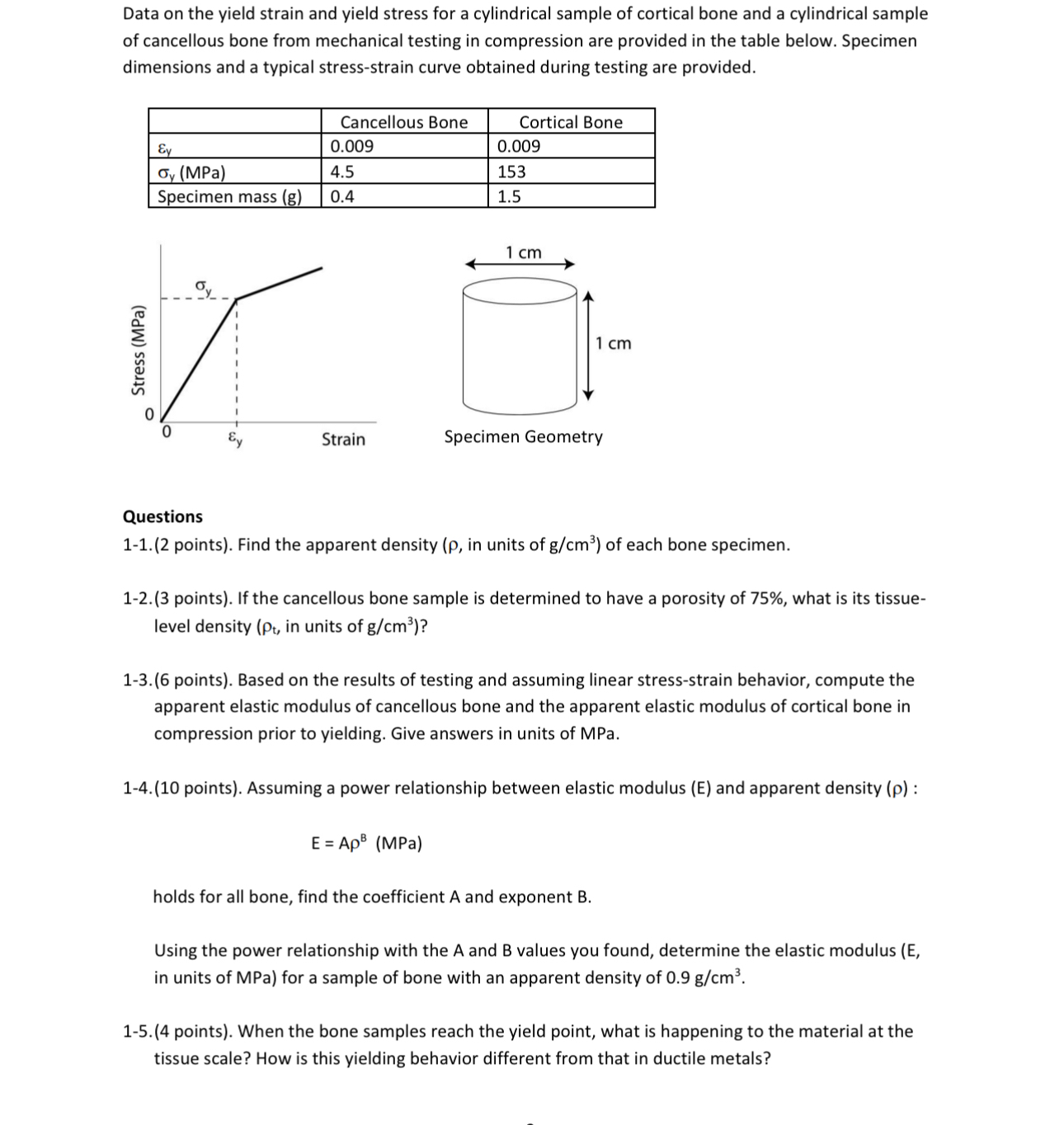
Data on the yield strain and yield stress for a cylindrical sample of cortical bone and a cylindrical sample
of cancellous bone from mechanical testing in compression are provided in the table below. Specimen
dimensions and a typical stressstrain curve obtained during testing are provided.
Questions
points Find the apparent density in units of of each bone specimen.
points If the cancellous bone sample is determined to have a porosity of what is its tissue
level density in units of
points Based on the results of testing and assuming linear stressstrain behavior, compute the
apparent elastic modulus of cancellous bone and the apparent elastic modulus of cortical bone in
compression prior to yielding. Give answers in units of MPa.
points Assuming a power relationship between elastic modulus E and apparent density :
holds for all bone, find the coefficient A and exponent
Using the power relationship with the A and values you found, determine the elastic modulus
in units of MPa for a sample of bone with an apparent density of
points When the bone samples reach the yield point, what is happening to the material at the
tissue scale? How is this yielding behavior different from that in ductile metals?
Step by Step Solution
There are 3 Steps involved in it
1 Expert Approved Answer
Step: 1 Unlock

Question Has Been Solved by an Expert!
Get step-by-step solutions from verified subject matter experts
Step: 2 Unlock
Step: 3 Unlock
 Study Help