







Question: data science python Free Response problem: Write your answers in the spaces following each prompt if possible Make note if your work continue where 12.
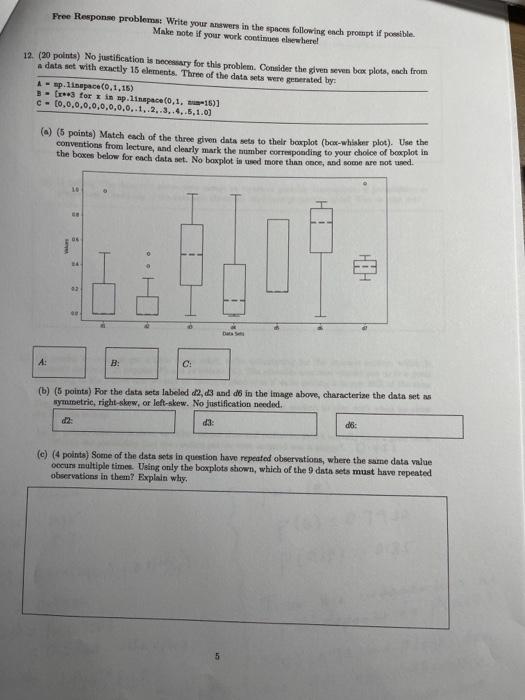
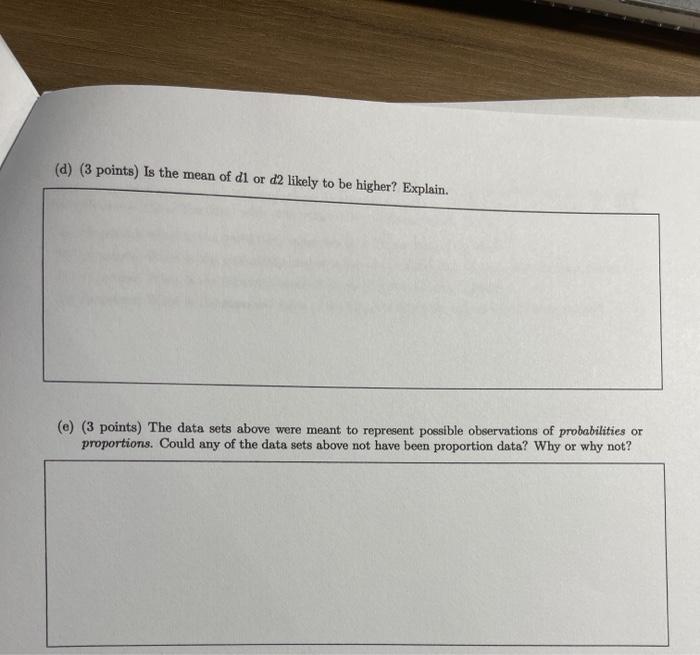
Free Response problem: Write your answers in the spaces following each prompt if possible Make note if your work continue where 12. (20 points) No justification is necesary for this problem. Comider the given seven box plots, ench from data set with exactly 15 elements. Three of the data sets were generated by: A - np. linapace(0,1,15) - 3 for insp.linspace(0,1, 15) C-(0,0,0,0,0,0,0,0,0..1..2..3..4..5,1.0) () (5 points) Match each of the three given data sets to their baxplot (box-whisker plot). Use the conventions from lecture, and clearly mark the number correponding to your choice of boxplot in the boses below for each datat. No boxplot in used more than one, and some are not used. 10 22 A: B: C: (b) (6 points) For the data sets labeled d2,3 and do in the image above, characterize the data set as wymmetrie, right-skew, or left-skew. No justification needed. do: (e) (4 points) Some of the data sets in question have repeated observations, where the same data value occurs multiple times. Using only the boxplots shown, which of the data sets must have repeated observations in them? Explain why, (d) (3 points) is the mean of di or d2 likely to be higher? Explain. (e) (3 points) The data sets above were meant to represent possible observations of probabilities or proportions. Could any of the data sets above not have been proportion data? Why or why not? Free Response problem: Write your answers in the spaces following each prompt if possible Make note if your work continue where 12. (20 points) No justification is necesary for this problem. Comider the given seven box plots, ench from data set with exactly 15 elements. Three of the data sets were generated by: A - np. linapace(0,1,15) - 3 for insp.linspace(0,1, 15) C-(0,0,0,0,0,0,0,0,0..1..2..3..4..5,1.0) () (5 points) Match each of the three given data sets to their baxplot (box-whisker plot). Use the conventions from lecture, and clearly mark the number correponding to your choice of boxplot in the boses below for each datat. No boxplot in used more than one, and some are not used. 10 22 A: B: C: (b) (6 points) For the data sets labeled d2,3 and do in the image above, characterize the data set as wymmetrie, right-skew, or left-skew. No justification needed. do: (e) (4 points) Some of the data sets in question have repeated observations, where the same data value occurs multiple times. Using only the boxplots shown, which of the data sets must have repeated observations in them? Explain why, (d) (3 points) is the mean of di or d2 likely to be higher? Explain. (e) (3 points) The data sets above were meant to represent possible observations of probabilities or proportions. Could any of the data sets above not have been proportion data? Why or why not
Step by Step Solution
There are 3 Steps involved in it

Get step-by-step solutions from verified subject matter experts
 Study Help