







Question: Data Structures in C++: Algebra and Calculus on Polynomials The files: https://www.dropbox.com/s/14dfijvf22r0pel/P1.zip?dl=0 https://www.dropbox.com/s/hvosx668717bgww/Project%20Data%20in%20C%2B%2B.doc?dl=0 Contact: Write a comment with email. Overview You will implement and test
Data Structures in C++: Algebra and Calculus on Polynomials
The files:
https://www.dropbox.com/s/14dfijvf22r0pel/P1.zip?dl=0
https://www.dropbox.com/s/hvosx668717bgww/Project%20Data%20in%20C%2B%2B.doc?dl=0
Contact:
Write a comment with email.
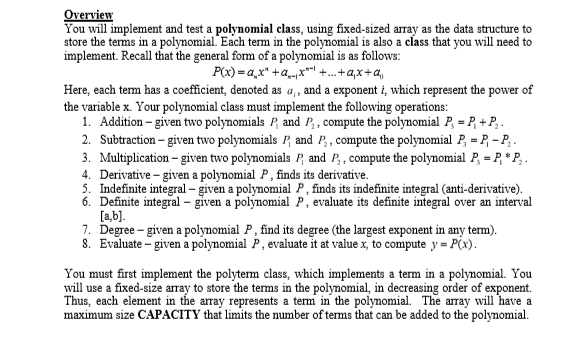
Overview You will implement and test a polynomial class, using fixed-sized store the terms in a polynomial. Each term in the polynomial is also a class that you will need to implement. Recall that the general form of a polynomial is as follows: array as the data structure to Here, each term has a coefficient, denoted as a, and a exponent i, which represent the power of the variable x. Your polynomial class must implement the following operations: 1. Addition- given two polynomials P and P, compute the polynomial P-+P 2. Subtraction- given two polynomials P and P, compute the polynomial P - R-P 3. Multiplication - given two polynomials P and P, compute the polynomial P- P*P 4. Derivative - given a polynomial P, finds its derivative. 5. Indefinite integral given a polynomial P, finds its indefinite integral (anti-derivative) 6. Definite integral - given a polynomial P, evaluate its definite integral over an interval [a,b] 7. 8. Evaluate - given a polynomial P, evaluate it at value x, to compute y - Px) Degree-given a polynomial P, find its degree (the largest exponent in any term). You must first implement the polyterm class, which implements a term in a polynomial. You will use a fixed-size array to store the terms in the polynomial, in decreasing order of exponent. Thus, each element in the array represents a term in the polynomial. The array will have a maximum size CAPACITY that limits the number of terms that can be added to the polynomial. Overview You will implement and test a polynomial class, using fixed-sized store the terms in a polynomial. Each term in the polynomial is also a class that you will need to implement. Recall that the general form of a polynomial is as follows: array as the data structure to Here, each term has a coefficient, denoted as a, and a exponent i, which represent the power of the variable x. Your polynomial class must implement the following operations: 1. Addition- given two polynomials P and P, compute the polynomial P-+P 2. Subtraction- given two polynomials P and P, compute the polynomial P - R-P 3. Multiplication - given two polynomials P and P, compute the polynomial P- P*P 4. Derivative - given a polynomial P, finds its derivative. 5. Indefinite integral given a polynomial P, finds its indefinite integral (anti-derivative) 6. Definite integral - given a polynomial P, evaluate its definite integral over an interval [a,b] 7. 8. Evaluate - given a polynomial P, evaluate it at value x, to compute y - Px) Degree-given a polynomial P, find its degree (the largest exponent in any term). You must first implement the polyterm class, which implements a term in a polynomial. You will use a fixed-size array to store the terms in the polynomial, in decreasing order of exponent. Thus, each element in the array represents a term in the polynomial. The array will have a maximum size CAPACITY that limits the number of terms that can be added to the polynomial
Step by Step Solution
There are 3 Steps involved in it

Get step-by-step solutions from verified subject matter experts
 Study Help