







Question: Database Programming with PL/SQL 8-3: Passing Parameters Practice Activities Vocabulary Identify the vocabulary word for each definition below: Try It / Solve it 1. Name
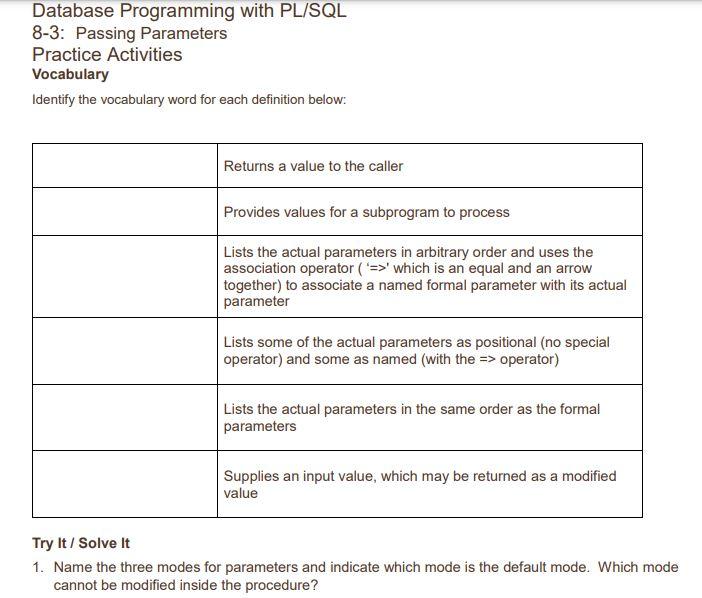
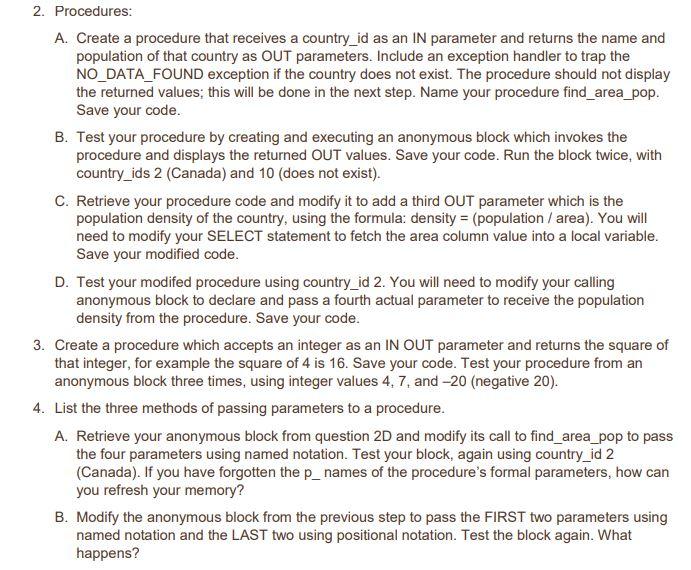
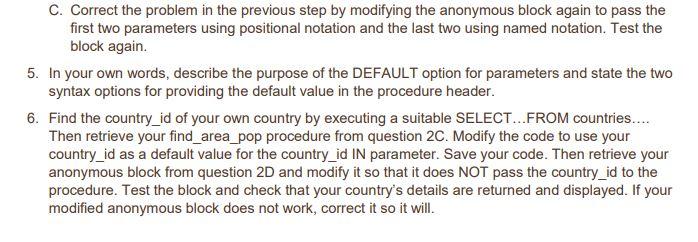
Database Programming with PL/SQL 8-3: Passing Parameters Practice Activities Vocabulary Identify the vocabulary word for each definition below: Try It / Solve it 1. Name the three modes for parameters and indicate which mode is the default mode. Which mode cannot be modified inside the procedure? 2. Procedures: A. Create a procedure that receives a country_id as an IN parameter and returns the name and population of that country as OUT parameters. Include an exception handler to trap the NO_DATA_FOUND exception if the country does not exist. The procedure should not display the returned values; this will be done in the next step. Name your procedure find_area_pop. Save your code. B. Test your procedure by creating and executing an anonymous block which invokes the procedure and displays the returned OUT values. Save your code. Run the block twice, with country_ids 2 (Canada) and 10 (does not exist). C. Retrieve your procedure code and modify it to add a third OUT parameter which is the population density of the country, using the formula: density = (population / area). You will need to modify your SELECT statement to fetch the area column value into a local variable. Save your modified code. D. Test your modifed procedure using country_id 2 . You will need to modify your calling anonymous block to declare and pass a fourth actual parameter to receive the population density from the procedure. Save your code. 3. Create a procedure which accepts an integer as an IN OUT parameter and returns the square of that integer, for example the square of 4 is 16 . Save your code. Test your procedure from an anonymous block three times, using integer values 4,7 , and 20 (negative 20). 4. List the three methods of passing parameters to a procedure. A. Retrieve your anonymous block from question 2D and modify its call to find_area_pop to pass the four parameters using named notation. Test your block, again using country_id 2 (Canada). If you have forgotten the p_names of the procedure's formal parameters, how can you refresh your memory? B. Modify the anonymous block from the previous step to pass the FIRST two parameters using named notation and the LAST two using positional notation. Test the block again. What happens? C. Correct the problem in the previous step by modifying the anonymous block again to pass the first two parameters using positional notation and the last two using named notation. Test the block again. 5. In your own words, describe the purpose of the DEFAULT option for parameters and state the two syntax options for providing the default value in the procedure header. Find the country_id of your own country by executing a suitable SELECT...FROM countries.... Then retrieve your find_area_pop procedure from question 2C. Modify the code to use your country_id as a default value for the country_id IN parameter. Save your code. Then retrieve your anonymous block from question 2D and modify it so that it does NOT pass the country_id to the procedure. Test the block and check that your country's details are returned and displayed. If your modified anonymous block does not work, correct it so it will
Step by Step Solution
There are 3 Steps involved in it

Get step-by-step solutions from verified subject matter experts
 Study Help